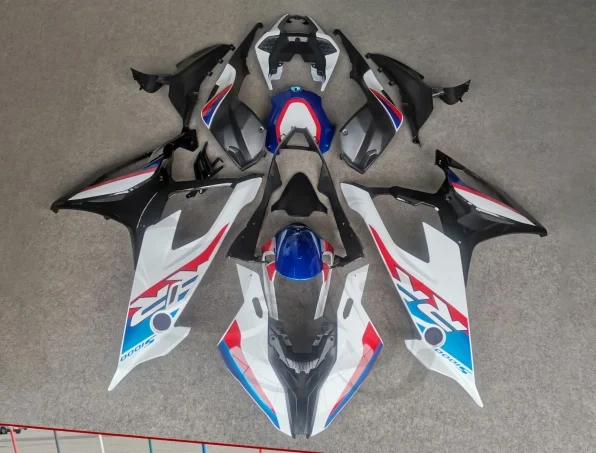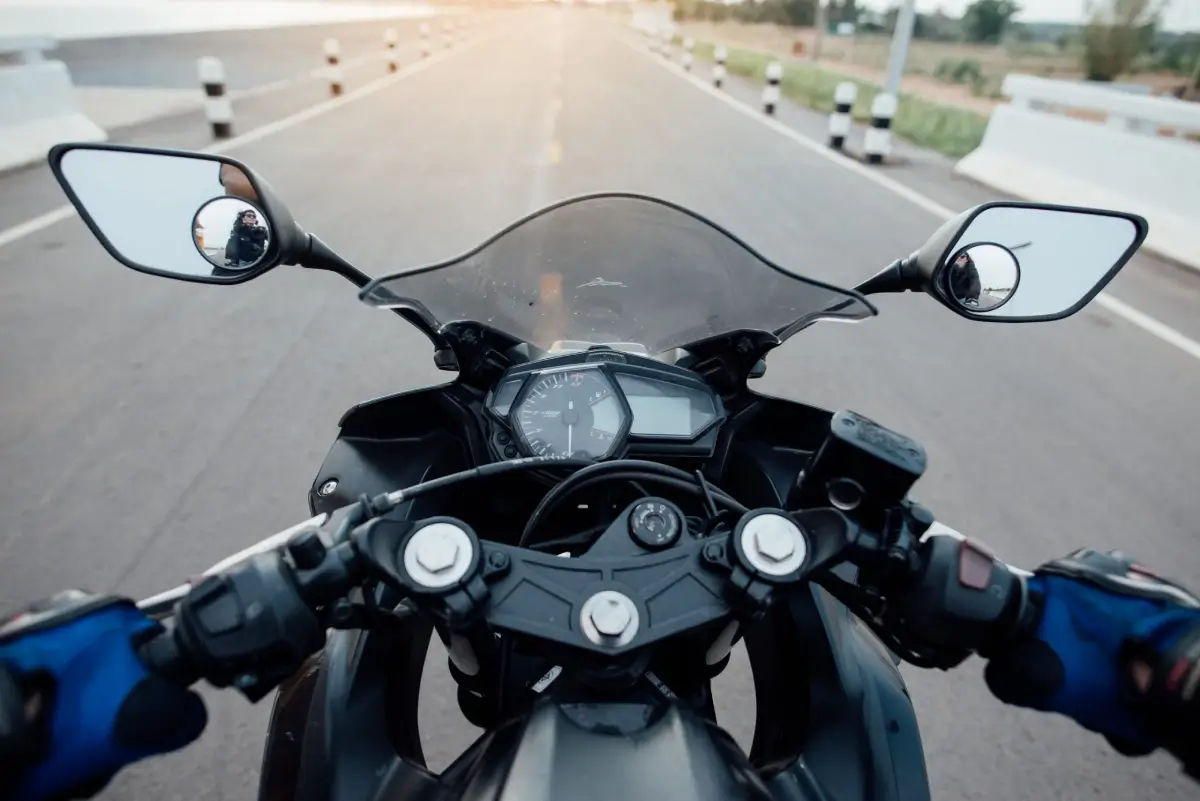




bikerbiker Aliwheels is a leading motorcycle parts supplier offering free shipping anywhere in the world on orders above $300. Please note that all of our motorcycle parts and accessories are certified and tested. With more than 10,000* products to choose from this is your one place to get the motorcycle part you need. Browse our vast inventory of motorcycle radiators, fairings, clutch plates, headlights, chains, and sprockets. biker

Free Shipping over $300

Support 24/7

Secure Payments

Hot Offers

Aliwheels is a leading motorcycle parts supplier offering free shipping anywhere in the world on orders above $300. Please note that all of our motorcycle parts and accessories are certified and tested. With more than 10,000* products to choose from this is your one place to get the motorcycle part you need. Browse our vast inventory of motorcycle radiators, fairings, clutch plates, headlights, chains, and sprockets.

Free Shipping over $300

Support 24/7

Secure Payments

Hot Offers

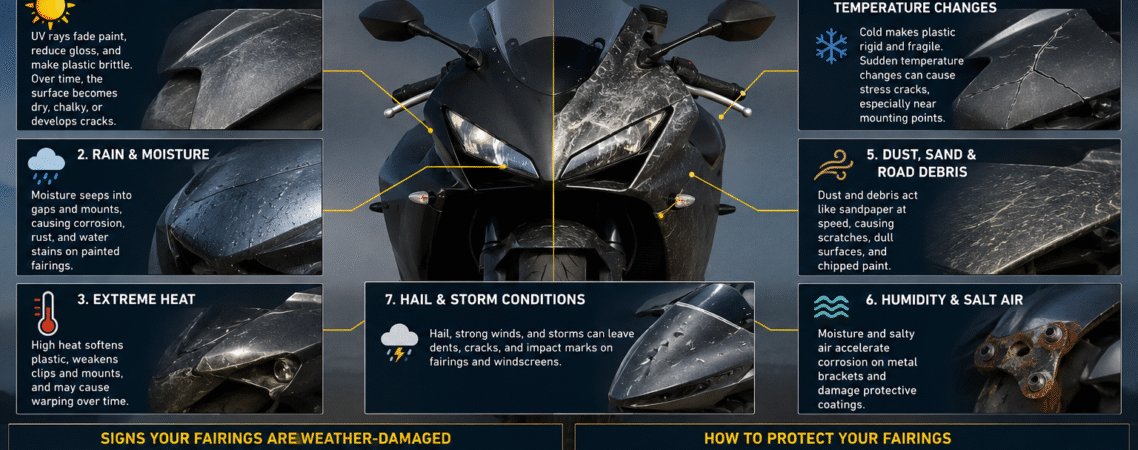
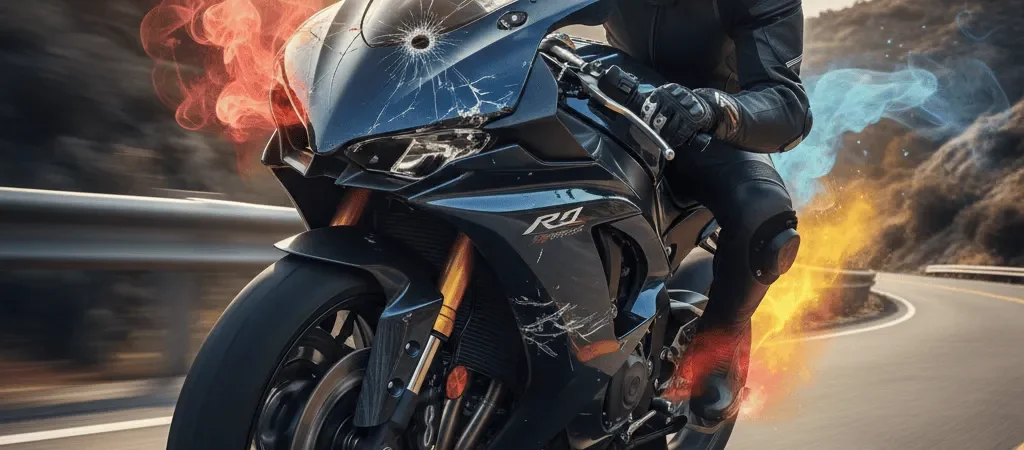
Your motorcycle’s fairings take the impact of every weather condition your bike experiences. Rain, UV radiation, heat, cold, road salt, humidity, and so on. All work against the material continuously.

Most riders notice motorcycle fairing damage after it becomes visible. By that point, significant damage has already occurred. Understanding how each weather condition attacks your motorcycle’s fairings helps you protect them earlier.

UV Radiation is the silent destroyer

Sunlight is the most damaging factor for motorcycle fairings. The damage happens slowly until it reaches a critical point.

ABS plastic and fiberglass fairings contain pigments and protective additives that absorb UV radiation. Over the time, UV exposure breaks down the molecular structure of both the paint and the base material under it.

The first sign is color fading. A deep black or vibrant red color, gradually losing its depth and intensity. The surface begins to look hazy or chalky rather than glossy.

As your motorcycl continue toexpereince UV, the plastic becomes brittle. ABS that was once flexible and impact-resistant starts fading. A panel that could survive a minor impact will crack under the same force once it is UV-degraded.

There are certain Paints that provide significant UV protection. This is why paint maintenance matters beyond aesthetics. Wax and ceramic coatings add a protective layer over the paint. They reduce UV penetration and slow the degradation process noticeably.

Bikes parked outdoors in open exposure to high UV radiation age faster than bikes kept in shaded parking or garages. The UV exposure over several riding seasons produces visible differences in fairing condition.

Rain and Water Ingress

Water damages fairings in several ways.

Although direct rain exposure is the least damaging, modern paint systems are water-resistant. But the paint coating repels water effectively.

The real damage comes from water that gets under the fairings.

When fairings develop small cracks or loose mounting tabs, water enters the gap between the fairing and the frame. This water remains hidden without evaporating. It promotes corrosion on any metal mounting hardware it contacts. 

Furthermore, trapped water moves into micro-cracks in the fairing material itself. When temperatures drop below freezing, that water expands. The freeze-thaw cycle propagates cracks that begin too small to see. Over several winters, those micro-cracks become visible fractures.

Make sure to inspect fairing mounting points and edges after prolonged rain exposure. Moreover, ensure drainage paths are clear. Do not allow water to be stored in hidden fairing sections.

Road Salt and Winter Riding

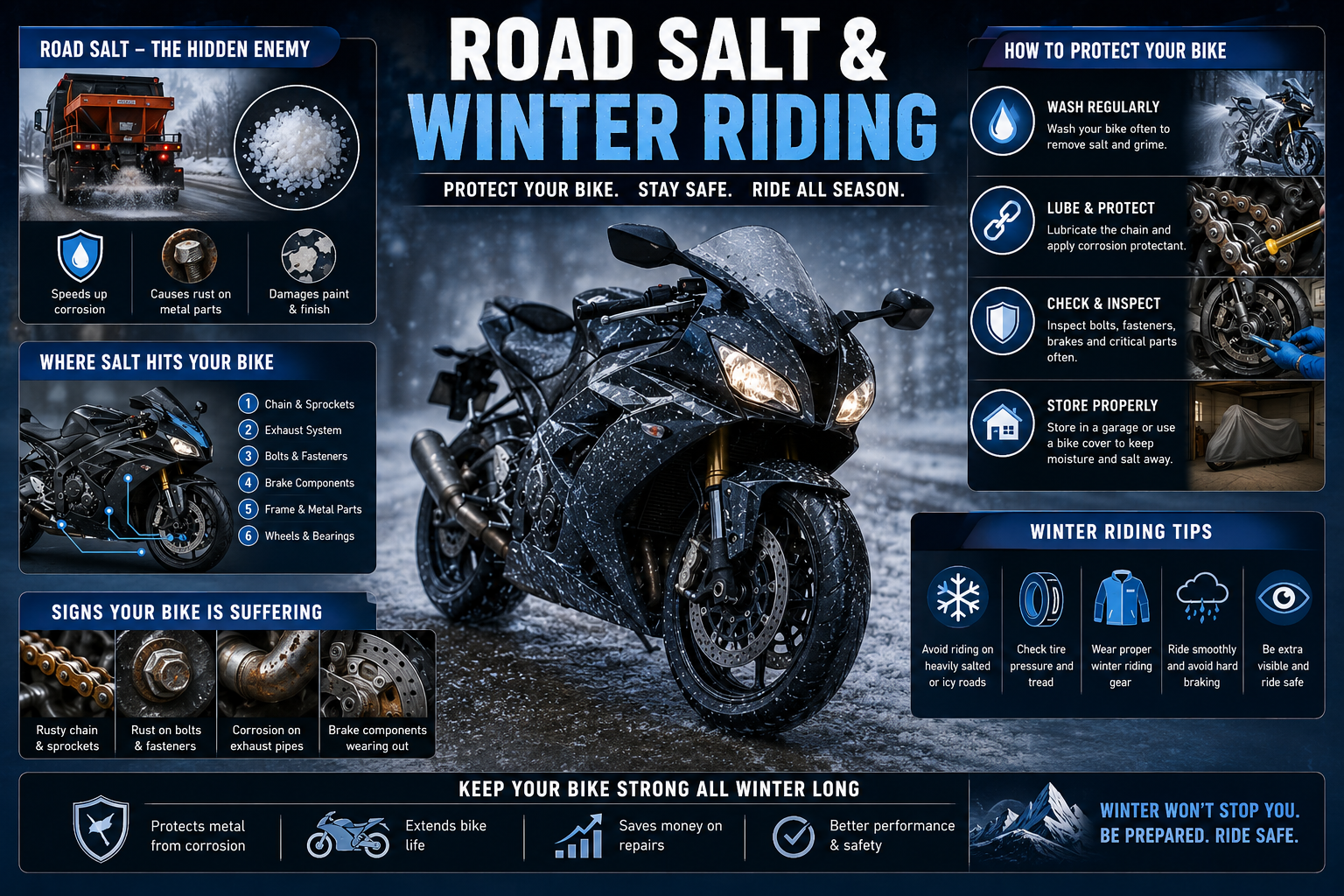
Riders who continue riding through winter face early fairing damage.

Road salt is hygroscopic. It attracts and holds moisture against surfaces. Salt spray thrown up from the front wheel coats the lower fairing sections, the belly pan, and the inside surfaces of front fairings heavily.

The salt and moisture combination attacks paint at a microscopic level. It finds any chip, scratch, or imperfection in the paint surface and begins working underneath. Paint lifts from the substrate through a process called “delamination.” Once salt-driven delamination begins, it spreads laterally under the paint surface, even where the exterior appears intact.

Mounting hardware corrodes rapidly with repeated salt exposure. Steel fasteners used in fairing attachment points seize into their threads. Removal during future maintenance becomes difficult and risks damaging the fairing panel.

Winter riders must clean their fairings thoroughly after every salted road ride. A proper rinse that reaches inside the lower fairing sections removes salt before it has time to act. Allow the bike to dry fully before covering or storing it.

Apply a wax or sealant layer before winter riding begins. This gives salt spray a barrier to attack before it reaches the paint itself.
Heat and Thermal Cycling

Motorcycle fairings experience significant heat variation during every ride.

The engine radiates substantial heat. Fairings positioned near the engine bay, particularly the inner lower fairings, experience continuous heat exposure during riding. Exhaust routing can direct heat directly onto fairing panels if aftermarket systems are installed without heat shields.

ABS plastic has a specific temperature tolerance range. Sustained exposure above that range causes warping. Panels develop slight curves or distortions that create visible gaps between previously flush surfaces.

Paint also reacts to heat. Repeated thermal expansion and contraction cycles cause paint to develop fine surface cracking called checking or crazing over many years. This is distinct from impact cracking and creates a network of tiny surface fractures visible in direct sunlight.

The daily cycle of heating up during a ride and cooling down afterward also affects mounting hardware. Fasteners in thermally stressed locations loosen slightly over time through thermal cycling. Regular torque checks on fairing screws in high-heat zones prevent panels from working loose.

Keep fairings away from direct exhaust contact. Use heat shields where aftermarket exhaust routing brings pipes close to fairing surfaces.

Humidity and Condensation

High-humidity environments affect fairings in ways that are less obvious than rain damage but equally persistent.

Humidity promotes oxidation on any metal hardware associated with fairing mounting. Painted surfaces in humid climates tend to develop microscopic bubbling beneath the clear coat as moisture permeates the paint system over the years.

The more problematic effect is condensation. Fairings that experience rapid temperature changes, such as a cold morning ride followed by parking in a warm garage, develop condensation on their inner surfaces. This moisture has nowhere to go efficiently. It sits and slowly works on any vulnerabilities in the material or paint.

Bikes stored in spaces with high humidity variation benefit from breathable covers that allow moisture to escape rather than sealing it against the fairing surfaces.

Wind-Driven Debris

Wind does not damage fairings directly. But wind-carried debris does.

Sand particles, fine grit, road dust, and small stones carried by wind and forward momentum create continuous abrasion on fairing surfaces. This is most visible on the leading edges of fairings, the front of the headlight fairing, and the lower sections of side panels.

The clear coat layer erodes first. Once it thins past a critical point, the underlying color coat becomes directly exposed. Fading and staining accelerate rapidly without clear coat protection.

Stone chips are the visible acute version of this process. A chip that penetrates to bare plastic or substrate creates a corrosion initiation point. Paint edges around the chip lift if not promptly sealed.

Touch-up paint applied promptly to chips prevents the undermining that turns a small chip into a large paint failure.

Ozone and Atmospheric Degradation

This is one of the least discussed factors in fare deterioration.

Atmospheric ozone reacts with rubber and certain plastics. Rubber trim pieces, gaskets around fairing edges, and elastomeric mounting grommets degrade through ozone exposure over time.

The rubber becomes hard, loses flexibility, and develops surface cracking. Rubber gaskets that have ozone-hardened no longer seal effectively. Water and debris enter gaps that the gaskets were designed to prevent.

Rubber components in fairing mounting systems should be inspected annually. Hardened or cracked rubber grommets and gaskets replace the sealing function they were providing. Replacement parts are inexpensive, and their condition directly affects how well the fairing system resists other forms of weather damage.

Protecting Your Fairings Against Weather Damage

Wash regularly and correctly. Rinse thoroughly after rain, salt exposure, or dusty riding. Use a pH-neutral motorcycle wash. Avoid high-pressure water directed into fairing gaps or mounting points.
Protecting Your Fairings Against Weather Damage

Apply wax or ceramic coating twice yearly. Modern ceramic coatings applied over clean paint provide significant UV protection and hydrophobic properties. They reduce the adhesion of road grime and salt.

Store with protection in mind. A breathable cover protects against UV, dust, and rain while allowing moisture to escape. An airtight cover in a humid environment traps moisture against the fairing surfaces.

Inspect mounting points and seals seasonally. Catch developing cracks, loosening hardware, and degraded rubber before they allow water ingress.

Touch up paint chips promptly. Every unprotected chip is a point where weather damage accelerates into the surrounding paint system.

Park in shade where possible. Reducing cumulative UV exposure has a measurable effect on long-term fairing condition. A shade structure or garage extends fairing life significantly compared to permanent outdoor parking in direct sunlight.

When Weather Damage Requires Replacement

Some fairing damage from weather exposure reaches a point where restoration is not practical.

UV-degraded plastic that has become brittle throughout its thickness cannot be restored by surface treatments. The molecular degradation is structural. A brittle panel that cracks at minor impacts is a safety concern. Debris ejected from a shattering fairing panel creates hazards for other road users.

Paint delamination that has progressed across large panel areas requires a complete respray. For older bikes, replacement with quality aftermarket panels can be more cost-effective than refinishing panels in poor condition.

Warped panels that no longer fit correctly against adjacent panels allow water and debris ingress regardless of how carefully the rest of the fairing system is maintained.

Quality motorcycle fairings from Aliwheels are manufactured to correct OEM dimensions. They are made using appropriate material thickness to provide the best long-term weather resistance when combined with consistent maintenance.

Conclusion

Weather damage to fairings is cumulative and largely invisible in its early stages. By the time the damage is obvious, the underlying deterioration is well advanced.

Regular maintenance, protective coatings, proper storage, and prompt attention to damage stop that progression before it becomes expensive.

Your fairings are both functional and aesthetic. They protect the mechanical components they enclose, reduce wind fatigue during riding, and define how the motorcycle presents itself. Protecting them from the weather protects the whole bike.

Shop quality motorcycle fairings built for lasting weather resistance at AliWheels.
(Commenting: OFF)

Most riders think of body fairings as cosmetic parts. Something that makes the bike look sharp, aggressive, or race-inspired. In reality, motorcycle fairings and fenders do far more than shape the look of a machine. They play a direct role in how the bike cuts through the air, how the engine manages heat, and how comfortable the rider feels over long miles.

When a fairing cracks, warps, or goes missing, the effects go far beyond appearance. Many handling complaints, overheating issues, and unexpected fatigue on long rides trace back to damaged or poorly fitted body panels. This is especially true for sportbikes, touring motorcycles, and modern naked bikes that rely heavily on airflow management. Understanding what damaged fairings actually do to your ride helps you decide when replacement is necessary and why ignoring them can cost more in the long run.

How Fairings Control Airflow at Speed?

At highway and track speeds, air becomes one of the strongest forces acting on your motorcycle. Motorcycle Fairings are designed to guide that airflow smoothly around the bike and the rider. When fairings are intact, air flows evenly across the front end, around the tank, and past the rider’s torso. This reduces turbulence, stabilizes the bike at speed, and limits how much wind pressure hits your body.

Cracked panels, loose mounts, or missing sections interrupt that airflow. Instead of moving smoothly, the air starts to tumble and swirl. Riders often describe this as instability, buffeting, or a vague feeling in the bars at higher speeds. On sportbikes, damaged front fairings can even change how much air pressure loads the front tire. That subtle change affects steering feedback, especially during fast corner entry. Riders chasing handling upgrades often overlook fairing condition, even though it directly influences aerodynamic balance.

Why Cooling Suffers When Fairings Are Damaged?

Modern motorcycles rely on carefully directed airflow to keep engine temperatures under control. Radiators, oil coolers, and exhaust headers are positioned with airflow paths in mind.

Fairings do not just block air. They guide it.

Air enters through specific intake areas, flows across cooling components, and exits through vents designed to pull hot air away. If panels are cracked, warped, or replaced with poorly fitting aftermarket pieces, that airflow path breaks down.

The result can be higher operating temperatures, especially in traffic or warm climates. Some riders notice their fans running more often. Others see fluctuating temperature readings that never quite settle.

This problem is common after low-speed tip-overs where fairings crack but remain partially attached. Even a slight misalignment can redirect airflow enough to reduce cooling efficiency.

On performance bikes, heat management is critical. Excess heat shortens the life of hoses, wiring, sensors, and even engine internals over time.

Rider Comfort Takes a Bigger Hit Than Expected

One of the first things riders notice after fairing damage is increased fatigue.

Wind pressure that used to be deflected now hits the chest, shoulders, or helmet directly. Turbulence around the helmet increases noise, which leads to faster mental fatigue on long rides. On touring motorcycles, even small cracks near windscreen mounts can change airflow enough to cause helmet buffeting.

Damaged lower fairings also expose legs to more wind and engine heat. This becomes especially noticeable on long highway rides or during colder seasons when wind chill increases.

On naked and streetfighter style bikes, side fairings and shrouds still play a role in directing heat away from the rider. When those panels are missing or damaged, riders often complain about excessive heat around the thighs and knees.

Comfort issues may seem minor at first, but over hundreds of miles, they add up. Riders arrive more tired, less focused, and more prone to mistakes.

Structural Integrity and Vibration Problems

Fairings are not load-bearing in the traditional sense, but they do add rigidity to mounting points and distribute vibration.

When mounting tabs crack or bolts loosen, fairings begin to vibrate. That vibration transfers into the bars, mirrors, and footpegs. Over time, this can loosen additional fasteners and create rattles that are difficult to track down.

Worse, loose panels can rub against wiring harnesses, brake lines, or coolant hoses. These issues often go unnoticed until a real failure occurs.

A missing inner fender or damaged belly pan can also expose components to debris, water, and road grime. This accelerates wear and corrosion, especially in wet or dusty environments.

Aerodynamics and Fuel Efficiency

It might surprise some riders, but damaged fairings can even affect fuel consumption.

When airflow becomes turbulent, the bike requires more energy to maintain speed. On long highway rides, that added drag can reduce fuel efficiency. Touring riders may notice fewer miles per tank without changing riding habits.

On smaller displacement motorcycles, where aerodynamic efficiency matters more, the effect becomes even more noticeable. While the difference may not be dramatic on a short ride, over time it adds to operating costs.

When Cosmetic Damage Becomes a Real Problem?

Not every scratch requires immediate replacement. Light surface scuffs and paint damage are mostly cosmetic.

The real issues begin when you see:

  • Cracks near mounting points
  • Panels pulling away from the frame
  • Warped fairings that no longer align
  • Missing inner fenders or heat shields
  • Broken tabs secured with zip ties or glue

These signs indicate that the fairing is no longer doing its job properly. Riders often delay replacement because the bike still runs fine. But the hidden effects on cooling, comfort, and stability quietly continue.

Replacing vs Repairing Body Fairings

In some cases, minor cracks can be repaired professionally. Plastic welding or fiberglass reinforcement can restore strength if done correctly. However, repairs that alter panel shape or block airflow vents can cause more harm than good. Fitment matters as much as material.

Quality replacement fairings and fenders are designed to match factory airflow paths and mounting points. Poorly molded panels may look similar but fail to deliver the same performance benefits. When replacing, always check alignment before fully tightening bolts. A properly fitted fairing should sit naturally without being forced into position.

Why Body Panels Are Part of Performance Maintenance?

Riders invest heavily in suspension, brakes, and tires, yet overlook bodywork condition. Fairings are part of the system that makes a motorcycle ride the way it was designed to ride.

Healthy body panels mean predictable airflow, stable handling, controlled temperatures, and reduced fatigue. That combination keeps you riding longer, safer, and with more confidence.

Ignoring damaged fairings does not usually cause an immediate failure. Instead, it slowly degrades the riding experience until small problems become expensive ones.

Conclusion

Motorcycle body fairings and fenders are not just about looks. They shape how your bike interacts with air, heat, and your own body. Damage that seems minor can quietly affect aerodynamics, cooling efficiency, and long ride comfort. Check out the collection of Motorcycle body fairings and fenders available at Aliwheels Now!

If your bike feels hotter than it used to, less stable at speed, or more tiring to ride, take a closer look at the condition and fitment of your fairings. Restoring proper bodywork often fixes issues riders mistakenly blame on suspension or engine performance. A well-maintained motorcycle is not just one that runs. It manages airflow, heat, and comfort the way its engineers intended.

(Commenting: OFF)

The fairings of your motorcycle are not simply its body panels, but very important components of its design, aerodynamics and brand. You may want to give your bike the perkiness of a different fairing kit after a full season of bike riding. In any case, swapping a motorcycle fairings kit is a satisfying assignment to undertake right in your own garage.

In this blog, we will take you step-by-step through the process, with a special emphasis on being accurate.

Step 1: Prepare the Tools and Materials.

The first step to an effective installation is being prepared. You would not want to consider halfway through the process and then think that you forgot a very important tool.

Here’s what to get ready:

  • Screwdrivers: Flathead and Phillips.
  • Allen keys or hex bits: needed with most fairing bolts.
  • Ratchet set: To cut and fasten nuts.
  • Soft cloths or towels: To prevent scratches on the surfaces of a painting.
  • Containers or zip bags: These items will be used to store and process all the bolts that you take off.

Step 2: Remove the Old Fairings

It is a sensitive process that is done over time. Begin by finding all the bolts and screws that are visible on the fairing panels you are replacing.

  • Record the details: Before you begin, and after each piece of your bike is removed, snap photos of your bike in various positions. This is a priceless visual record so that there is no confusion about where each part is.
  • Sort your hardware: When you freakin’ take off every bolt, bag it in a labelled bag. This makes things nice so that you never lose any parts.
  • Stay careful: A great deal of fairings have clips or interlocked tabs. Avoid pulling or yanking. With a light, wiggling movement, in most cases, it is necessary to get a panel free.

Step 3: Look Behind the Curtain

Depending on how old the fairings are, a user goes off with a faulty frame and components without the old fairings being in place, leaving the opportunity to examine your motorcycle a perfect chance.

  • Finger examination: Inspect occasionally broken mounting tabs, loose wires or brackets that are aged. It is hard to say how much easier it is to repair these blunders despicably easily today when the new fairings are in place.
  • Clean the surface: Wipe the frame to clear it of any accumulating dust, oil and a dirty appearance. By providing a clean surface, it also fits a lot better and leaves a more professional surface.
  • Check frame bolts: Check exposed frame bolts to ensure they are firmly attached.

Step 4: Test Fit the New Kit

Do not go directly to the ultimate installation. A test fit is important in ensuring that there is no problem with the new fairings.

Flatten the panels: Up to this point, all the panels must be carefully placed against the frame to ensure that the mounting holes are in place and that the edges of the panels lie flat with the rest of the areas.

Minor modifications: Sometimes, fairing kits need small modifications. Some might require that all you do is cut a little tab or lightly sand an edge in order to fit in perfectly.

If you rush this step, it may result in a misaligned or even worse final product. Be very gentle when you have all the panels in place.

Step 5: Screw in the New Fairings

Now for the transformation. Begin with the biggest and most central of the panels, and go outward at both ends.

  • Install the screws and bolts first: Attach all screws and bolts with your hands before applying your tools. It eliminates cross-threading and allows you to fit the fit.
  • Sectional work: When all the panels are called in, start tightening the bolts evenly. Reverse and repeat work on the various bolts, so that they seem to have the same pressure throughout and take a smooth fit.
  • Keep centred: Make sure, as you lay each panel in place, that it fits into place with the old ones. When you have attached the last bolt, the new appearance of your motorcycle will be complete.

Step 6: FINAL inspection and test ride

Check as you work is the final guideline, since you need to scrutinise your work and ensure all is right before you get to the road.

Cleaning: Wipe the new fairings with a microfiber cloth, removing any physical evidence on it.

Tap on the stability: Tapping is necessary to ensure that there are no loose factions or attacks.

Clearance: Swivel the handlebars on their side and test the suspension to confirm that the new fairings are not in touch with it.

After every piece is in place, you can try a little short ride on the bike to ensure that the new fairings are in place, given the road conditions.

Locating the Perfect Fairing Kit

Here, dozens of riders need guidance. Your fairing kit design will determine the way the whole job is done as well as the outcome. The substandard kit may be attractive in the photo; however, it would turn into a nightmare to assemble, and it would not last a long time on the road.

The trick is having a credible source. We have witnessed the constant plethora of choices on the internet, and sometimes it is difficult to be polite about whom you talk to. Find out sites specialising in motorcycle clothing that are reliable. The online stores, such as Aliwheels, enter here. We do the vetting of suppliers and remove the guesswork from the equation, allowing you to work on the enjoyable part, which is assigning your bike a new identity.

Conclusion

Replacing the fairing kit on your motorcycle is a satisfying exercise which puts the entire power of aesthetic choice at your disposal. A quality kit will give a hassle-free installation and a long life expectancy.

This is the only way to make your projects work out: get your tools ready, record your disassembling process and test-fit all the components first, then install everything on the final. After a little bit of patience, you will be able to upgrade your motorbike to a professional level and make an impression on the road.

(Commenting: OFF)

Motorcycles go past simple methods of transportation; they represent freedom, intensity, and distinction. Among the large number of components that add to the performance and style of a motorcycle, fairings hold a unique spot. Motorcycle fairings are not just a necessary piece of a bike’s design yet in addition assume an essential part in upgrading its usefulness and streamlined features. In this extensive article, we will dig into the universe of bike fairings, exploring their types, and benefits, and giving fundamental installation tips.

Motorcycle Fairing

Fairings provide your motorcycle with the presence of wings. It’s normally made of plastic or fiberglass, however, carbon fiber is additionally utilized in certain models. They cover the front and sides of the bike, with some reaching out to cover extra regions, for example, the tail segment or seat region. In a motorbike, Gsxr Fairings are shells that experts install over the frame, particularly on racing and sport bikes, to deflect wind and reduce air drag, enhancing aerodynamic features. The design serves not only for style but also for improved performance during long rides and races by decreasing wind resistance.

motorcycle fairings

What Do Fairings Do?

As well as diminishing drag and further improving execution, motorcycle fairings likewise give a lot of security for the rider in case of a mishap. They can assist with redirecting debris and different objects from hitting the rider, and can likewise assist with keeping them protected from the breeze and climate. Fairings can likewise make a motorcycle all the more stylishly satisfying and can add to the general worth of the bike.

Notwithstanding what fairings do, what are the various kinds of motorcycle fairing styles? Bike fairings come in different shapes and sizes. Some are intended for smooth optimal design and dashing execution, while others offer more inclusion for better assurance against wind and climate. In any case, other bike fairings give substantially more security than both of these and might incorporate a windshield for additional inclusion against trash.

What Is The Motivation Behind Motorcycle Fairings?

Fairings make the motorcycle additional wind-resistant. One of the main roles of motorcycle fairings is to help the bike’s streamlined features, in this manner diminishing the air drag and giving downforce for much better footing and security. This can make the bike slice through the air significantly more easily. It will surely require less ability to keep its speed, as well.

Subsequently, fairings can affect fuel use, which is noticed right at high velocities as at decreased speeds while riding on expressways or highways, and can permit the motorcycle to secure speed somewhat quicker. 

motorcycle fairings

How Would I Pick The Right Fairings For My Bike?

While picking fairings for your motorcycle, it’s critical to consider the sort of bike you have, as well as your riding style and inclinations. There is a wide range of styles and materials accessible, so you should pick what turns out best for your necessities. Fairings are a significant piece of your bike, and they play a wide range of jobs.

Your fairing can be produced using a wide range of materials, including plastic, fiberglass, and composite. Everyone enjoys its benefits and hindrances. For instance, plastic is modest yet it’s not entirely tough; while plastic are more costly yet offer unrivaled insurance against water harm (however they’re a lot heavier). Fiberglass is someplace in the center, offering a decent equilibrium between sturdiness and moderation.

While picking fairings for your motorcycle, it’s essential to consider what kind of riding you do. On the off chance that you’re generally doing short drives in and out of town, then a fundamental arrangement of plastic fairings ought to be fine. In any case, if you’re going for long drives, you’ll require something more sturdy and streamlined.

Regardless of what kind of motorcycle you have or what sort of riding you do, there are a bunch of fairings that are ideal for you. So set aside some margin to search around and track down the best set for your requirements. You’ll be happy you did!

Things To Consider While Picking Motorcycle Fairings: 

The following are a couple of things to remember:

  • The kind of bike you have – not all fairings are widespread and will fit each motorcycle. Try to explore what sorts of fairings are viable with your specific bike model.
  • Your riding style – if you do a ton of riding, you’ll need to consider getting a bunch of fairings that lessen wind opposition. If you’re to a greater degree a city rider, something that safeguards you from bugs and debris might be a superior choice.
  • Your financial plan – like all the other things throughout everyday life, bike fairings arrive in a scope of costs relying upon their quality and highlights. Make sure to save sufficient cash to get the right arrangement of fairings for what you want.
  • Your inclination – what do you like? Certain individuals favor hand-crafted fairings, while others might need to set aside cash and purchase pre-made ones from an online store or at a showroom close to them. You can likewise get utilized bike parts assuming that suits your financial plan best!

In light of these things, you’re prepared to begin looking for motorcycle fairings! There are various sorts and styles accessible, so take as much time as is needed and track down the right set for you. Remember that they work on the vibe of your bike as well as its performance- so it merits putting resources into a decent quality set. Enjoy your rides much more with an extraordinary arrangement of bike fairings!

Kinds Of Fairing

As a few manufacturers will positively offer custom fairing, the skies are limitless when it relates to types and design. Nonetheless, there are a couple of common kinds of fairings that most bikers will generally include:

Quarter

Quarter fairing extends around the headlamp of the motorcycle and offers a designated safeguard for the motorcyclist. It’s somewhat a negligible sort of fairing contrasted with half and complete.

motorcycle fairings

Half

50% fairing covers the upper region of the front of the bike.

This will positively offer a ton of the advantages of a full fairing and can keep the lower part of the motorcycle uncovered, as certain riders would like. The upper fairing offers the advantages of boosted aerodynamics.

motorcycle fairings

Full

The full fairing is one of the most consolidating kinds of fairing, providing security for the top and lower portions of the bike.

motorcycle fairings

Café Racer Fairings

Café racer fairings are intended for custom and retro-style motorcycles. They are much of the time small and basic, covering the headlamp and gauges, while allowing the remainder of the bike to stay uncovered.

motorcycle fairings

Off-Road or Motocross Fairings

These fairings are lightweight and intended for rough terrain and motocross bikes. They safeguard against mud and trash, commonly covering just the front piece of the bike.

motorcycle fairings

Handlebar

Handlebar fairing produces a miniature barrier behind the handlebars. This can be useful for those riding with a GPS or mobile installed onto the handlebars. The fairing gives these devices extra security and simplifies them to utilize accessories in breezy circumstances.

motorcycle fairings

Wheel

Front and Back fairing can be fastened to reach out over the front or back wheel. This can help with avoiding dust sprinkling up. For off-road racing or riding, this can help quit a lot of dust and debris on the riders.

motorcycle fairings

How Would I Install Motorcycle Fairings?

Installing fairings is generally a direct interaction. Most bikes have mounting sections appended to the edge under each wheel; if not then, these can be bought independently from any car store or online retailer. The fairings snap onto these sections and are commonly held with screws or bolts. It’s essential to ensure that the fairings are appropriately adjusted before getting them set up.

Motorcycle fairings can give a few advantages to your bike, including further developed execution and security for the rider. It’s vital to pick the right fairings for your necessities and to introduce them accurately for the best outcomes. With the right fairings, you can partake in a smoother, quicker ride while shielding yourself from the wind and the weather!

motorcycle fairings

Benefits of Fairing

Improved Performance

The fairing is exceptionally common on sports and racing bikes because of the improved performance it offers. By being more aerodynamic, the bike can speed up quicker. In racing, this has a significant effect as riders can reach higher speeds rapidly. Fairings offer clear benefits in any racing conditions, especially in more brutal weather patterns.

Being more protected from the wind additionally implies the bike is more steady. In racing circumstances, this is a major reward and lessens the gamble of mishaps brought about by instability.

Comfort

By diverting the wind, the fairing can make a significantly more pleasant and comfortable ride. The general impact of wind hitting you and the bike at high speeds is significantly reduced, and it decreases helmet noise. This is valuable in a wide range of circumstances, from courageous riding in blustery circumstances to fast racing. In cold circumstances, redirecting that chilly air can have a significant effect and keep you from feeling harshly cold for the entire journey.

The fairing can likewise make added comfort by empowering a better stance. Customized fairing can give the ideal situation to your legs.

Adjustable

If you like to redo your bike, fairing gives you a major fresh start when prepared to design. Many services offer custom designs for motorbike fairing. This can add character and personality to your bike.

If you are getting the fairing uniquely crafted, you can likewise demand explicit elements inside the framing to make a definitive bike for your particular requirements.

Assurance

Fairing safeguards the motor and inward operations of a motorcycle. Especially in case of a mishap, the fairing can assist with giving security to the rider and the center components of a bike.

Engine Life Expectancy

The better-streamlined features imply that the motor doesn’t have to function as hard. This resulted in a more extended life expectancy and worked on by and large execution. As the engine is straightforwardly liable for the entire motorcycle, hence, keeping up with it is beneficial, especially for those on a careful spending design who need to stay away from the expenses related to broken-down engines.

Accessories

Adding GPS, mobiles, and different accomplices to the cockpit region has turned into a famous decision for some riders. From following execution to exploring obscure courses, these elements have rapidly turned into an unquestionable necessity.

Without sufficient fairing on the façade of a bike, these highlights might battle to work. Fairing helps safeguard these gadgets, which likewise permits a rider to utilize them easily.

Style and Aesthetics

The fairing can without a doubt add the wow component to a motorcycle. It can make a wonderful aesthetic and feel for the bike, while likewise having the capacity to increase the value of the bike. To instantly make an old, tired motorcycle look brand new, you can also resurface the fairing.

motorcycle fairings

Conclusion

Motorcycle fairings are a critical part of a motorcycle’s design, giving aerodynamics, protection, insurance, style, and rider comfort. Understanding the different sorts of fairings and their advantages permits riders to pick the right kind for their particular requirements and inclinations. Moreover, following proper installation systems is fundamental to guarantee a solid and practical fit for your fairings. With this extensive article, you are exceptional in coming to informed conclusions about motorcycle fairings and effectively introducing them on your motorcycle, enhancing both its performance and visual appeal.

(Commenting: OFF)

Or login with your social account