



Free Shipping over $300

Support 24/7

Secure Payments

Hot Offers

Aliwheels is a leading motorcycle parts supplier offering free shipping anywhere in the world on orders above $300. Please note that all of our motorcycle parts and accessories are certified and tested. With more than 10,000* products to choose from this is your one place to get the motorcycle part you need. Browse our vast inventory of motorcycle radiators, fairings, clutch plates, headlights, chains, and sprockets.

Free Shipping over $300

Support 24/7

Secure Payments

Hot Offers

The Short Answer:
Disc brakes outperform drum brakes in stopping distance, heat dissipation, wet weather performance, and modulation. Drum brakes are simpler, cheaper to maintain on basic commuter bikes, and adequate for low-speed applications. For any motorcycle used at highway speeds or requiring confident emergency braking, disc brakes are the superior system in every measurable metric.

The disc vs drum motorcycle brakes debate sounds outdated as if it belongs in 1985 when drum brakes were still common on full-sized motorcycles. But it is not. Drum brakes remain standard on many commuter motorcycles, small-displacement learner bikes, and entry-level machines sold in the US and globally in 2026. Riders who buy these bikes, and riders considering upgrades, face a real decision that affects their safety on every ride.

Here is the complete, engineering-based comparison with no brand advocacy and no nostalgia. Browse Aliwheels’ Motorcycle Brakes category for disc brake components, brake pads, and rotors across all major makes.

How Disc Brakes Work

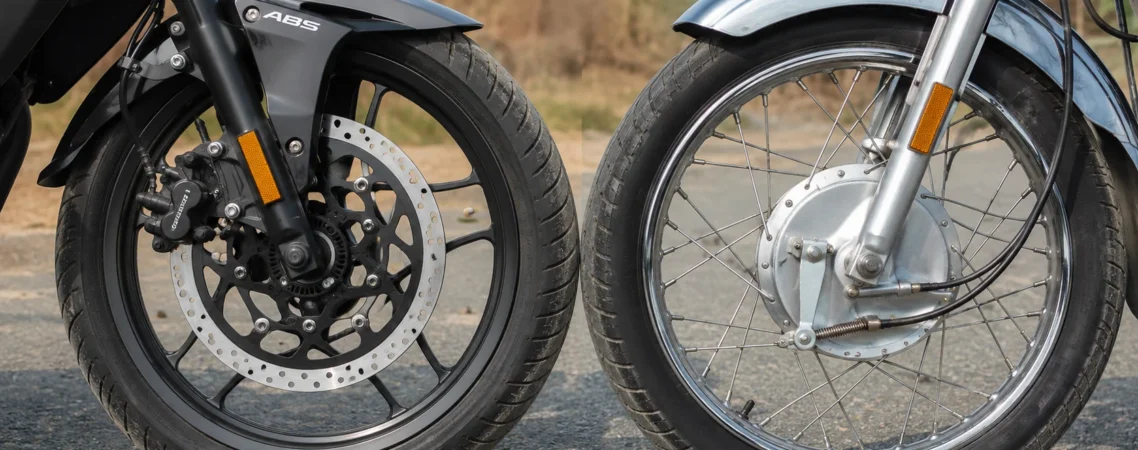
A disc brake system uses a rotor ,  a flat metal disc mounted to the wheel hub ,  and a caliper that clamps brake pads against the rotor surface when hydraulic pressure is applied through the master cylinder. The friction between the pads and the rotor surface converts kinetic energy to heat and slows the wheel.
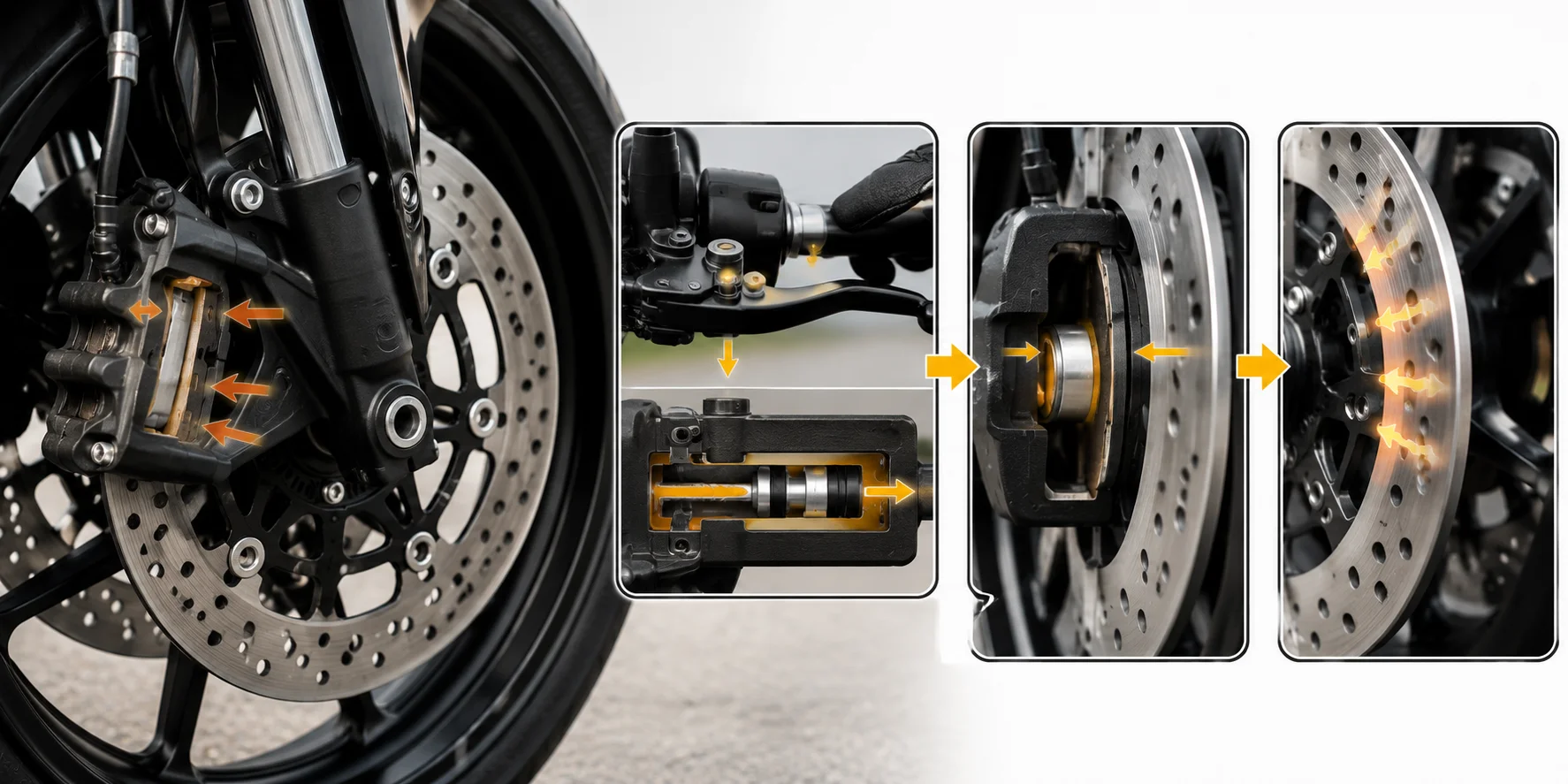
How Disc Brakes Work

The key physics advantage of this design: the rotor is mounted outside the wheel in open air, allowing heat generated by braking to dissipate directly into the surrounding airflow. This is the fundamental reason disc brakes outperform drum brakes in sustained braking scenarios; the heat goes away rather than accumulating in the system.

How Drum Brakes Work

A drum brake system uses shoes ,  curved friction material blocks ,  that press outward against the inside of a drum mounted on the wheel. The drum rotates with the wheel. When brake force is applied, the shoes expand outward to contact the drum’s inner surface, creating friction that slows the wheel.
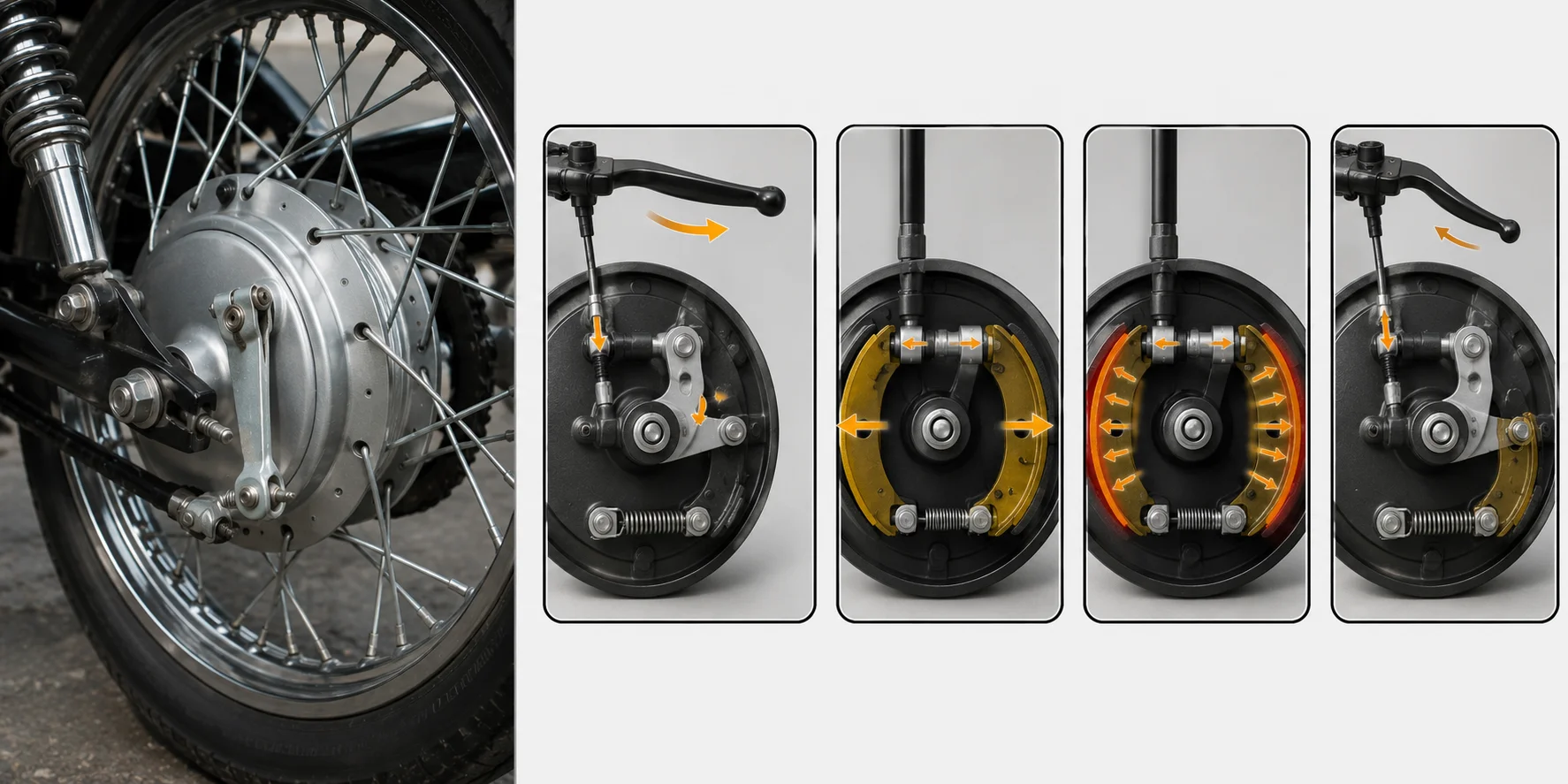
How Drum Brakes Work

The key physics disadvantage of this design: the drum is a closed structure. Heat generated by braking is trapped inside the drum with no direct path to dissipate into surrounding airflow. This is why drum brakes fade under sustained use; the accumulated heat reduces the friction coefficient progressively until braking force drops significantly.

The Performance Comparison: Every Metric That Matters

Stopping Distance

Disc brakes consistently produce shorter stopping distances than drum brakes in independent testing across equivalent vehicle weights and speed conditions. The difference is most pronounced in:

Emergency stops from highway speed, where the initial bite of a disc system generates maximum deceleration force immediately. Drum brakes require a brief build-up period as the shoes contact the full drum surface.

Repeated stops in traffic, where the thermal advantage of disc systems maintains consistent stopping performance while drum brakes accumulate heat and fade progressively.

According to motorcycle safety research published across multiple traffic safety organisations, the braking distance advantage of disc over drum systems increases as speed increases; the systems are closer to equivalent at very low speeds and diverge significantly above 30 mph.

Heat Management and Brake Fade

This is the most important performance difference for riders who descend hills, ride in heavy traffic, or make repeated stops from speed.

Brake fade, the reduction in braking force that occurs as brake system temperature rises ,  is primarily a drum brake problem. The closed drum structure cannot dissipate heat at the rate it is generated under sustained braking. A driver descending a long mountain grade with drum brakes is applying heat faster than the system can release it. The result is progressively reduced braking force at exactly the moment maximum braking is needed.

Disc brakes dissipate heat directly from the exposed rotor surface into airflow. At speed, ram air across the rotor surface prevents heat accumulation under all but the most extreme racing brake scenarios. Even standard street riding generates enough airflow to maintain disc brake temperatures within their operating range.

The practical implication: a motorcycle with drum brakes on a mountain descent is genuinely less safe than the same motorcycle with disc brakes, and the safety gap increases with descent duration and grade.

Wet Weather Performance

Drum brakes are largely unaffected by light rain because the drum’s closed structure prevents water from reaching the friction surfaces. This sounds like an advantage ,  and in very light rain, it is.

The problem appears when the drum does get wet. Water that enters the drum through the hub area or through brake adjustment ports pools inside the drum and dramatically reduces friction between the shoe and drum surface. A wet drum brake inside provides significantly less braking force than the same brake dry ,  and the drum must spin many times to centrifuge the water out.
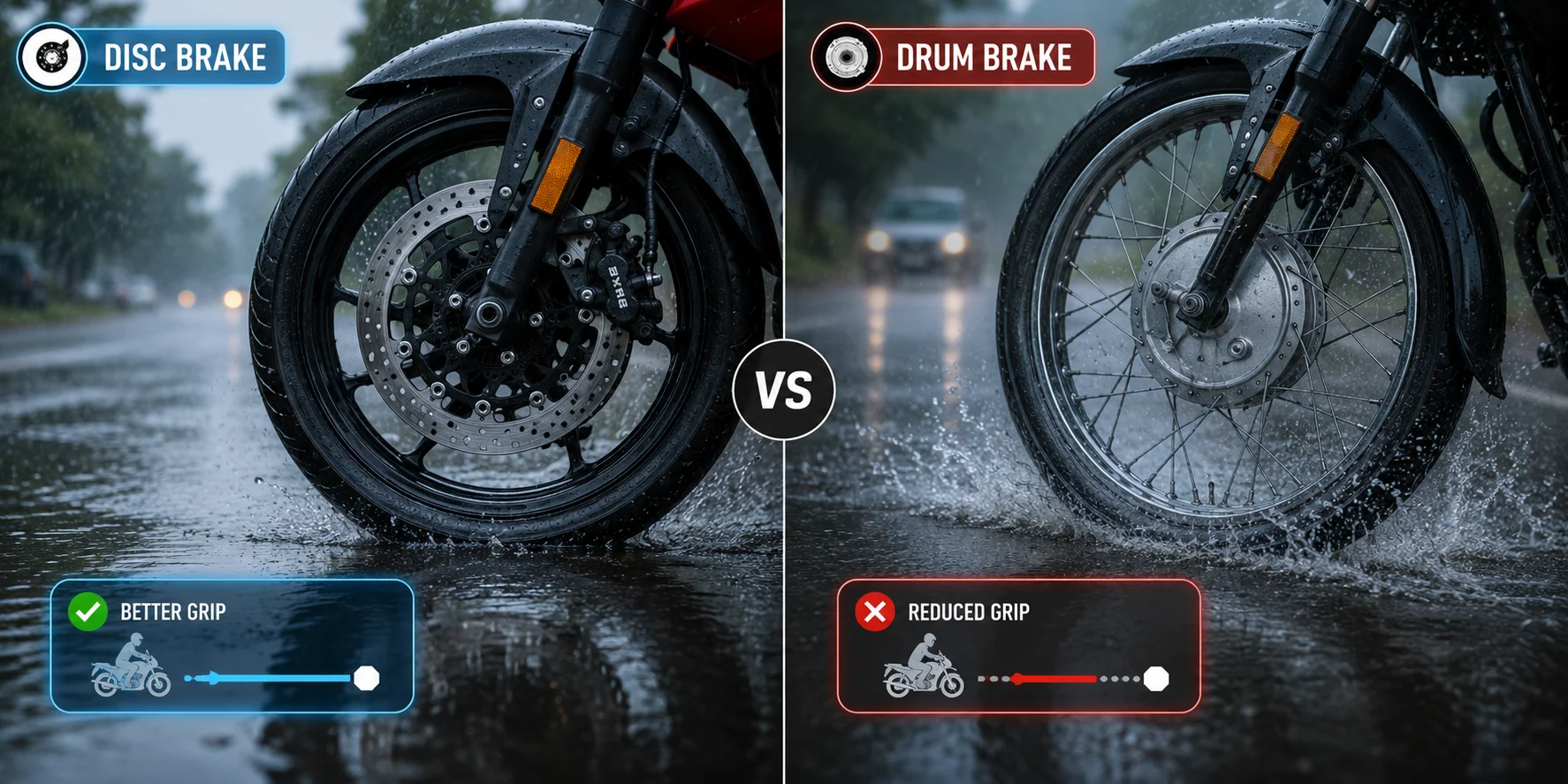
Wet Weather Performance comparison

Disc brakes are affected by water in the initial moment after a large water splash because the rotor surface can aquaplane briefly. However, the exposed rotor dries almost instantly as it rotates, typically within one or two brake applications. A disc brake that has been through a puddle regains full effectiveness within seconds. A drum brake that has taken on water may take considerably longer.

For riders in wet climates- the US Pacific Northwest, the Southeast during hurricane season, any region with significant rainfall- disc brakes provide more consistent and more predictable braking performance across varying weather conditions.

Modulation and Feel

Modulation, the ability to apply exactly the right amount of braking force with precise control through the lever, is significantly better in disc brake systems with hydraulic operation.

Hydraulic disc brakes transmit hand pressure directly to clamping force at the caliper through incompressible fluid. The relationship between lever pressure and braking force is linear and predictable. A skilled rider can modulate a disc brake to exactly the threshold of tyre lock-up with practice.

Cable-operated drum brakes introduce friction in the cable, non-linearity in the shoe expansion mechanism, and a mechanical advantage ratio that is fixed rather than adjustable. The feel is less direct, and the threshold between adequate braking and lock-up is harder to sense through the lever.

Maintenance and Durability

This is where drum brakes have a genuine advantage ,  specifically for very basic commuter applications in controlled conditions.

Drum brake shoes last longer than disc brake pads in equivalent mileage because the shoe surface area is larger and contact pressure is lower per unit area. On a simple commuter bike used for low-speed urban riding, drum brakes may require shoe replacement at 30,000 to 50,000 miles compared to disc pads at 10,000 to 20,000 miles.

Drum brake systems have fewer components ,  no caliper to service, no brake fluid to change, and no rotor to inspect for minimum thickness. For very basic bikes in markets where mechanical expertise and parts availability are limited, this simplicity has genuine value.

However, this advantage is entirely contextual. On a motorcycle used at highway speeds, carrying passengers, or ridden in varied conditions, the safety advantages of disc brakes far outweigh the maintenance simplicity of drums.

When Drum Brakes Are Adequate

Drum brakes perform adequately in these specific scenarios and no others:

Low-speed urban riding below 30 mph with short stopping distances. Entry-level scooters and 50cc to 125cc commuter bikes where maximum speed is legally limited. Rear brakes on some cruiser applications where the rear brake contributes a small percentage of overall stopping force and heat generation is minimal.

For any riding that involves sustained speed above 40 mph, regular highway use, riding in varied weather conditions, or frequent emergency stop scenarios ,  disc brakes are the correct system.

Can You Upgrade a Drum Brake Motorcycle to Disc?

The short answer is yes, but it’s a significant engineering project rather than a simple parts swap. A drum-to-disc conversion requires a different wheel hub to accept a rotor mount, a brake caliper and mounting bracket, a master cylinder and hydraulic line, and integration with the existing controls.
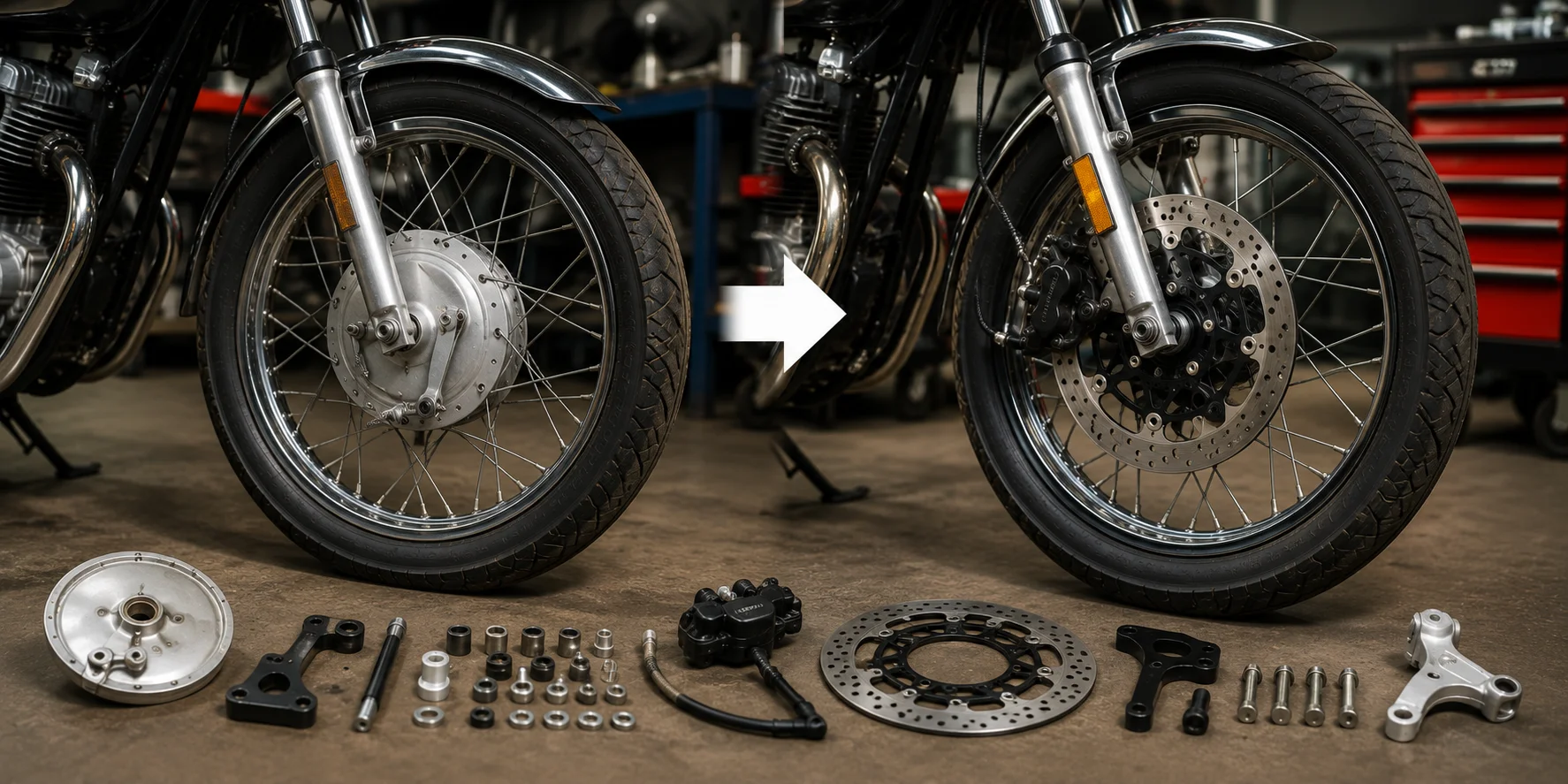
drum to disc brake upgrade

For motorcycles where aftermarket conversion kits are available from established suppliers, this is a viable upgrade. While unusual or low-volume models, the fabrication required makes it a specialist job.

For most riders on drum-brake equipped bikes, the more practical decision is whether to continue riding the current bike or to select a disc-brake equipped model when upgrading. Browse Aliwheels Motorcycle Brakes category for disc brake components including rotors, calipers, brake pads, and brake lines for the most popular disc-brake equipped motorcycles. For related maintenance parts across all makes, browse Motorcycle Parts.

The Verdict: Which System Is Actually Better?

MetricDisc BrakesDrum Brakes
Stopping distanceShorter, significantly at speedLonger,  gap increases with speed
Heat dissipationExcellent,  open rotor in airflowPoor, closed system traps heat
Brake fadeMinimal in street conditionsSignificant under sustained braking
Wet weatherBrief initial contact fade, recovers instantlyConsistent initially, significant fade if water enters
Modulation and feelExcellent,  hydraulic precisionModerate,  cable/mechanical limitations
Maintenance frequencyHigher,  pads wear fasterLower,  shoes last longer
Maintenance complexityModerate, fluid changes, rotor inspectionSimple, shoe inspection only
Best applicationHighway, varied conditions, any speedLow-speed urban, basic commuter

Conclusion

Disc brakes are superior to drum brakes in every performance metric that affects safety at realistic riding speeds and conditions. The stopping distance advantage, heat management, wet weather consistency, and modulation quality all favour disc systems for any motorcycle used beyond basic urban low-speed commuting.

Drum brakes have a place on very basic low-speed commuters where simplicity and maintenance accessibility justify the performance trade-off. For any other application, if you have the choice between a disc-equipped and drum-equipped motorcycle, choose disc every time.

Frequently Asked Questions

Q: Are drum brakes dangerous on motorcycles?

A: Drum brakes are not inherently dangerous at low speeds and in controlled urban conditions. However, they become progressively less adequate as speed increases, as conditions vary, and as sustained braking generates heat. At highway speeds and in emergency braking scenarios, drum brakes’ longer stopping distances and fade susceptibility represent a meaningful safety disadvantage compared to disc systems.

Q: Why do some motorcycles still use drum brakes?

A: Cost. Drum brakes are significantly cheaper to manufacture and fit than hydraulic disc systems. For entry-level scooters and commuter bikes where price is the primary purchase driver and top speed is limited, drum brakes represent an acceptable cost-performance trade-off. For any motorcycle designed for highway use or performance riding, disc brakes are now universal.

Q: Can you lock up a disc brake more easily than a drum brake?

A: Without ABS, disc brakes can be locked with less hand pressure than drum brakes because of their superior modulation; the power is more immediately available. However, ABS (Anti-lock Braking System) is now standard on most mid-range and above motorcycles globally and eliminates wheel lock regardless of brake type. On non-ABS bikes, disc brakes require more throttle-to-lock management than drums but provide more usable braking force before the lock point is reached.

Q: Is it worth upgrading from drum to disc brakes on a motorcycle?

A: If a conversion kit is available for your specific model from a reputable supplier, and the cost is justified by how you use the bike, yes. For commuter bikes used only in low-speed urban conditions, the performance benefit may not justify the conversion cost. For bikes used at highway speeds or in varied conditions, the safety improvement is significant enough to justify the investment.

Q: Do disc brakes require more maintenance than drum brakes?

A: Yes, in terms of frequency. Disc brake pads wear faster than drum shoes because they operate at higher friction intensity per unit area. Disc brake systems also require periodic brake fluid changes, typically every two years ,  because hydraulic fluid absorbs moisture over time and reduces boiling point. Drum brakes require shoe inspection and adjustment but no fluid changes. The maintenance trade-off is real but the performance advantage of disc systems makes it worthwhile for most riders.
(Commenting: OFF)

AI Summary

OEM motorcycle fairings guarantee perfect fitment and factory-color match, but cost 40 to 80 percent more than quality aftermarket alternatives. Quality aftermarket ABS fairings match OEM fitment and material specifications at a significantly lower cost and are the correct choice for most replacement scenarios. Custom fairings offer unique graphics and personalization at mid-range pricing. Fiberglass fairings are lighter but more fragile than ABS and are better suited to track use, where weight matters more than durability. 

You’ve dropped the motorcycle. Or a stone has cracked a fairing panel. Or the previous owner’s repair is failing and the whole front section needs replacing. Whatever brought you here, fairing replacement is one of the most emotionally charged parts purchases a rider makes — because the fairing is the face of the motorcycle, and getting it wrong is immediately visible.

The good news is that the fairing market has developed to a point where quality options exist at every price point, and the decision between OEM, aftermarket, and custom is genuinely straightforward once you know what each option actually delivers.

Here is the complete fairing replacement guide. Browse Aliwheels’ Motorcycle Fairings and Customized Fairings categories for the full range across all major makes.

What Motorcycle Fairings Actually Do

Before comparing options, understanding what fairings are engineered to deliver clarifies which specifications actually matter for your use case.

Aerodynamics are the primary function on sport and supersport motorcycles. The fairing’s profile manages airflow around the motorcycle and rider at speed — reducing drag, managing lift forces, and directing cooling air to the radiator. On a track-day ZX6R at 130 mph, the fairing’s aerodynamic profile is a performance component. On a commuter CBR500R at 50 mph, it’s primarily cosmetic with some weather protection benefit.

Wind and weather protection matters most for touring-oriented fairings. Larger fairing profiles on touring motorcycles redirect wind around the rider, reducing fatigue and improving comfort across long distances.

Cosmetics and visual identity are the primary function in the rider’s perception. The fairing makes the motorcycle visually distinctive and is the surface that shows damage, fading, and personalisation most obviously.

OEM Motorcycle Fairings: What You Actually Get

OEM fairings are manufactured to the motorcycle manufacturer’s original specifications — the same moulds, the same ABS plastic compound, the same colour-matched paint process. They are the reference standard against which all alternatives are measured.

OEM motorcycle fairings

What OEM delivers:

Perfect fitment. OEM fairings use the original mounting points, mounting hardware specifications, and dimensional tolerances. They install without modification and align with all adjacent panels correctly.

Factory colour match. OEM paint is mixed and applied to the same specification as the rest of the bike’s bodywork. On a well-maintained motorcycle without panel damage, an OEM replacement panel matches the adjacent surfaces.

Manufacturer warranty. OEM parts carry the manufacturer’s parts warranty — typically one to two years — through the dealer network.

What OEM costs:

The OEM premium is significant. For popular sport motorcycles like the Honda CBR600RR, Kawasaki ZX6R, and Yamaha YZF-R1, a complete OEM fairing set can run $800 to $2,500 depending on model and year. Individual panels run $150 to $600 each at dealer retail. This pricing reflects the dealer network margin, the manufacturer’s parts business profitability requirements, and in some cases genuine supply limitation for older models.

When OEM is the right choice:

The motorcycle is under manufacturer warranty and you need the manufacturer’s parts compliance for warranty purposes. The motorcycle is a rare or collector model where originality affects resale value significantly. You need an exact paint match on a motorcycle with unusual or complex factory colour schemes that are difficult to replicate. Age has faded the adjacent panels and you’re replacing all bodywork simultaneously with OEM so the new paint ages identically.

Aftermarket ABS Fairings: The Smart Choice for Most Riders

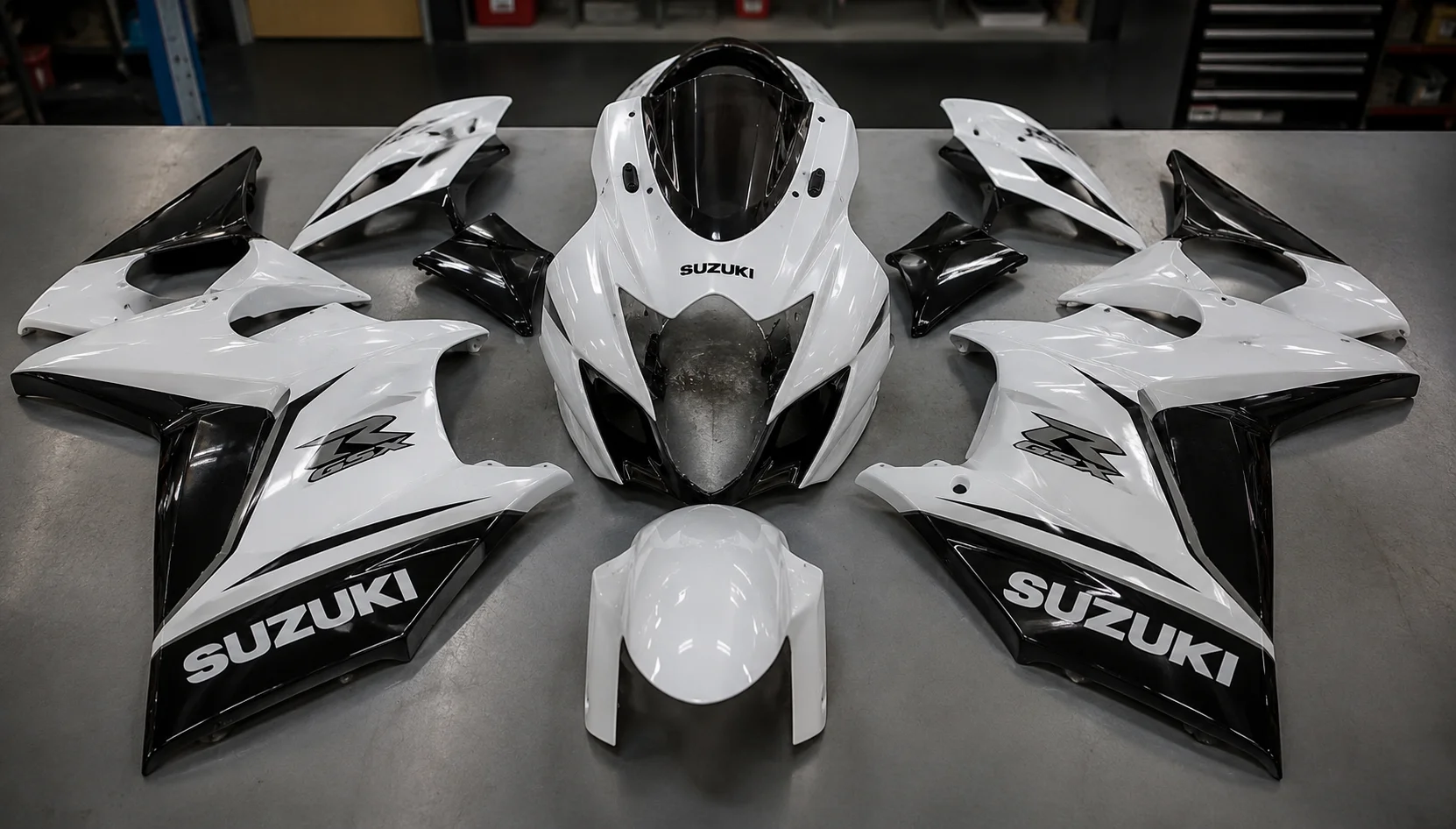
Quality aftermarket fairings for popular motorcycle models are manufactured from the same ABS (Acrylonitrile Butadiene Styrene) material as OEM fairings, using moulds derived from original panels. The result is a fairing that matches OEM fitment and material quality at 30 to 60 percent less cost.

Aftermarket ABS Fairings

What quality aftermarket delivers:

Equivalent material. ABS plastic is ABS plastic. The wall thickness, flex characteristics, and mounting boss construction in a quality aftermarket fairing matches the OEM specification because both are manufacturing the same material to the same dimensional requirements.

Good fitment. On popular models with well-developed aftermarket tooling, fitment quality is indistinguishable from OEM in installation. Minor trimming or adjustment is occasionally required on less popular models where the tooling has seen less refinement.

Accessible pricing. A complete aftermarket ABS fairing set for a popular supersport costs $200 to $600 — compared to the $800 to $2,500 OEM equivalent. For a rider replacing fairings after a low-side where the insurance excess exceeds the replacement cost, this pricing makes the repair financially practical where OEM pricing would not.

Unpainted or painted options. Aftermarket fairings are available unpainted (raw ABS ready for your own paint) or pre-painted to the OEM colour code. Pre-painted options add cost but save the painting step for riders who don’t want to source a painter.

What aftermarket requires:

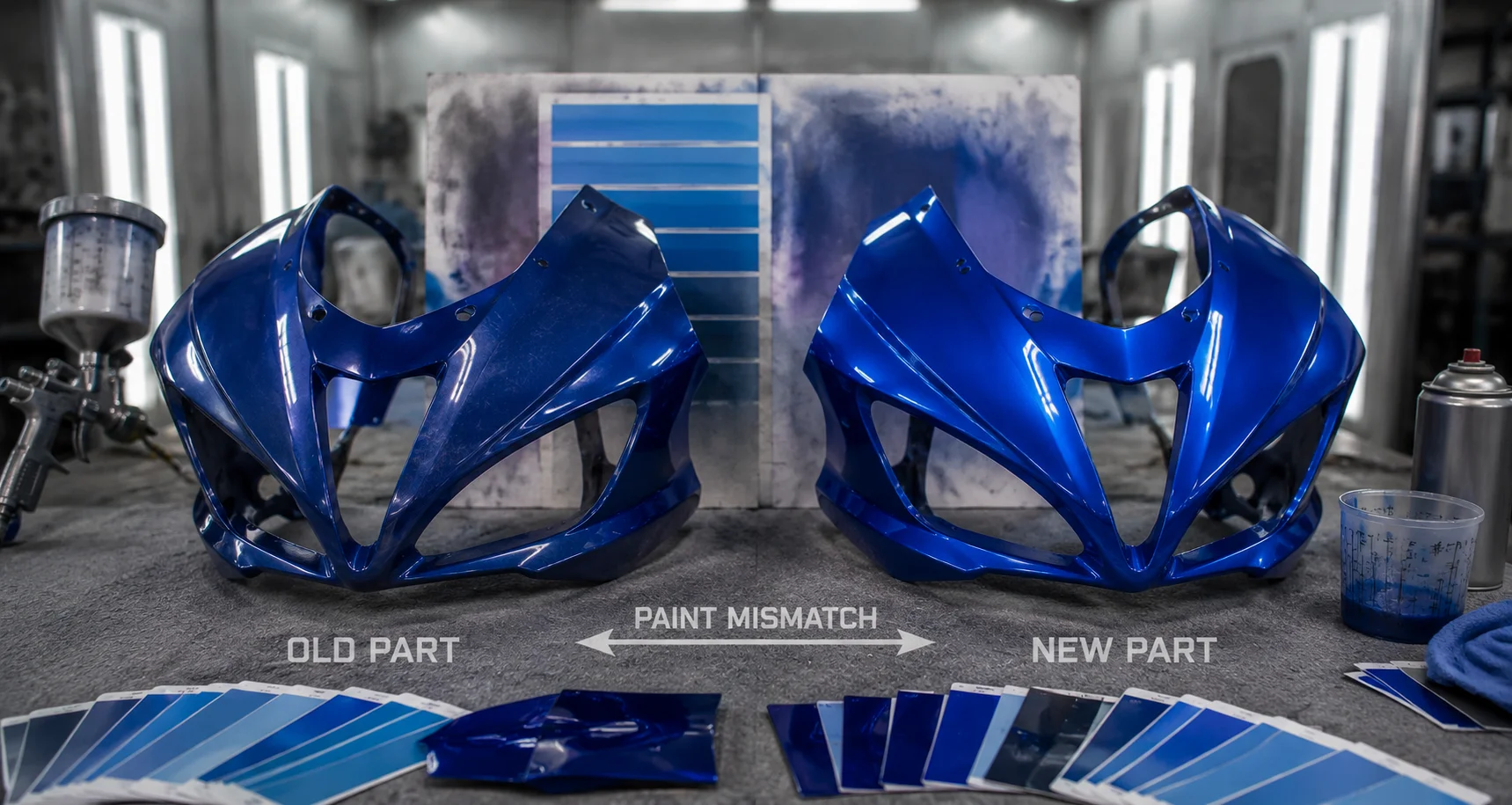
Paint matching. Aftermarket pre-painted fairings match the OEM colour code but not the aged paint on the rest of your motorcycle. On a well-maintained, recently painted motorcycle, the match is close. On a motorcycle with several years of UV fading on the existing panels, even perfectly colour-matched new paint looks noticeably different against aged paint. This is not an aftermarket-specific problem — OEM has the same issue.

Minor fitting adjustment on some models. First-fit installation occasionally requires minor trimming at mounting points or tab adjustment for precise alignment. This is a five-minute task on most applications.

Aliwheels stocks ABS aftermarket fairings and body panels across all major motorcycle brands. Browse the complete Motorcycle Fairings catalogue for available models and the Customized Fairings section for personalised options. For all related bodywork parts, browse Motorcycle Parts.

Custom Fairings: Personalisation With Protection

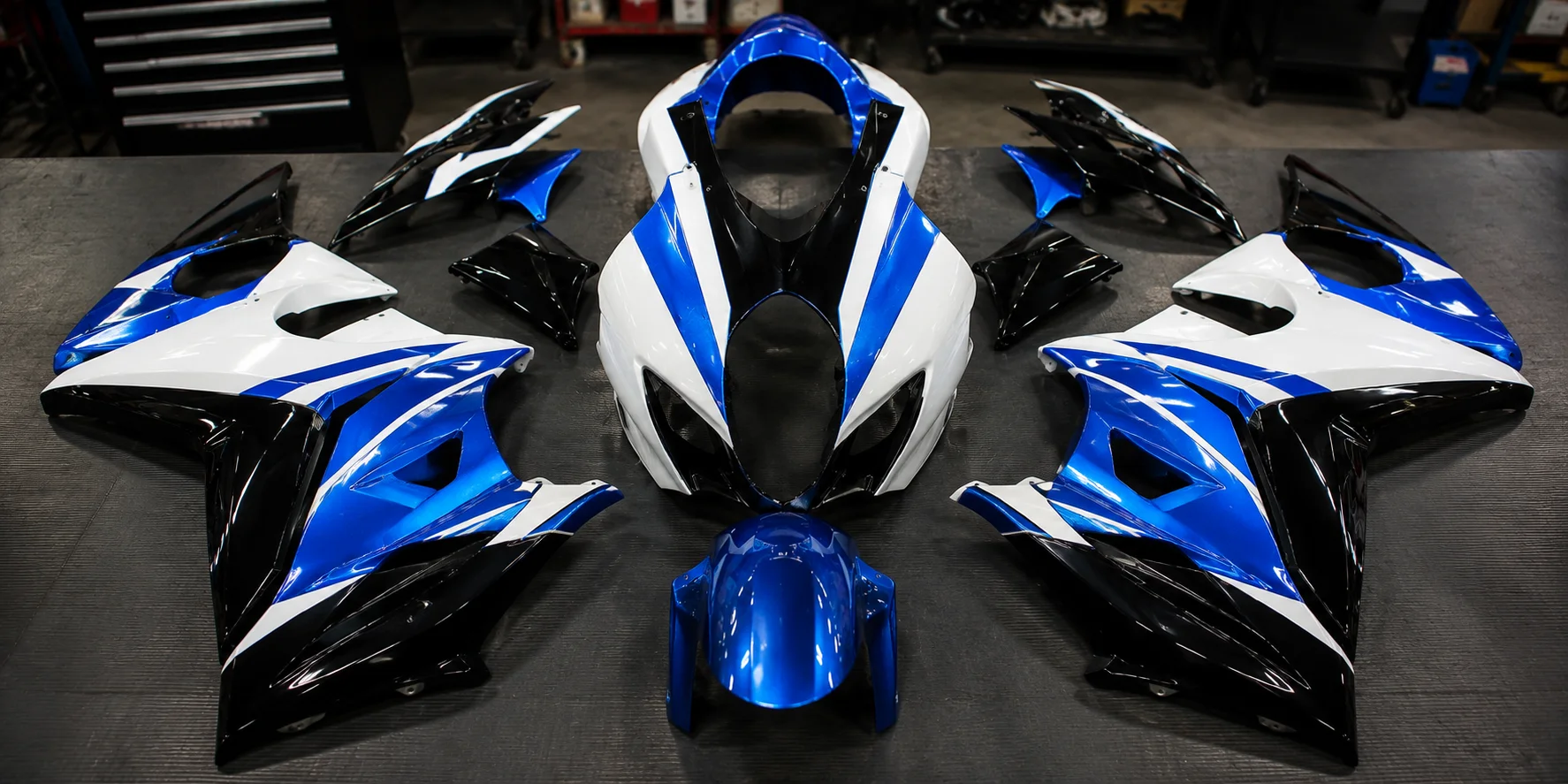
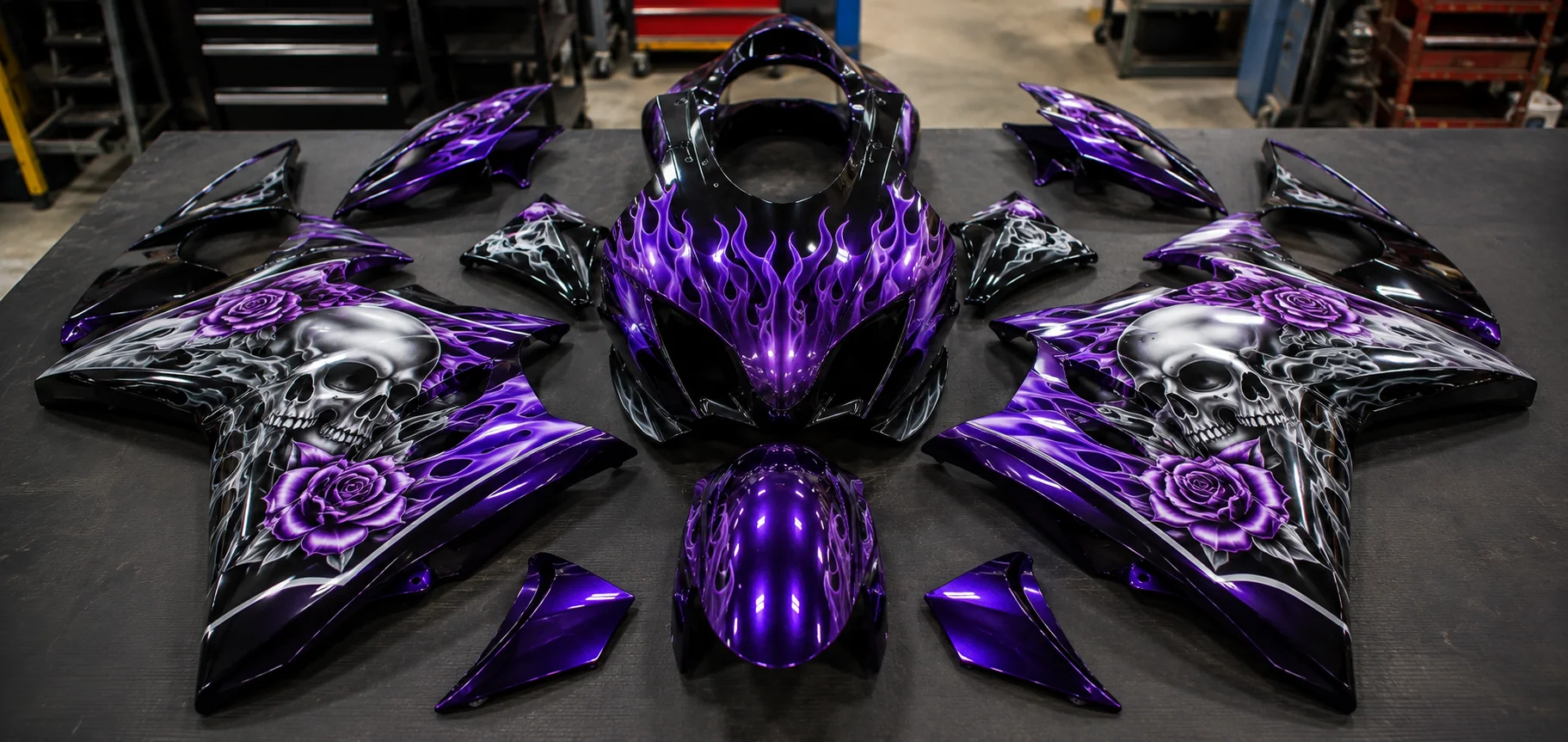
Custom fairings occupy a distinct market position — they are aftermarket ABS fairings with custom graphics, unique colour schemes, or personalised artwork applied rather than OEM colour replication. They suit riders who see a bodywork replacement as an opportunity to personalise rather than simply restore.

Custom Fairings

What custom fairings deliver:

Visual distinctiveness. Your motorcycle looks like your motorcycle, not a factory specification. In a paddock full of stock-coloured CBR600RRs, a custom-painted fairing set makes your motorcycle immediately identifiable.

Equivalent protection to standard aftermarket. Custom fairings use the same ABS substrate as standard aftermarket — the customisation is on the surface, not in the material.

Mid-range pricing. Custom fairings typically price between standard unpainted aftermarket and OEM — you’re paying for the artwork and finish rather than the OEM brand premium.

When custom is the right choice:

You’re using a bodywork replacement as an opportunity to give the motorcycle a new identity. The existing paint has faded significantly and you want a distinctive look rather than trying to match aged factory paint. You’re building a track motorcycle where a custom livery is part of the project. You want a race replica design — MotoGP liveries are popular custom fairing choices on street motorcycles.

Fibreglass vs ABS: The Material Question

Fibreglass fairings are lighter than ABS and offer more structural rigidity — properties that matter at race track use where weight reduction and structural performance under high-speed aerodynamic loads are genuine concerns. They are also more expensive to produce and more fragile in low-speed impacts like parking lot tip-overs.

ABS fairings flex slightly on impact without cracking — a characteristic that makes them significantly more practical for street use where minor impacts are part of life. Fibreglass cracks cleanly at impact points. ABS deforms and may crack, but tends to absorb more impact energy before catastrophic failure.

For street use, ABS is the correct material choice in virtually every application. For dedicated track use where every gram of weight reduction has measurable performance value, fibreglass is worth the fragility trade-off.

The Paint Matching Problem — And How to Manage It

Regardless of whether you choose OEM or aftermarket, new fairings will not perfectly match the aged paint on your existing panels unless the entire motorcycle’s bodywork is being replaced simultaneously. UV fading, minor scratches, and the weathering of clear coat change the visual appearance of painted surfaces over time.

Paint Mismatch

The solutions are either replace all bodywork at the same time so all panels age together, accept a slight visual mismatch that becomes less noticeable as the new panels weather, or have the new panels painted to match the aged colour on your existing panels by a painter who colour-matches by eye rather than strictly by colour code.

For motorcycles where a single panel needs replacement, most experienced riders accept that a slight mismatch is less noticeable than a cracked or missing panel and fades over one to two seasons of UV exposure as the new paint ages to match.

The Full Comparison

FactorOEM FairingsAftermarket ABSCustom FairingsFibreglass
Fitment qualityPerfectVery good (minor adjust occasionally)Very goodGood
MaterialABS plasticABS plasticABS plasticFibreglass
Paint matchFactory specColour code matchCustom designCustom or bare
PriceHighest30-60% less than OEMMid-rangeHigher than ABS
Impact resistanceGoodGoodGoodLower than ABS
WeightStandardStandardStandardLighter
Best forWarranty motorcycles, collectorsMost replacement scenariosPersonalisation, track buildsDedicated track use

Conclusion

OEM fairings are the right choice for warranty motorcycles and collector models. Quality aftermarket ABS is the right choice for the majority of motorcycle fairing replacements — equivalent material, equivalent fitment, significantly lower cost. Custom fairings suit riders who want to personalise the motorcycle during the replacement. Fibreglass suits dedicated track use where weight reduction justifies the fragility trade-off.

The fairing replacement decision is simpler than it appears once you know what each option actually delivers rather than what the marketing around each claims.

Frequently Asked Questions

Q: Are aftermarket motorcycle fairings as good as OEM?

A: Quality aftermarket ABS fairings match OEM material specification and fitment quality for most popular motorcycle models. The material — ABS plastic — is the same in both cases. The difference is the manufacturing process refinement and the OEM brand premium. For the majority of replacement scenarios on out-of-warranty motorcycle, quality aftermarket delivers equivalent results at meaningfully lower cost.

Q: How much do replacement motorcycle fairings cost?

A: OEM fairing sets for popular sport motorcycles range from $800 to $2,500. Individual OEM panels range from $150 to $600. Quality aftermarket ABS fairing sets range from $200 to $600 for complete sets on popular models. Custom painted sets add $100 to $300 above standard aftermarket pricing depending on complexity. Fibreglass racing sets start from $400 and increase based on model and specification.

Q: Can I install motorcycle fairings myself?

A: Yes. Fairing installation is one of the most accessible DIY motorcycle maintenance tasks — it requires basic hand tools, patience with cable and harness routing, and careful attention to the mounting sequence documented in your service manual. The most common DIY installation error is over-tightening plastic mounting fasteners, which cracks the boss around the fastener hole. Use correct torque specification and never use power tools on plastic fairing fasteners.

Q: Do aftermarket fairings require any modification to fit?

A: On popular models with well-developed aftermarket tooling, aftermarket fairings install without modification. On less common models or older generations with less-refined aftermarket tooling, minor trimming at mounting tabs or alignment adjustment is occasionally required. This is typically a 15-minute task and does not affect the final installed result.

Q: Will a cracked motorcycle fairing affect safety?

A: A cracked fairing does not affect the mechanical safety of the motorcycle in most cases — the fairing is a body panel, not a structural component on most street motorcycles. However, a cracked fairing that has sharp edges creates an injury risk to other road users in a collision. Additionally, cracks propagate under vibration and UV exposure, meaning a small crack becomes a larger one and eventually a missing section if not addressed.

(Commenting: OFF)

Or login with your social account