




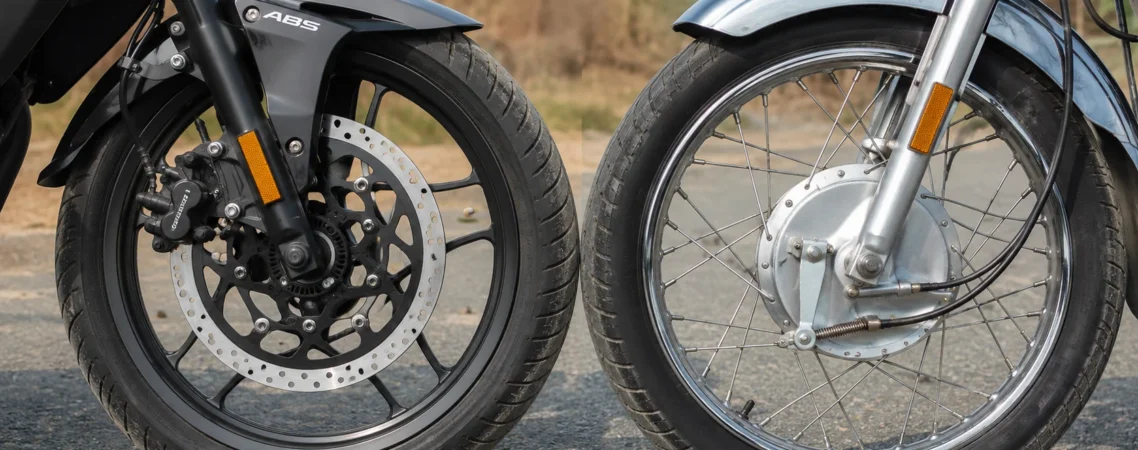
The Short Answer:
Disc brakes outperform drum brakes in stopping distance, heat dissipation, wet weather performance, and modulation. Drum brakes are simpler, cheaper to maintain on basic commuter bikes, and adequate for low-speed applications. For any motorcycle used at highway speeds or requiring confident emergency braking, disc brakes are the superior system in every measurable metric.
The disc vs drum motorcycle brakes debate sounds outdated as if it belongs in 1985 when drum brakes were still common on full-sized motorcycles. But it is not. Drum brakes remain standard on many commuter motorcycles, small-displacement learner bikes, and entry-level machines sold in the US and globally in 2026. Riders who buy these bikes, and riders considering upgrades, face a real decision that affects their safety on every ride.
Here is the complete, engineering-based comparison with no brand advocacy and no nostalgia. Browse Aliwheels’ Motorcycle Brakes category for disc brake components, brake pads, and rotors across all major makes.
How Disc Brakes Work
A disc brake system uses a rotor , a flat metal disc mounted to the wheel hub , and a caliper that clamps brake pads against the rotor surface when hydraulic pressure is applied through the master cylinder. The friction between the pads and the rotor surface converts kinetic energy to heat and slows the wheel.
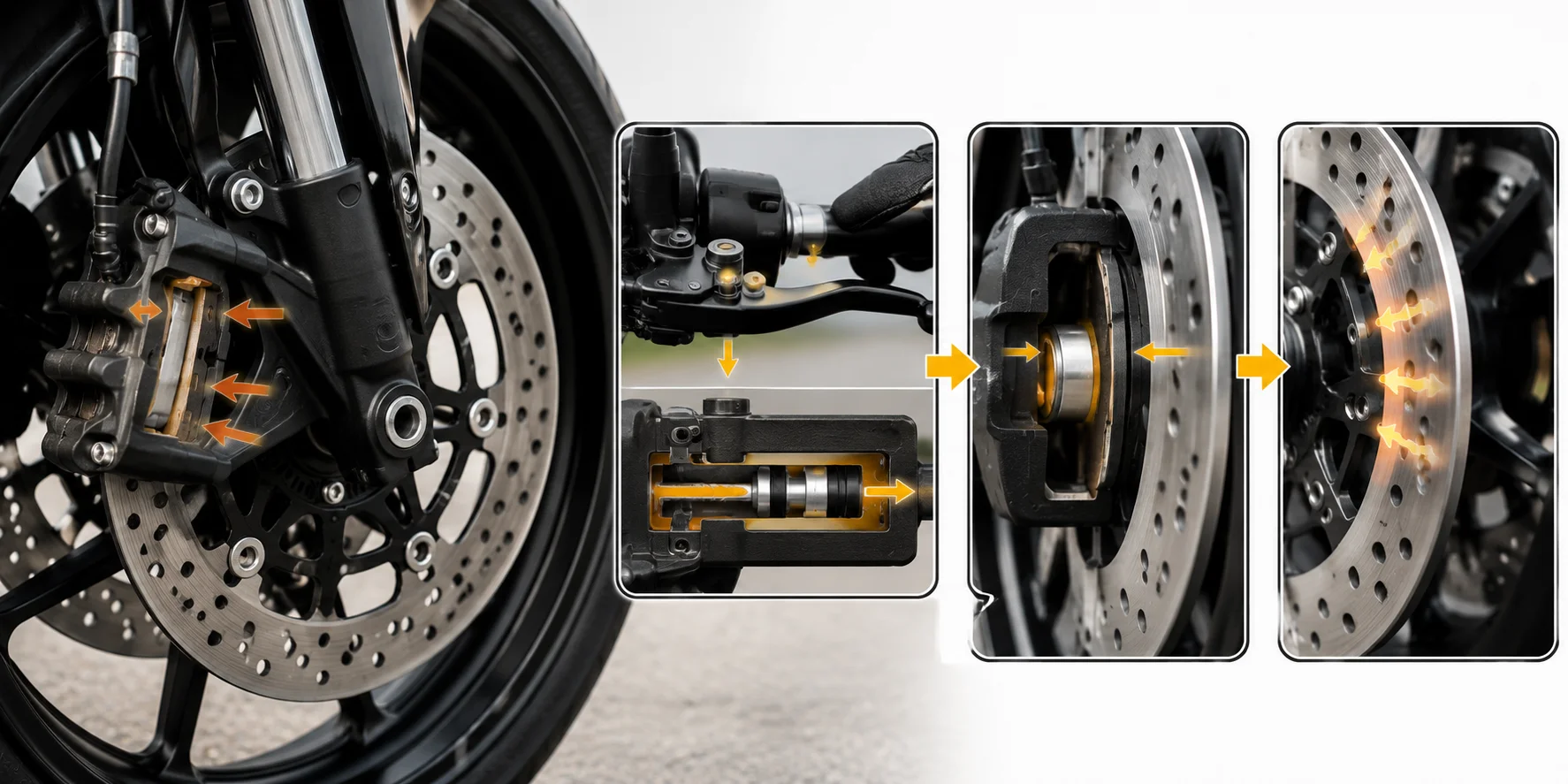
The key physics advantage of this design: the rotor is mounted outside the wheel in open air, allowing heat generated by braking to dissipate directly into the surrounding airflow. This is the fundamental reason disc brakes outperform drum brakes in sustained braking scenarios; the heat goes away rather than accumulating in the system.
How Drum Brakes Work
A drum brake system uses shoes , curved friction material blocks , that press outward against the inside of a drum mounted on the wheel. The drum rotates with the wheel. When brake force is applied, the shoes expand outward to contact the drum’s inner surface, creating friction that slows the wheel.
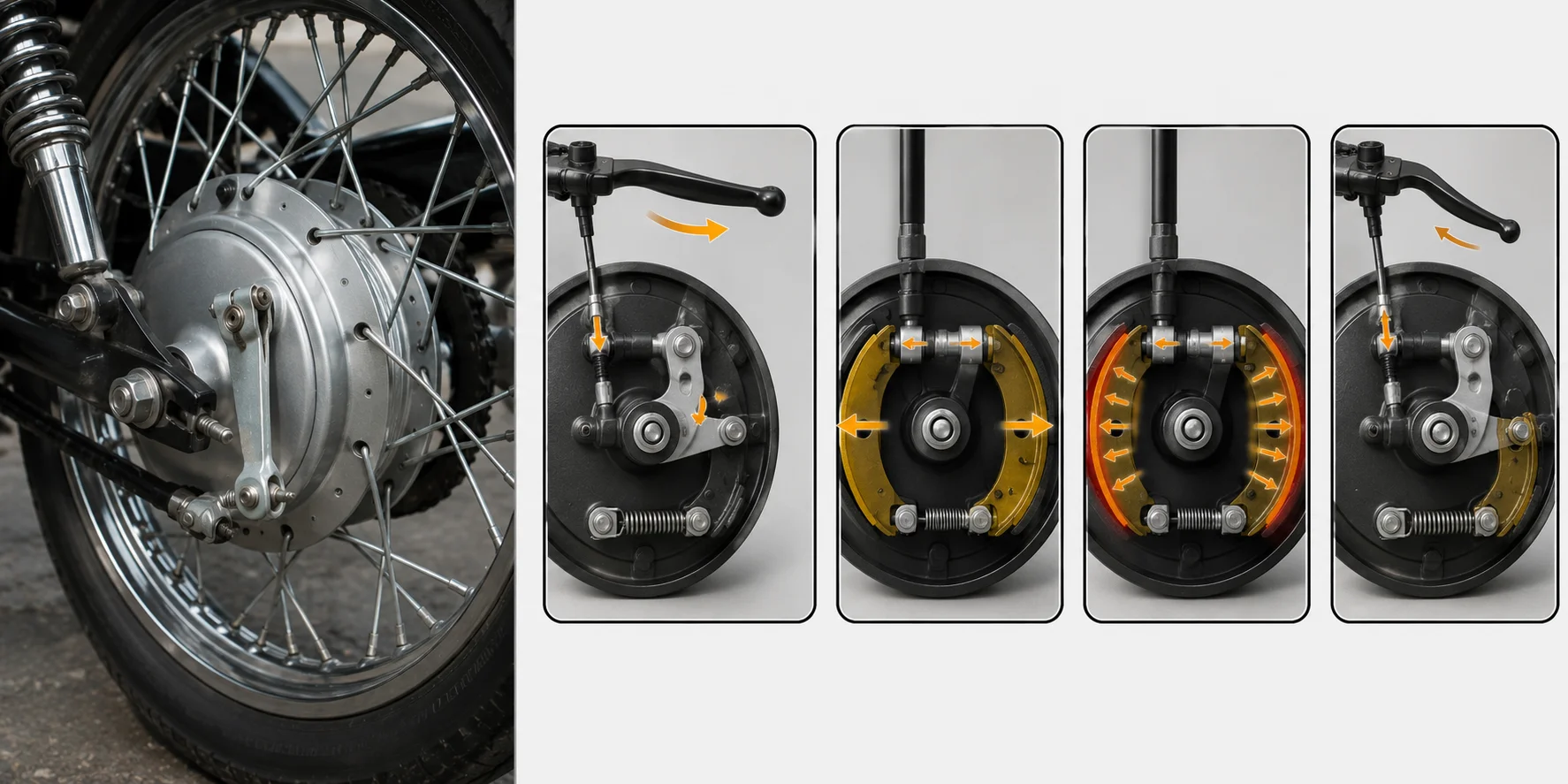
The key physics disadvantage of this design: the drum is a closed structure. Heat generated by braking is trapped inside the drum with no direct path to dissipate into surrounding airflow. This is why drum brakes fade under sustained use; the accumulated heat reduces the friction coefficient progressively until braking force drops significantly.
The Performance Comparison: Every Metric That Matters
Stopping Distance
Disc brakes consistently produce shorter stopping distances than drum brakes in independent testing across equivalent vehicle weights and speed conditions. The difference is most pronounced in:
Emergency stops from highway speed, where the initial bite of a disc system generates maximum deceleration force immediately. Drum brakes require a brief build-up period as the shoes contact the full drum surface.
Repeated stops in traffic, where the thermal advantage of disc systems maintains consistent stopping performance while drum brakes accumulate heat and fade progressively.
According to motorcycle safety research published across multiple traffic safety organisations, the braking distance advantage of disc over drum systems increases as speed increases; the systems are closer to equivalent at very low speeds and diverge significantly above 30 mph.
Heat Management and Brake Fade
This is the most important performance difference for riders who descend hills, ride in heavy traffic, or make repeated stops from speed.
Brake fade, the reduction in braking force that occurs as brake system temperature rises , is primarily a drum brake problem. The closed drum structure cannot dissipate heat at the rate it is generated under sustained braking. A driver descending a long mountain grade with drum brakes is applying heat faster than the system can release it. The result is progressively reduced braking force at exactly the moment maximum braking is needed.
Disc brakes dissipate heat directly from the exposed rotor surface into airflow. At speed, ram air across the rotor surface prevents heat accumulation under all but the most extreme racing brake scenarios. Even standard street riding generates enough airflow to maintain disc brake temperatures within their operating range.
The practical implication: a motorcycle with drum brakes on a mountain descent is genuinely less safe than the same motorcycle with disc brakes, and the safety gap increases with descent duration and grade.
Wet Weather Performance
Drum brakes are largely unaffected by light rain because the drum’s closed structure prevents water from reaching the friction surfaces. This sounds like an advantage , and in very light rain, it is.
The problem appears when the drum does get wet. Water that enters the drum through the hub area or through brake adjustment ports pools inside the drum and dramatically reduces friction between the shoe and drum surface. A wet drum brake inside provides significantly less braking force than the same brake dry , and the drum must spin many times to centrifuge the water out.
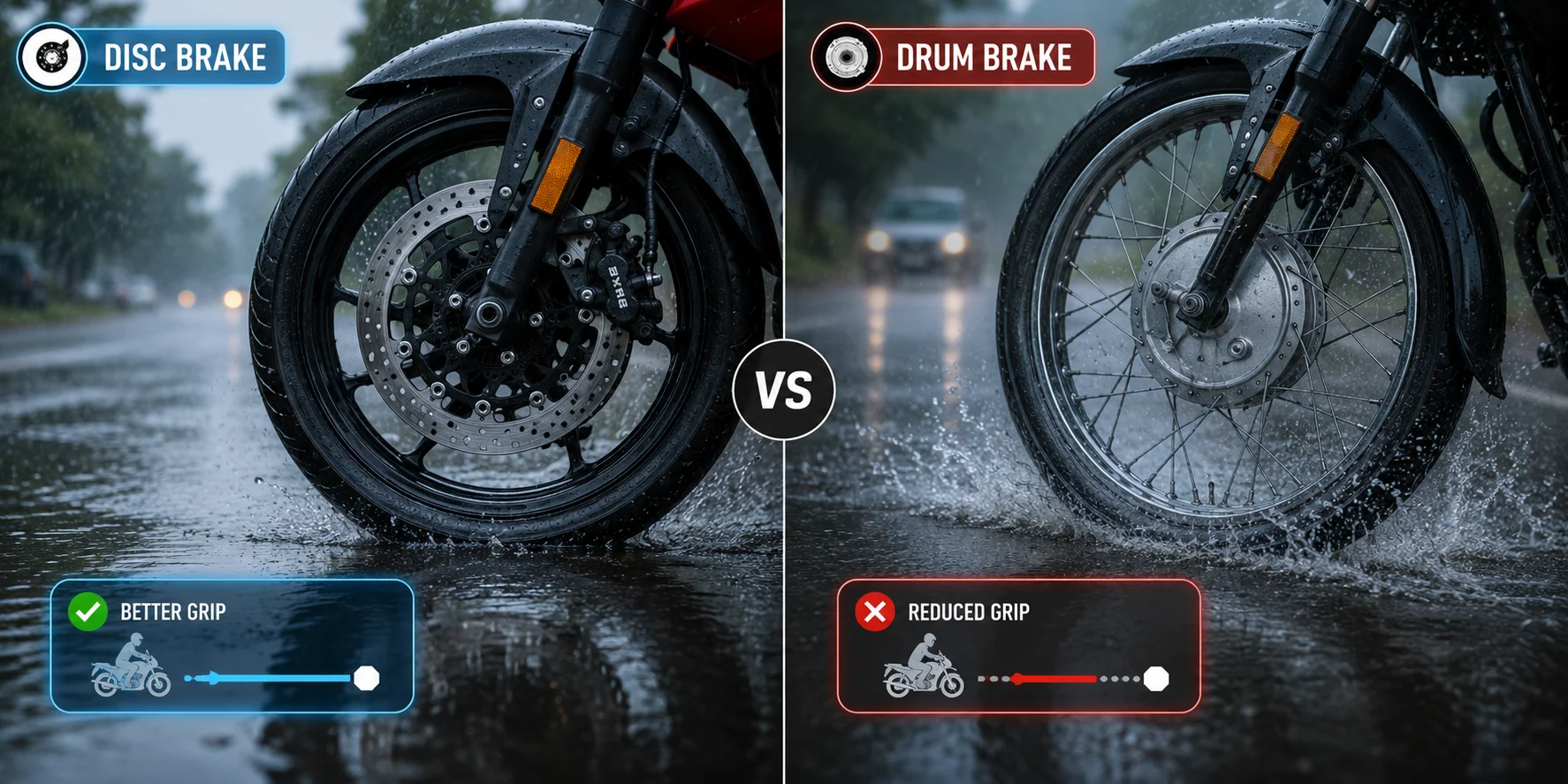
Disc brakes are affected by water in the initial moment after a large water splash because the rotor surface can aquaplane briefly. However, the exposed rotor dries almost instantly as it rotates, typically within one or two brake applications. A disc brake that has been through a puddle regains full effectiveness within seconds. A drum brake that has taken on water may take considerably longer.
For riders in wet climates- the US Pacific Northwest, the Southeast during hurricane season, any region with significant rainfall- disc brakes provide more consistent and more predictable braking performance across varying weather conditions.
Modulation and Feel
Modulation, the ability to apply exactly the right amount of braking force with precise control through the lever, is significantly better in disc brake systems with hydraulic operation.
Hydraulic disc brakes transmit hand pressure directly to clamping force at the caliper through incompressible fluid. The relationship between lever pressure and braking force is linear and predictable. A skilled rider can modulate a disc brake to exactly the threshold of tyre lock-up with practice.
Cable-operated drum brakes introduce friction in the cable, non-linearity in the shoe expansion mechanism, and a mechanical advantage ratio that is fixed rather than adjustable. The feel is less direct, and the threshold between adequate braking and lock-up is harder to sense through the lever.
Maintenance and Durability
This is where drum brakes have a genuine advantage , specifically for very basic commuter applications in controlled conditions.
Drum brake shoes last longer than disc brake pads in equivalent mileage because the shoe surface area is larger and contact pressure is lower per unit area. On a simple commuter bike used for low-speed urban riding, drum brakes may require shoe replacement at 30,000 to 50,000 miles compared to disc pads at 10,000 to 20,000 miles.
Drum brake systems have fewer components , no caliper to service, no brake fluid to change, and no rotor to inspect for minimum thickness. For very basic bikes in markets where mechanical expertise and parts availability are limited, this simplicity has genuine value.
However, this advantage is entirely contextual. On a motorcycle used at highway speeds, carrying passengers, or ridden in varied conditions, the safety advantages of disc brakes far outweigh the maintenance simplicity of drums.
When Drum Brakes Are Adequate
Drum brakes perform adequately in these specific scenarios and no others:
Low-speed urban riding below 30 mph with short stopping distances. Entry-level scooters and 50cc to 125cc commuter bikes where maximum speed is legally limited. Rear brakes on some cruiser applications where the rear brake contributes a small percentage of overall stopping force and heat generation is minimal.
For any riding that involves sustained speed above 40 mph, regular highway use, riding in varied weather conditions, or frequent emergency stop scenarios , disc brakes are the correct system.
Can You Upgrade a Drum Brake Motorcycle to Disc?
The short answer is yes, but it’s a significant engineering project rather than a simple parts swap. A drum-to-disc conversion requires a different wheel hub to accept a rotor mount, a brake caliper and mounting bracket, a master cylinder and hydraulic line, and integration with the existing controls.
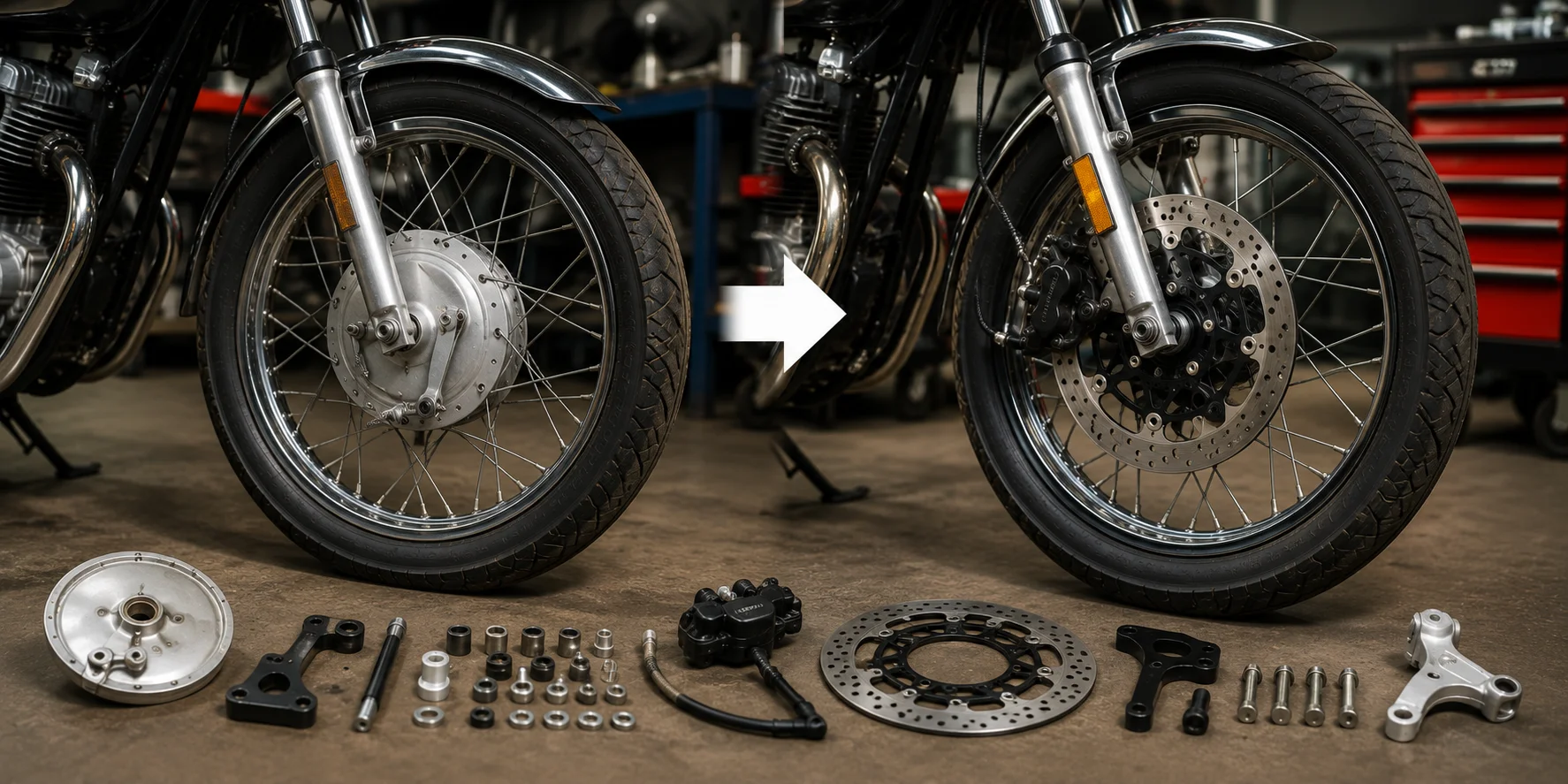
For motorcycles where aftermarket conversion kits are available from established suppliers, this is a viable upgrade. While unusual or low-volume models, the fabrication required makes it a specialist job.
For most riders on drum-brake equipped bikes, the more practical decision is whether to continue riding the current bike or to select a disc-brake equipped model when upgrading. Browse Aliwheels‘ Motorcycle Brakes category for disc brake components including rotors, calipers, brake pads, and brake lines for the most popular disc-brake equipped motorcycles. For related maintenance parts across all makes, browse Motorcycle Parts.
The Verdict: Which System Is Actually Better?
| Metric | Disc Brakes | Drum Brakes |
| Stopping distance | Shorter, significantly at speed | Longer, gap increases with speed |
| Heat dissipation | Excellent, open rotor in airflow | Poor, closed system traps heat |
| Brake fade | Minimal in street conditions | Significant under sustained braking |
| Wet weather | Brief initial contact fade, recovers instantly | Consistent initially, significant fade if water enters |
| Modulation and feel | Excellent, hydraulic precision | Moderate, cable/mechanical limitations |
| Maintenance frequency | Higher, pads wear faster | Lower, shoes last longer |
| Maintenance complexity | Moderate, fluid changes, rotor inspection | Simple, shoe inspection only |
| Best application | Highway, varied conditions, any speed | Low-speed urban, basic commuter |
Conclusion
Disc brakes are superior to drum brakes in every performance metric that affects safety at realistic riding speeds and conditions. The stopping distance advantage, heat management, wet weather consistency, and modulation quality all favour disc systems for any motorcycle used beyond basic urban low-speed commuting.
Drum brakes have a place on very basic low-speed commuters where simplicity and maintenance accessibility justify the performance trade-off. For any other application, if you have the choice between a disc-equipped and drum-equipped motorcycle, choose disc every time.
Frequently Asked Questions
Q: Are drum brakes dangerous on motorcycles?
A: Drum brakes are not inherently dangerous at low speeds and in controlled urban conditions. However, they become progressively less adequate as speed increases, as conditions vary, and as sustained braking generates heat. At highway speeds and in emergency braking scenarios, drum brakes’ longer stopping distances and fade susceptibility represent a meaningful safety disadvantage compared to disc systems.
Q: Why do some motorcycles still use drum brakes?
A: Cost. Drum brakes are significantly cheaper to manufacture and fit than hydraulic disc systems. For entry-level scooters and commuter bikes where price is the primary purchase driver and top speed is limited, drum brakes represent an acceptable cost-performance trade-off. For any motorcycle designed for highway use or performance riding, disc brakes are now universal.
Q: Can you lock up a disc brake more easily than a drum brake?
A: Without ABS, disc brakes can be locked with less hand pressure than drum brakes because of their superior modulation; the power is more immediately available. However, ABS (Anti-lock Braking System) is now standard on most mid-range and above motorcycles globally and eliminates wheel lock regardless of brake type. On non-ABS bikes, disc brakes require more throttle-to-lock management than drums but provide more usable braking force before the lock point is reached.
Q: Is it worth upgrading from drum to disc brakes on a motorcycle?
A: If a conversion kit is available for your specific model from a reputable supplier, and the cost is justified by how you use the bike, yes. For commuter bikes used only in low-speed urban conditions, the performance benefit may not justify the conversion cost. For bikes used at highway speeds or in varied conditions, the safety improvement is significant enough to justify the investment.
Q: Do disc brakes require more maintenance than drum brakes?
A: Yes, in terms of frequency. Disc brake pads wear faster than drum shoes because they operate at higher friction intensity per unit area. Disc brake systems also require periodic brake fluid changes, typically every two years , because hydraulic fluid absorbs moisture over time and reduces boiling point. Drum brakes require shoe inspection and adjustment but no fluid changes. The maintenance trade-off is real but the performance advantage of disc systems makes it worthwhile for most riders.