



Your R6’s dash lights start dimming. The horn gets weaker. Then the tach drops to zero, and the bike just dies, mid-ride, for no obvious reason. If you own a 1999-2002 R6, this isn’t a random fluke. It’s one of the most consistently documented problems on the entire platform, and it’s been discussed on dedicated Yamaha R6 forums for over two decades.
A Design Weak Point Yamaha Never Fully Solved on Early Models
First-generation Yamaha R6 owners report the same failure pattern repeatedly: weak or overheating wiring between the stator and voltage regulator, wires and connectors that melt, corrode, or work loose over time, and a charging system that gradually stops keeping the battery topped up. One published breakdown of common Yamaha R6 issues lists this specifically as a defining problem of early models, alongside gearbox jerkiness and a front sprocket nut prone to loosening on 1999-2006 bikes.
The mechanism is straightforward once you understand it. The stator generates AC, a lot of it, and pushes it through wiring and connectors to the regulator/rectifier, which converts it to clean DC power for your battery. High current through a marginal connection generates heat. Heat degrades insulation and solder joints. Degraded connections generate more heat. It’s a feedback loop that eventually ends with melted wiring, a fried regulator, or both.
Riders’ Insights: What Owners Actually Experienced
One owner’s dash indicator light barely lit up while riding at night, then the bike started sputtering, the speedometer went blank, the tach dropped to zero, and the engine died completely. He described it as the bike “sucking all the juice,” with the horn failing and dash lights dimming before the final shutdown.
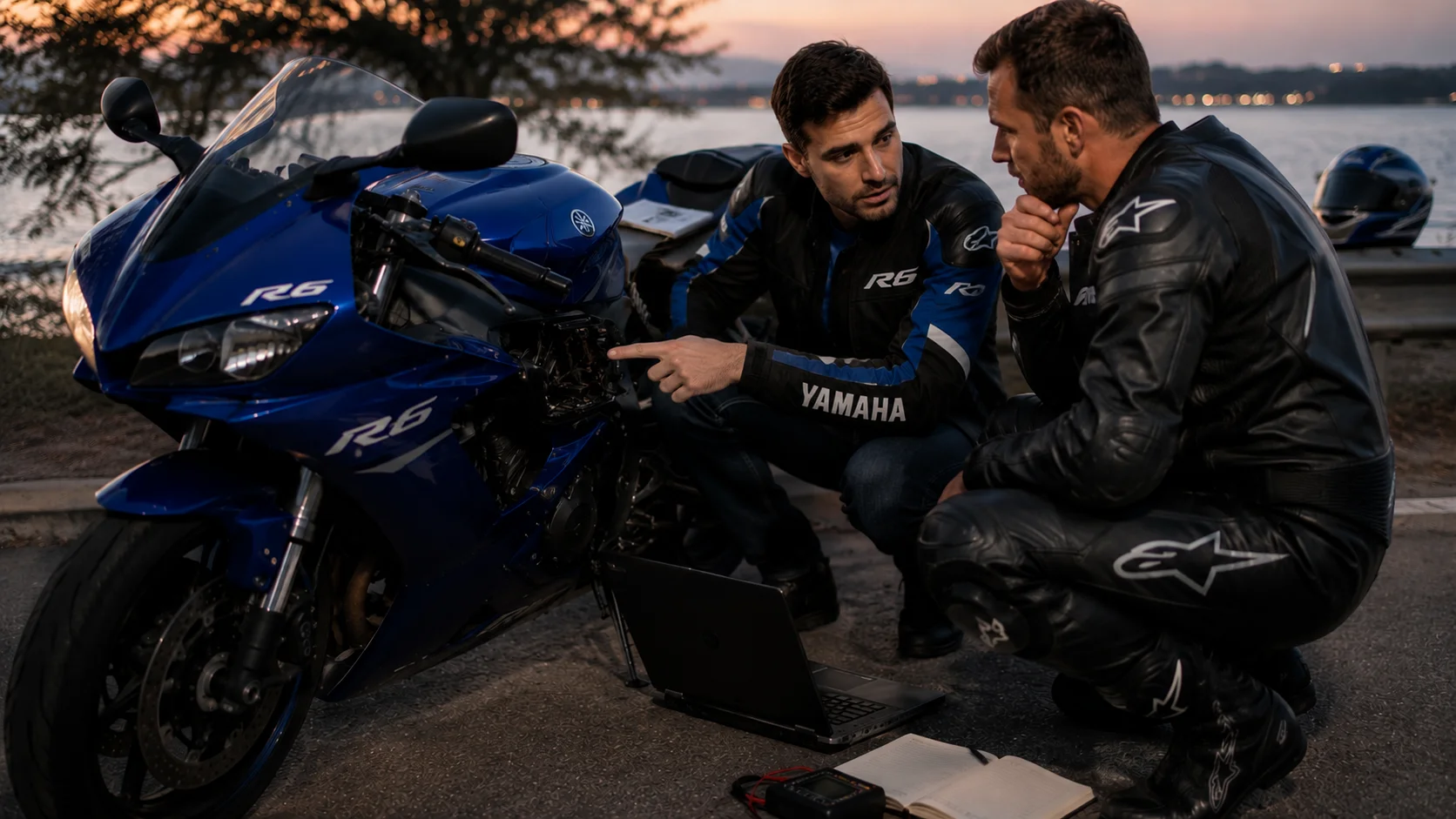
Another common pattern involves a bike that seems to charge fine at idle but loses voltage as RPM climbs, exactly backward from how a healthy system should behave. If your battery reads reasonable at a stop but your electronics get weaker the harder you ride, that’s a strong signal your regulator or stator connections are struggling under load.
How Owners Test This
The Yamaha R6 forum community has refined a consistent testing method over years of troubleshooting.
Start at the battery. With the engine off, you should see roughly 12.6 to 13.5 volts. Start the bike and check again at idle. Then rev to around 5,000 rpm and check once more. A healthy system should climb to somewhere between 14.0 and 14.5 volts and hold steady there. If voltage doesn’t rise at all from idle, your stator is the likely culprit. If it climbs past 15 volts, your regulator/rectifier has failed and is overcharging, which is just as damaging as undercharging.
To test the stator directly, disconnect it and set your multimeter to AC volts, not DC, since the stator outputs alternating current before the regulator converts it. Check across the three stator wire combinations. You’re looking for roughly 50 volts AC at higher RPM in each pairing. If one combination reads significantly lower or zero, that phase of the stator has likely failed.
For the regulator/rectifier, check continuity across the input and output wires with the engine off, testing both positive and negative connections. A regulator with broken continuity in one of these paths isn’t converting power correctly, regardless of how healthy your stator is.
One important habit worth adopting: test with a fully charged, known-good battery first. More than one owner chased a “bad charging system” for hours only to discover the battery itself was the actual problem, testing fine at rest but failing under real load.
Are Connectors Important as Much as the Parts?
Experienced Yamaha R6 owners always warn that stators and rectifiers fail a lot because of a problem elsewhere and not as the original cause. Any of these will cause a healthy stator to fail prematurely. Bad or corroded connections, an aging battery that makes the system work harder, or aftermarket electrical accessories that overload the charging capacity. That is why sometimes replacing parts without fixing the root cause ( connection quality ) doesn’t work later on.
If you’re fixing a failed charging system, use quality wiring and connectors for any repairs. And consider adding dielectric grease at connector points to reduce the risk of future corrosion.
OEM Versus Aftermarket Replacement Parts
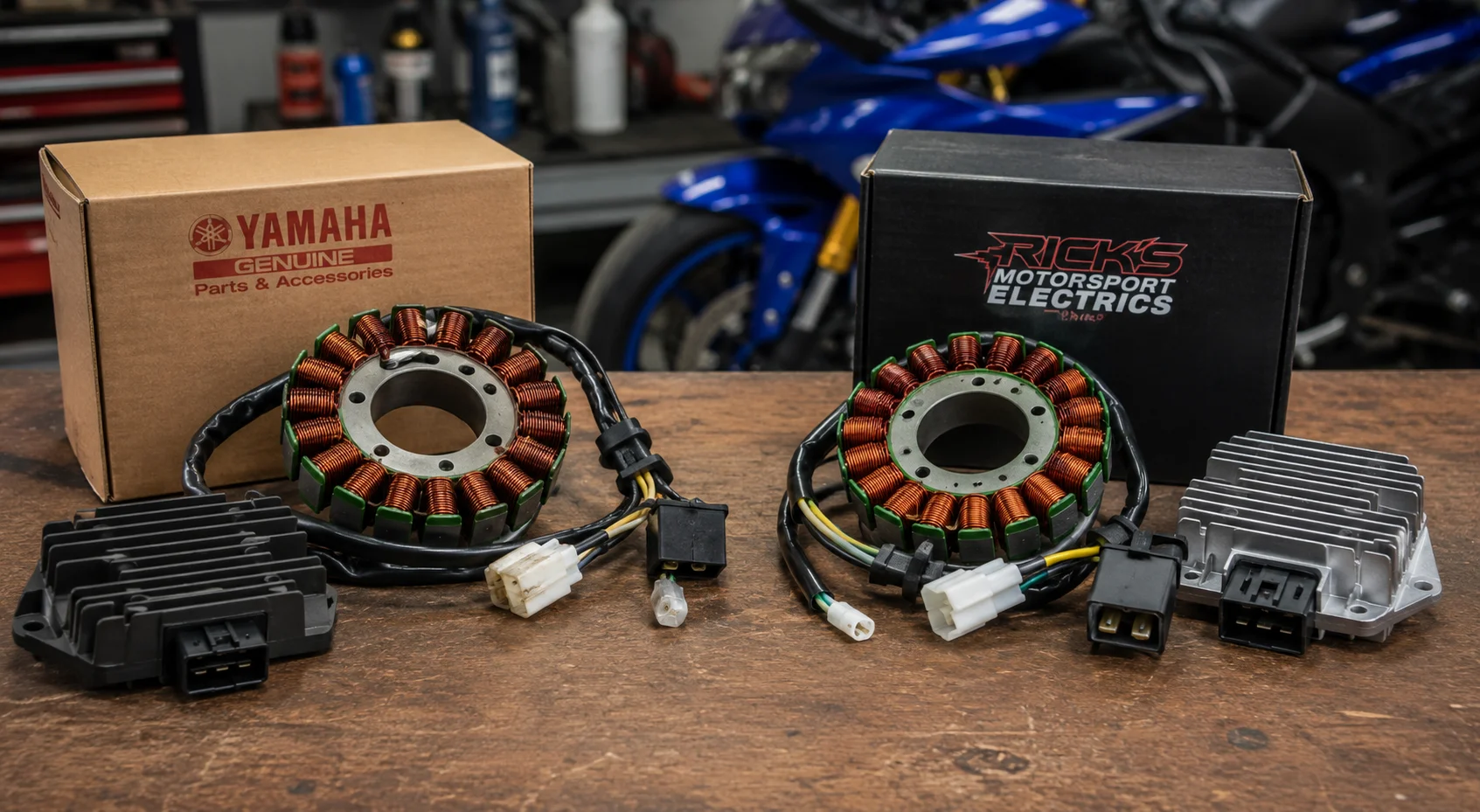
This is a genuinely debated topic among Yamaha R6 owners. Multiple experienced voices on the forums specifically recommend Rick’s Motorsport Electrics as the one aftermarket stator brand that performs close to OEM quality, while cautioning against cheaper generic alternatives. The consensus isn’t that OEM is broken; it’s that stators and rectifiers typically fail as a downstream symptom of connection or battery issues rather than inherent part weakness, which means a quality replacement, OEM or a trusted aftermarket equivalent, resolves the problem reliably as long as the underlying cause gets addressed too.
Browse Yamaha R6 Parts at Aliwheels
Aliwheels lists a confirmed Yamaha YZF-Yamaha R6 Fuel Pump for 1999-2002, covering the exact first-generation years discussed throughout this guide, along with additional fitment-matched components across later model years including a Speedometer for 2008-2016, an Oil Filter for 2006-2020, and an Engine Crankcase for 2003-2019.
Frequently Asked Questions
Why does my first-generation R6’s charging system keep failing?
Early Yamaha R6 models are known for stator and regulator/rectifier connections that overheat under the high current these components carry, gradually degrading wiring and connectors until the charging system fails.
How do I know if it’s the stator or the regulator that’s bad?
Test at the battery with the engine running at around 5,000 rpm. Voltage that doesn’t rise from idle points to the stator. Voltage climbing past 15 volts points to a failed regulator/rectifier.
Should I test my stator with the AC or DC setting on my multimeter?
AC. The stator produces alternating current before the regulator converts it to DC, so testing on DC will give you inaccurate readings.
Is it normal for the battery to seem fine but the charging system to still be bad?
Yes. A battery can test acceptable at rest but still be part of the problem under load, and a struggling charging system often shows up first as symptoms elsewhere, dimming lights, a weakening horn, before the battery itself reads low.
Should I buy OEM or aftermarket replacement parts?
Experienced owners specifically recommend Rick’s Motorsport Electrics as a trustworthy aftermarket option close to OEM quality, while cautioning against unbranded budget alternatives.
Browse our full Yamaha motorcycle parts collection for fitment-matched components across the YZF-Yamaha R6 lineup.