


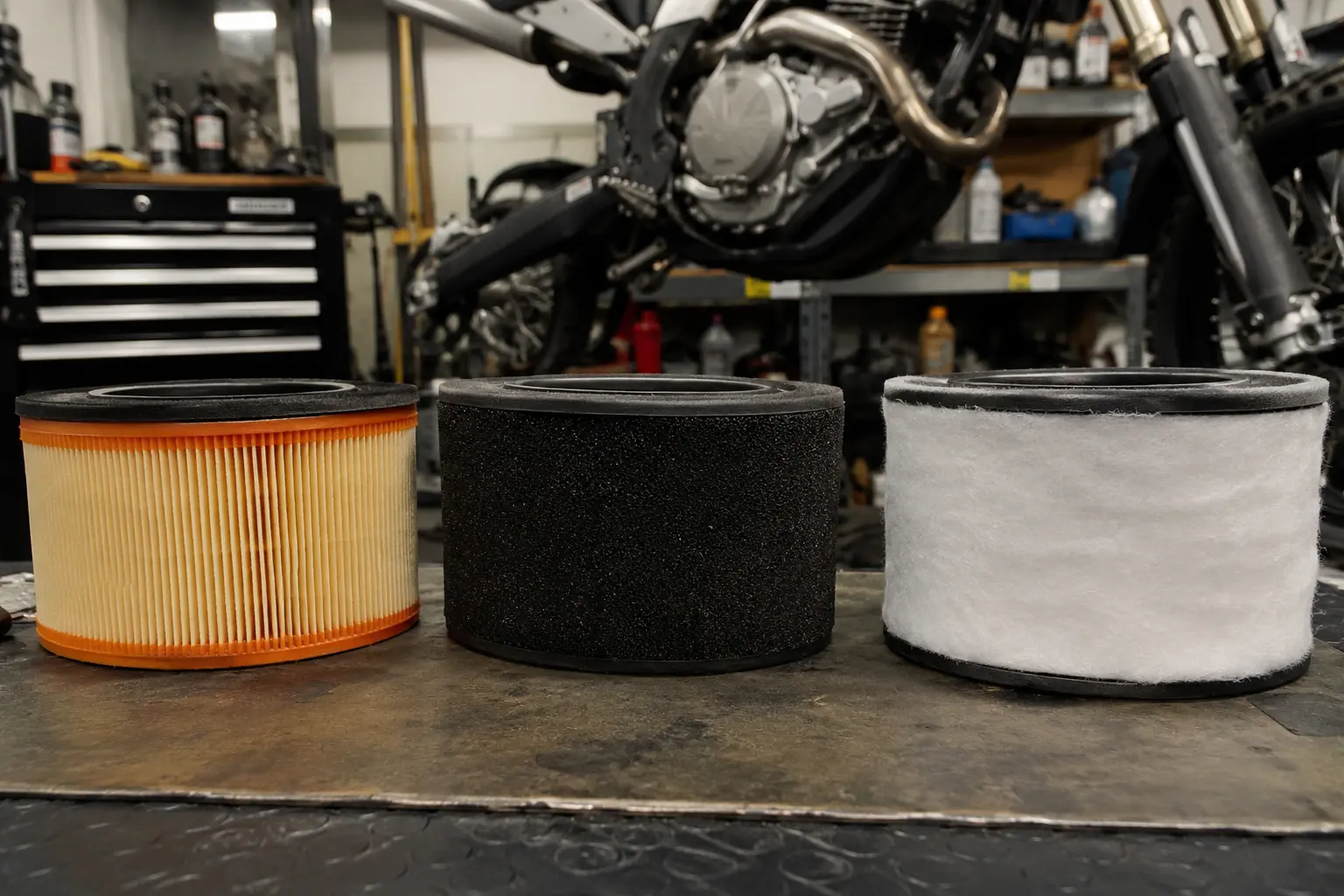

Your motorcycle sucks in air with every combustion cycle. At highway speed, a 600cc engine pulls in thousands of cubic feet of air per hour. Every particle of dust, pollen, and debris in that air hits your air filter before it hits your engine.
The filter you choose determines how clean that air is, how freely it flows, and how often you are pulling it out for cleaning or replacement. Those three factors directly affect engine performance, long-term reliability, and your maintenance schedule.
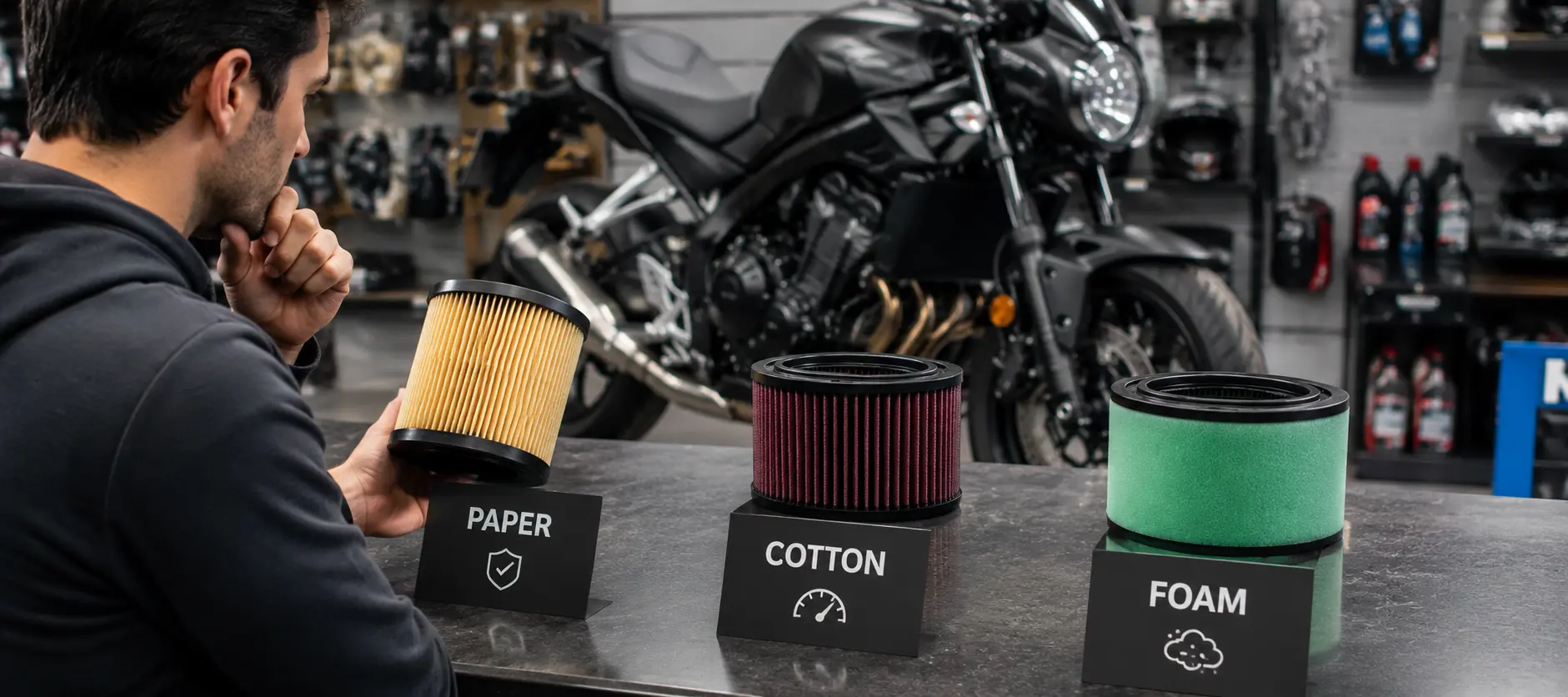
There are three types every US motorcycle owner encounters: paper, foam, and cotton gauze. Here is the honest comparison. Browse Aliwheels’ full range of Motorcycle Air Filters after reading to find the right type for your riding style.
The Three Motorcycle Air Filter Types: What Each One Actually Is
Paper / Cellulose Filters (Stock / OEM Style)
The filter that came with your bike is almost certainly a pleated paper or cellulose element. The accordion-style pleating maximizes surface area in a compact package. These filters are dry. Mo oil required, and they are designed as single-use, disposable components.
Foam Filters
Foam filters use open-cell polyurethane foam as the filtration medium. They are reusable, require periodic cleaning and re-oiling, and are particularly common on off-road and dual-sport bikes where dusty conditions demand frequent filter cleaning rather than replacement.
Cotton Gauze Filters (Performance Style)
Cotton gauze filters like those made by K&N use multiple layers of oiled cotton gauze between wire mesh frames. They offer higher airflow than paper elements and are designed to be cleaned and re-oiled rather than replaced. They are reusable for the life of the bike when maintained correctly.
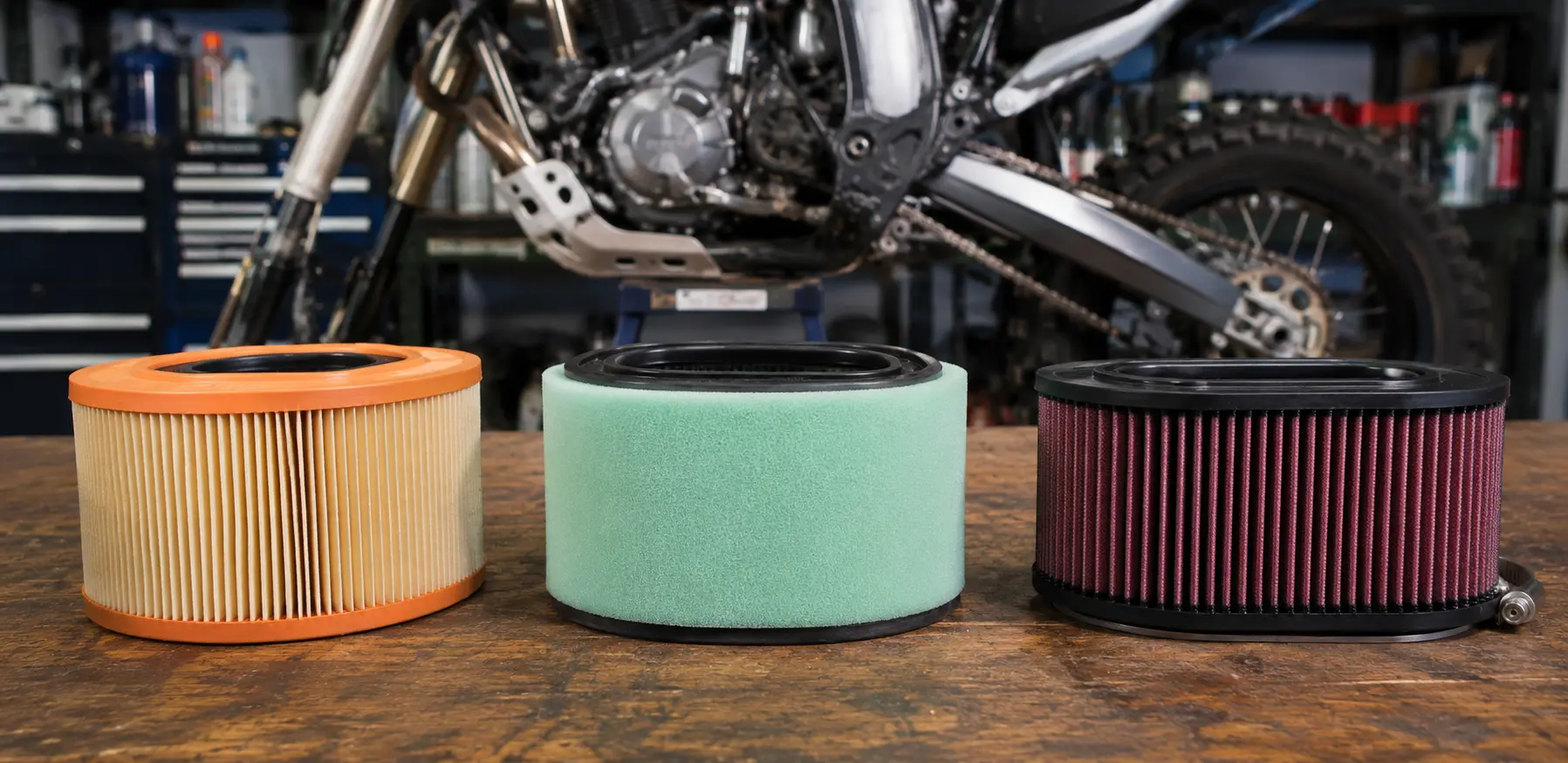
Head-to-Head Comparison: Paper vs Foam vs Cotton Air Filter for Motorcycles
| Factor | Paper / OEM | Foam | Cotton Gauze |
| Filtration efficiency | Excellent — traps finest particles | Good — depends on pore size | Very good — oiled cotton captures fine particles |
| Airflow / performance | Standard OEM flow | High flow — good for off-road | Highest flow — performance gains possible |
| Lifespan | Single use — replace at interval | Reusable with cleaning | Reusable for bike lifetime |
| Maintenance required | None — just replace | Clean + re-oil every 5-15K miles | Clean and re-oil every 15-25K miles |
| Cost over 5 years | Lowest per unit, multiple purchases | Moderate — ongoing oil costs | Higher upfront, lowest long-term |
| Best conditions | Street, urban, clean environments | Off-road, dusty, wet trails | Street, highway, performance builds |
| Risk of over-oiling | None | Moderate — foam absorbs too much oil | Yes — excess oil contaminates MAF sensor on FI bikes |
| OEM compatibility | Direct replacement | Requires correct foam spec | Check MAF sensor compatibility on FI bikes |
Paper Air Filters: When They Are the Right Choice
For the majority of US street riders, commuters, weekend cruisers, and highway tourers, the stock paper filter is genuinely the correct choice. It filters most finely, requires zero maintenance between replacements, and never creates the over-oiling risk that can contaminate mass airflow sensors on fuel-injected bikes.
The criticism that paper filters restrict airflow is accurate but largely irrelevant for stock engines. Harley-Davidson, Honda, Kawasaki, and others tune their fuel maps and exhaust systems around the OEM filter’s flow characteristics. Swapping to a higher-flow filter on a stock engine without retuning the fuel map often makes things worse, not better.
| Real talk: On a stock, street-ridden motorcycle with no other modifications, the paper filter replacement at the OEM service interval is the highest-value choice. Save the performance filter upgrade for when the rest of the system is ready for it. |
Foam Air Filters: Built for Dirt, Not Pavement
Foam filters dominate the off-road world for good reason. They can be pulled out mid-ride, cleaned in minutes with filter cleaning solution, and re-oiled quickly. In dusty desert racing or muddy trail conditions where paper filters would clog and destroy themselves in a single session, foam filters are the practical choice.
On a street bike, foam filters are less compelling. The filtration is not as fine as a good paper filter, the maintenance schedule is more involved, and there is limited performance benefit on a carbureted or stock FI engine. Where foam makes sense on a street bike is on older carbureted singles and twins ridden in dusty environments where the rider prefers to clean rather than replace.
Cotton Gauze Performance Filters: The Real Story
The performance air filter market is dominated by brands like K&N, and for good reason — cotton gauze filters offer measurably higher airflow than paper elements. On a modified engine with an aftermarket exhaust and a retuned fuel map, a performance air filter is part of a complete package that genuinely improves power output.
However, two things are frequently misunderstood about cotton gauze filters on motorcycles.
First, the performance gain on a completely stock engine is minimal. According to technical discussions on ADVrider and Harley-Davidson forums, riders who swap to a performance filter without any other modifications rarely see measurable dyno gains. The factory air box and fuel map are designed around the stock filter’s flow rate.
Second, over-oiling is a genuine risk on fuel-injected motorcycles. Too much filter oil reaches the mass airflow sensor and causes rich running conditions, poor idle, and in severe cases, MAF sensor failure. If you install a cotton gauze filter on a fuel-injected motorcycle, apply oil conservatively and allow it to distribute evenly before installation.
Which Motorcycle Air Filter Should You Actually Buy?
| Your Situation | Best Choice | Why |
| Stock street bike, mostly city and highway | Paper OEM replacement | Finest filtration, zero maintenance complexity, correct for factory tune |
| Off-road, dual sport, dusty conditions | Foam filter | Easy to clean mid-ride, handles debris-heavy environments |
| Modified engine with exhaust and fuel tune | Cotton gauze performance | Higher flow matches modified breathing requirements |
| FI bike, performance upgrade on a budget | Paper first — upgrade when tuning | Risk of MAF contamination not worth it without full tune |
| High mileage bike, original filter unknown age | Paper replacement now | Clean baseline before deciding on upgrades |
For riders also looking at carburetor and fuel system components, browse the full Air and Fuel category at Aliwheels. And for all Motorcycle Parts needs, the support team confirms fitment 24/7 before your order ships.
Conclusion
Paper filters win for street riders on stock bikes. Foam wins for off-road riders who need quick maintenance. Cotton gauze wins for modified engines with supporting upgrades. There is no universal best, only the right filter for your specific bike, your riding conditions, and what else has been done to your engine.
The worst choice is buying any filter that physically fits without confirming it matches your engine’s specifications and your riding setup. The best choice is a certified replacement sourced by your exact make, model, and year, which is exactly how Aliwheels’ air filter category page is organized.
Frequently Asked Questions
Q: Will a K&N air filter add horsepower to my stock motorcycle?
A: On a completely stock motorcycle, the power gain from a cotton gauze filter alone is minimal and often unmeasurable on a dyno. Real performance gains from an air filter happen when it is part of a complete package including an aftermarket exhaust and a retuned fuel map. Without supporting modifications, the factory fuel map limits what a higher-flow filter can actually deliver.
Q: Can I clean a paper motorcycle air filter instead of replacing it?
A: Paper and cellulose filters are single-use components. Attempting to clean them with compressed air or cleaning solvents degrades the filter media and reduces filtration efficiency. The correct approach is replacement at the manufacturer’s recommended interval, or earlier in dusty environments.
Q: How often should I clean a foam motorcycle air filter?
A: Under normal off-road conditions, foam filters typically need cleaning every 5 to 15 riding hours or whenever visible dirt buildup appears. On a street bike in clean conditions, cleaning every 5,000 to 10,000 miles is typical. Always re-oil after cleaning with the correct foam filter oil.
Q: My fuel-injected bike runs rough after I installed a performance air filter. What is wrong?
A: The most likely cause is over-oiling the cotton gauze filter. Excess filter oil reaches the mass airflow sensor and causes the fuel system to read incorrect air volumes, resulting in rich running, rough idle, and hesitation. Remove the filter, clean the MAF sensor with electrical contact cleaner, allow it to dry, and reinstall the filter with less oil applied.
Q: Does the air filter brand matter if the dimensions are the same?
A: Yes, significantly. Dimensions determine whether it fits the airbox. The filter media, micron rating, and oiling specification determine whether it actually protects your engine and flows correctly for your setup. Always buy from a supplier with published specifications for your exact model.