






The Kawasaki Ninja range is engineered for optimum performance. The riding position reflects that. Bars are low relative to the seat. Weight goes forward. The aggressive crouch is part of what makes the Ninja feel alive.
But for riders who commute daily, cover long distances, or have any wrist, shoulder, or back sensitivity, that forward-biased position becomes genuinely fatiguing within an hour. And unlike seat or suspension issues, handlebar position affects every single minute of every ride, specifically, from the entry-level 500 through to the 650 and beyond
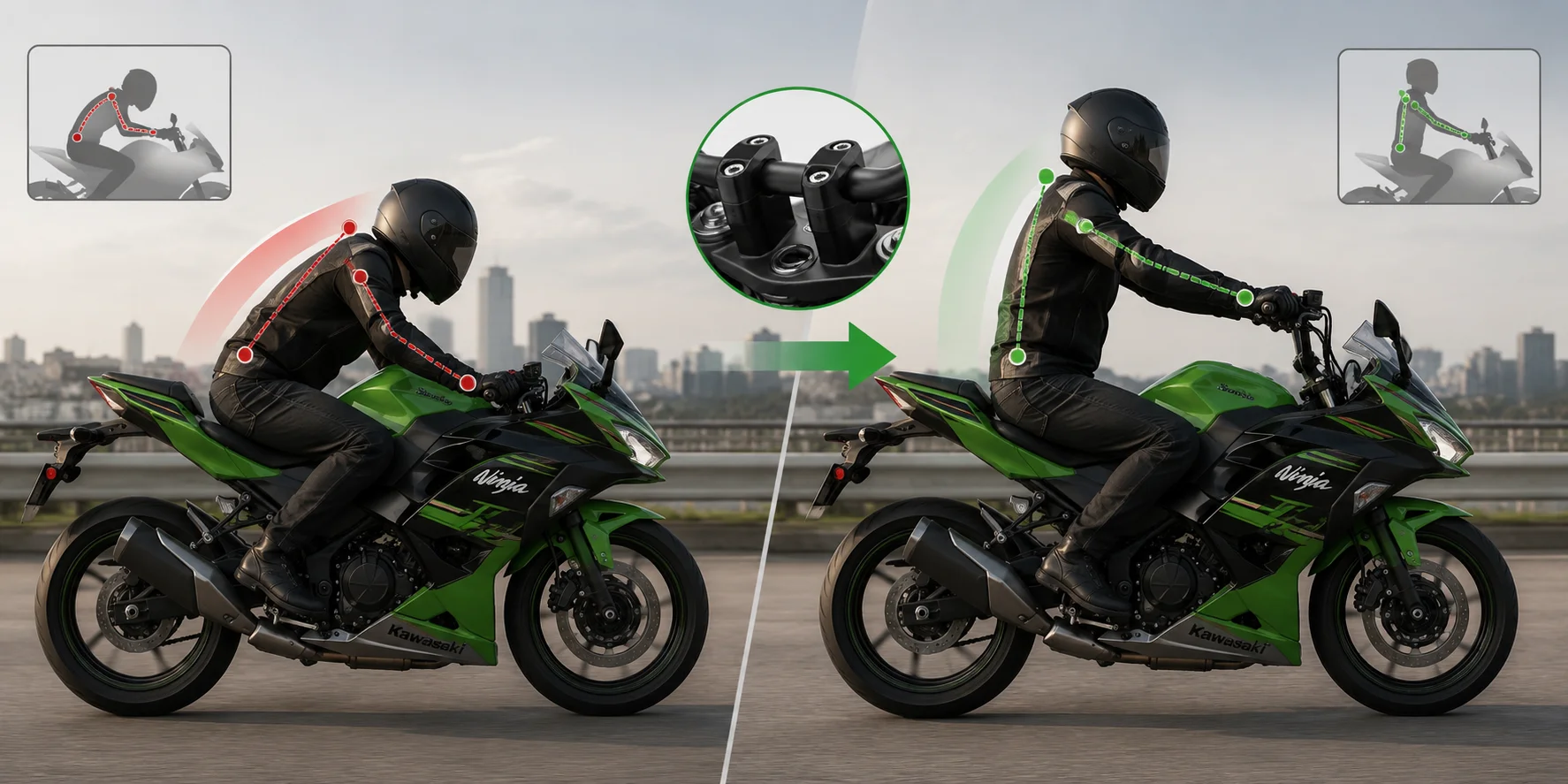
A handlebar riser changes the geometry by raising the bar height and bringing the bars closer to the rider. The result is a more upright position, reduced weight on the wrists, and significantly less upper body fatigue on longer rides. It does not transform the Ninja into a cruiser. It makes it liveable for real-world riding distances.
Browse Aliwheels‘ Kawasaki Ninja handlebar risers in the Kawasaki Motorcycle Parts and Motorcycle Handlebars categories, and for the full range, browse Motorcycle Parts.
How Do Handlebar Risers Affect the Ninja’s Riding Position?
The standard Kawasaki Ninja handlebar position requires the rider to reach forward and down to reach the bars. This puts sustained tension in the wrists, forearms, shoulders, and upper back to support the upper body’s weight partially transferred through the arms.
A riser raises the clamp point where the bars mount to the top clamp. A 20 mm rise typically reduces forward lean by several degrees. Enough to transfer meaningful weight back to the seat and away from the wrists. Most Ninja riders report immediate wrist pressure reduction and reduced shoulder and upper back fatigue within the first ride after installation.
The secondary effect is on controlling weight. With less body weight supported through the arms, you ride the bars with your hands rather than leaning on them. Counter-steering inputs become lighter and more precise because your arms are not simultaneously holding up your upper body.
According to Kawasaki Ninja owner forums, including Ninja650.org and KawiForums, handlebar risers are among the top five most commonly recommended comfort modifications for any Ninja model used for commuting or longer-distance riding.
Riser Height: How Much Rise Do You Actually Need?
This is the question most buyers get wrong because they assume more is always better. It is not.
Too little rise, 10 mm, provides minimal comfort improvement on a bike with a genuinely aggressive stock position. Most riders feel little difference.
The sweet spot for most Ninja riders is 20 to 30mm of rise. This meaningfully reduces forward lean and wrist pressure without significantly altering the bike’s handling character or creating awkward bar-to-body proportions.
Too much rise, 40 mm or more, can move the bars past the point where the OEM cables, brake lines, and wiring have sufficient length to accommodate the changed geometry. Over-length brake cables that become slack reduce braking feel. Tight cables that pull at full lock create dangerous steering resistance.
Before finalizing riser height, check your existing cable and brake line lengths with the risers fitted but not permanently secured. Turn the bars to full lock in both directions. All cables, brake lines, and wiring must have enough slack to complete full lock travel without tension. If they do not, extended cables or brake lines must be sourced at the same time as the risers.
Clamp Diameter: Getting This Right
Kawasaki Ninja handlebars use a standard 22mm (7/8 inch) bar diameter across the Ninja 250, 300, 400, 500, and 650 models. Risers must match this diameter exactly at the clamp point.
Some risers are designed for the 28.6mm (1-1/8 inch) diameter used on larger naked bikes and ADV machines. These will not clamp correctly on Ninja bars. Confirm the clamp diameter specification before ordering any riser.
Installation: What the Job Requires
Installing handlebar risers on the Kawasaki Ninja range is an intermediate DIY task. You do not need specialist tools beyond a metric socket set and a torque wrench.
Remove the original top clamp bolts that secure the handlebar to the top triple clamp. Most Ninjas use two bolts per side.
If the riser replaces the OEM bar clamp, install the riser in place of the clamp. If it is a riser that fits over the existing clamp, position it correctly before reinstalling the bar.
Loosely refit the handlebar to allow position adjustment.
Sit on the bike in your riding position and adjust bar height and sweep angle before final torquing. Small adjustments in bar angle make significant differences in wrist angle at the grip.
Check full lock in both directions for cable and line clearance as described above.
Torque all fasteners to specification using thread locker on the riser-mounting bolts. Typical Ninja handlebar clamp torque is 20 to 25 Nm; check your service manual for the exact figure.
Step 7: Road-test at low speed before any highway riding to confirm that the bar position feels correct and that the steering is unaffected.
What About Clip-On Risers vs. Full Replacement Risers?
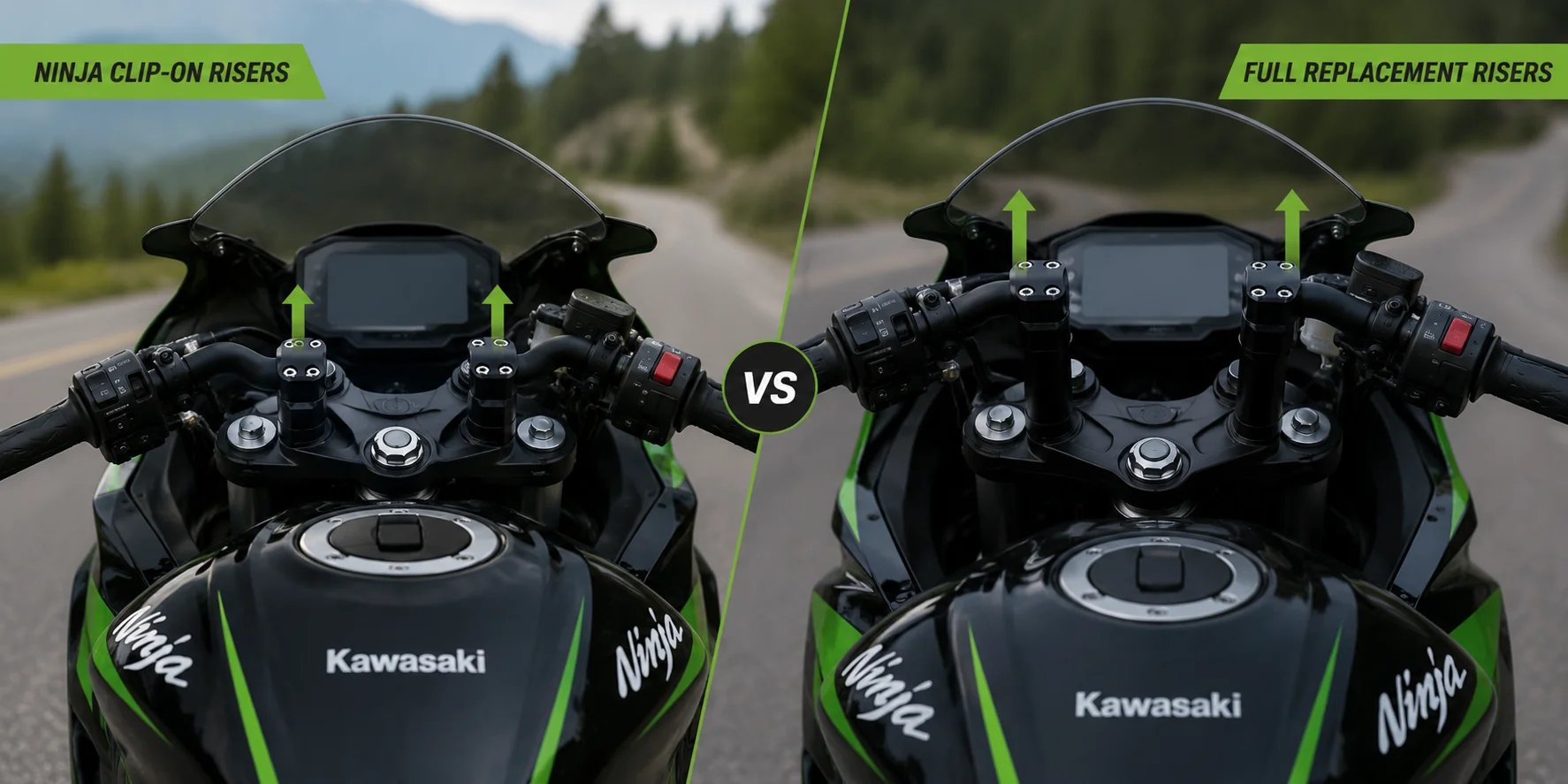
Clip-on risers that attach to the existing top clamp provide the simplest installation path. They add height without requiring disassembly of the upper triple clamp area. The trade-off is that their load capacity is lower than a full replacement riser, and some designs have more flex under hard braking loads.
Full replacement risers replace the OEM handlebar clamp entirely with a unit incorporating the rise. These are stronger and more precise but require slightly more involved installation.
For comfort-oriented Ninja riders doing predominantly street and touring riding, clip-on risers in the 20-30mm range are the practical choice. For riders who push the bike hard or track day regularly, a quality full replacement riser with an appropriate clamp design is the better investment.
Related reading: How to Stop Vibrations in Motorcycle Handlebars with the Right Grips on the Aliwheels blog.
Conclusion
A Kawasaki Ninja handlebar riser is one of the most effective and reversible ergonomic upgrades available for any Ninja model. The improvement in wrist and upper body fatigue is immediate and significant for riders doing more than 30 minutes per ride. The key decisions are correct rise height for your body proportions and riding style, correct 22mm clamp diameter for Ninja models, and cable clearance verification before finalizing installation.
Get those three things right, and the Ninja transforms from a bike you ride in spite of its position to one you ride comfortably because of it.
Frequently Asked Questions
Q: Will a handlebar riser change how my Kawasaki Ninja handles?
A: A moderate rise of 20 to 30mm produces minimal change in the Ninja’s handling character. The steering geometry is unchanged — only the rider’s position relative to the bars shifts slightly. Riders transitioning from aggressive track positions to road comfort sometimes report that the more upright position makes them feel slightly less connected to the front end initially, but this adapts quickly within the first few rides.
Q: Do I need to replace the cables after fitting Kawasaki Ninja handlebar risers?
A: It depends on the riser height and your specific model year. At a 20mm rise, most Ninja models have enough cable and brake line length to handle the change without modifications. Moving up to a 30mm rise may require an extended front brake line on some models. For rises of 40mm or more, cable and brake line extensions are usually necessary. Always check clearance at full lock in both directions before finalizing the installation.
Q: Can I install handlebar risers on a Kawasaki Ninja as a beginner mechanic?
A: Yes. This is a beginner to intermediate task requiring only basic tools and careful attention to the torque specifications and cable clearance check. The most common beginner mistake is forgetting to check full lock cable clearance after installation. Take your time on this step, as it is the one that matters most for safety.
Q: Will handlebar risers void the Kawasaki Ninja warranty?
A: In the US, the Magnuson-Moss Warranty Act prevents manufacturers from voiding a warranty solely because an aftermarket part was installed, unless the manufacturer can demonstrate the aftermarket part caused the specific failure being claimed. A handlebar riser that is correctly installed and does not damage any covered component does not void your powertrain warranty.
Q: What is the correct torque for Kawasaki Ninja handlebar clamp bolts?
A: Torque specifications vary slightly by Ninja model year. The Ninja 650 service manual specifies 20 Nm for handlebar holder upper bolts. The Ninja 400 and 500 specifications are similar. Always use your specific model year’s service manual as the definitive torque reference rather than generic specifications.