




Most riders check their oil. They check their brakes. Maybe tire pressure. But the chain? The sprockets? These two parts quietly take abuse every single second your motorcycle moves, and they seldom get attention until something goes wrong. And when they fail, they fail ugly. A worn chain can snap at speed, slap the swingarm, lock your rear wheel, or even damage your crankcase. A dying sprocket can chew through a new chain in days. Yet every one of these catastrophic failures gives warning signs long before the actual failure happens, if you know what to look for. This guide breaks down the signals riders spot in Motorcycle Chains & Sprockets forums, so you learn exactly how to detect chain or sprocket wear before it hits the danger zone.
Why Chains and Sprockets Wear Faster?
Your chain is exposed to dust, grit, heat, tension, mud, moisture, and constant metal-to-metal movement. Every rotation applies friction, gear change applies load, and every wet ride invites corrosion.
Sprockets wear even faster when the chain isn’t aligned or lubricated.
And here’s the important thing: Chains rarely fail suddenly; they fail gradually, but riders ignore the early signs. If you know the symptoms early, you save your motorcycle, your wallet, and your safety.
The First Sign: Uneven Chain Tension
This is the earliest and most common sign of chain wear.
Put the bike on a stand or roll it forward while checking slack at several points. If the slack varies, loose in one spot, tight in another, your chain has stretched unevenly.
Uneven stretching means the chain links are wearing at different rates. At this point, lubrication won’t fix it. The metal itself has worn internally.
Real riders describe it this way:
- I adjust Slack every week, and it still feels wrong.
- There’s always one tight spot.
- The chain feels jerky when rolling the bike.
When this happens, your chain is already on the way out.
The Chain Feels Notchy, Stiff, or Has Frozen Links
A healthy chain rolls smoothly.
A worn chain develops stiffness, called kinked links.
Signs of worn internal O-rings:
- Clicking while pushing the bike
- The chain doesn’t straighten fully
- Visible links that don’t flex like the others
- The chain “snaps” instead of flowing when you move it
This happens because dirt, water, and old grease have damaged the seals between chain plates. Once the O-rings fail, lubrication cannot get inside, and the chain will deteriorate fast.
Mechanics consider kinked links a 100 percent replacement sign.
Metallic Grinding or Whining While Riding
A worn chain makes noise. A healthy chain is almost silent.
Riders usually report:
- constant metallic whine
- grinding under acceleration
- ticking sounds from the front sprocket area
- rattling at low speeds
If the noise increases with speed, your chain and sprockets are already wearing each other out.
Noise means the metal is rubbing wrong, and that means the chain is stretched or the sprocket teeth have changed shape.
Shark-Fin Sprocket Teeth (A Clear Visual Warning)
This is one of the easiest signs.
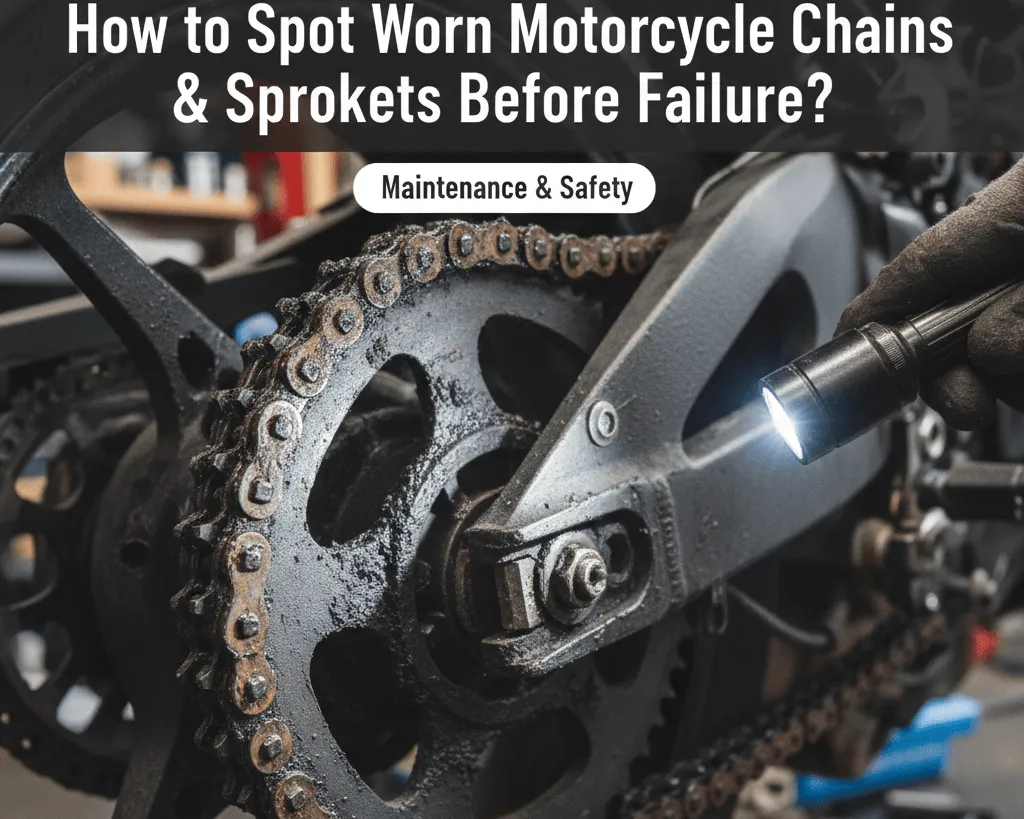
Take a look at your rear sprocket. Healthy sprocket teeth are symmetrical.
Worn teeth become:
- sharp
- hooked
- pointed
- leaning forward like shark fins
If even one tooth looks hooked, your sprocket is no longer meshing with the chain correctly. And here’s the dangerous part: A worn sprocket destroys a new chain instantly. This is why shops recommend replacing the chain + both sprockets together as a kit.
Chain Snaps or Jerks Under Acceleration
If your bike jerks forward in pulses when throttling in first, second, or third gear, especially at lower RPM, that’s chain wear. The chain is no longer sitting properly on the sprocket teeth.
Riders describe it as:
- Feels like Slack suddenly tightens.
- The chain feels like it’s jumping on the sprocket.
- The throttle feels inconsistent.
This is a high-risk symptom. At this stage, the chain can skip teeth or snap under acceleration.
Rust on the Chain Pins or Rollers
A little surface rust on plates is cosmetic. But rust on rollers, pins, and between the plates can cause structural damage.
It means the O-rings have failed, lubricant has escaped, and water has entered the internal metal surfaces. Rust inside the chain pins weakens the chain significantly; you cannot repair this. Any rust on the moving chain components means replace it immediately.
Excessive Rear Wheel Movement Even With Correct Chain Slack
If your wheel alignment is correct, your axle nut is tight, and slack is within spec, but the rear still “shifts” slightly during throttle/brake transitions, that’s worn sprockets or chain wear causing inconsistent load behavior. It feels like the rear wheel is unstable or slightly delayed in its response.
This is especially common on:
- sportbikes
- adventure bikes
- cruisers carrying heavy loads
- older motorcycles with original sprockets
If the rear of the bike feels loose or unstable in corners, don’t ignore it.
Chain Adjusters Maxed Out
If you have to move the chain adjusters all the way to the back of the swingarm to keep proper slack, your chain has stretched too far.
A stretched chain is structurally weak. At this stage, most riders describe the bike as:
- buzzy
- unstable
- rough on throttle
- loud at high speed
Once adjusters are at the limit, the chain is at the end of its life.
Oil Sling and Black Grease Build-Up
Old, worn-out chain grease turns into:
- black paste
- sticky sludge
- thick buildup around sprocket covers
This residue contains metal shavings from chain wear. If you clean your chain and the black sludge returns fast, the chain is wearing internally and grinding against the sprockets.
How Often Chains and Sprockets Actually Last? (Real Rider Data)
Manufacturer recommendations are generic.
Real rider communities report true lifespan:
- Low-quality chain: 8,000 – 12,000 km
- Mid-range chain: 15,000 – 20,000 km
- High-performance chain: 20,000 – 30,000 km
- Sprockets: every 1–2 chains, depending on usage
Touring riders and highway commuters often destroy chains faster due to constant high-speed heat cycles. Aggressive throttle users kill chains even quicker.
How to Spot Chain/Sprocket Failure Before It Happens?
Replace your chain and sprockets when you see:
- uneven tension
- kinked links
- shark-fin sprocket teeth
- The chain noise increases with speed
- rust on rollers
- jerky acceleration
- chain adjusters at full limit
Chains rarely fail without warning; they give dozens of signs before the dangerous moment. Learn to spot them early, and your motorcycle will feel smoother, safer, and more predictable on every ride.