



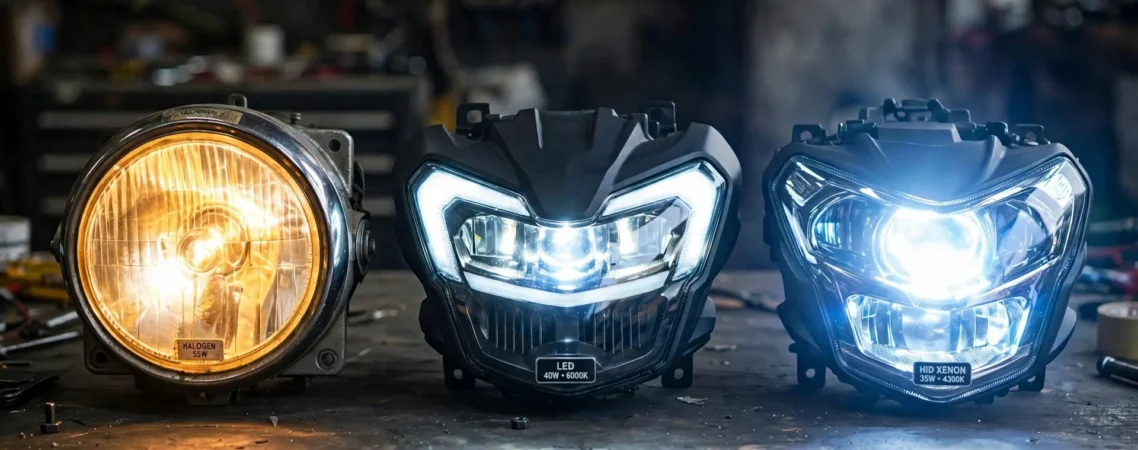
Motorcycle headlights come in three main types. Halogen is the simple, affordable standard fitted to most bikes. LEDs use less power, last longer, and switch on instantly, but quality varies and the bike’s wiring and headlight housing both matter. HID (xenon) is very bright but needs a ballast and a short warm-up. Many replacement assemblies on the market combine technologies, so you will also see “halogen plus LED” units. The right choice depends less on brightness claims and more on four things: your bike’s electrical system, the housing the light sits in, how and where you ride, and the lighting rules where you live.
This guide explains how each type works, where each one goes wrong, and what to check before you spend money.
Why the Type Matters More Than the Brightness Number
Most riders start by asking which headlight is brightest. That is the wrong first question. A bright light aimed badly, or one that scatters its beam across the road and into oncoming eyes, is worse than a modest light that puts its output where you need it. Headlight performance depends on the light source, the reflector or lens that shapes the beam, the power the bike supplies, and the aim. Change one of those without thinking about the others, and you can end up with a light that looks impressive on the box but works poorly on the road.
Halogen Headlights
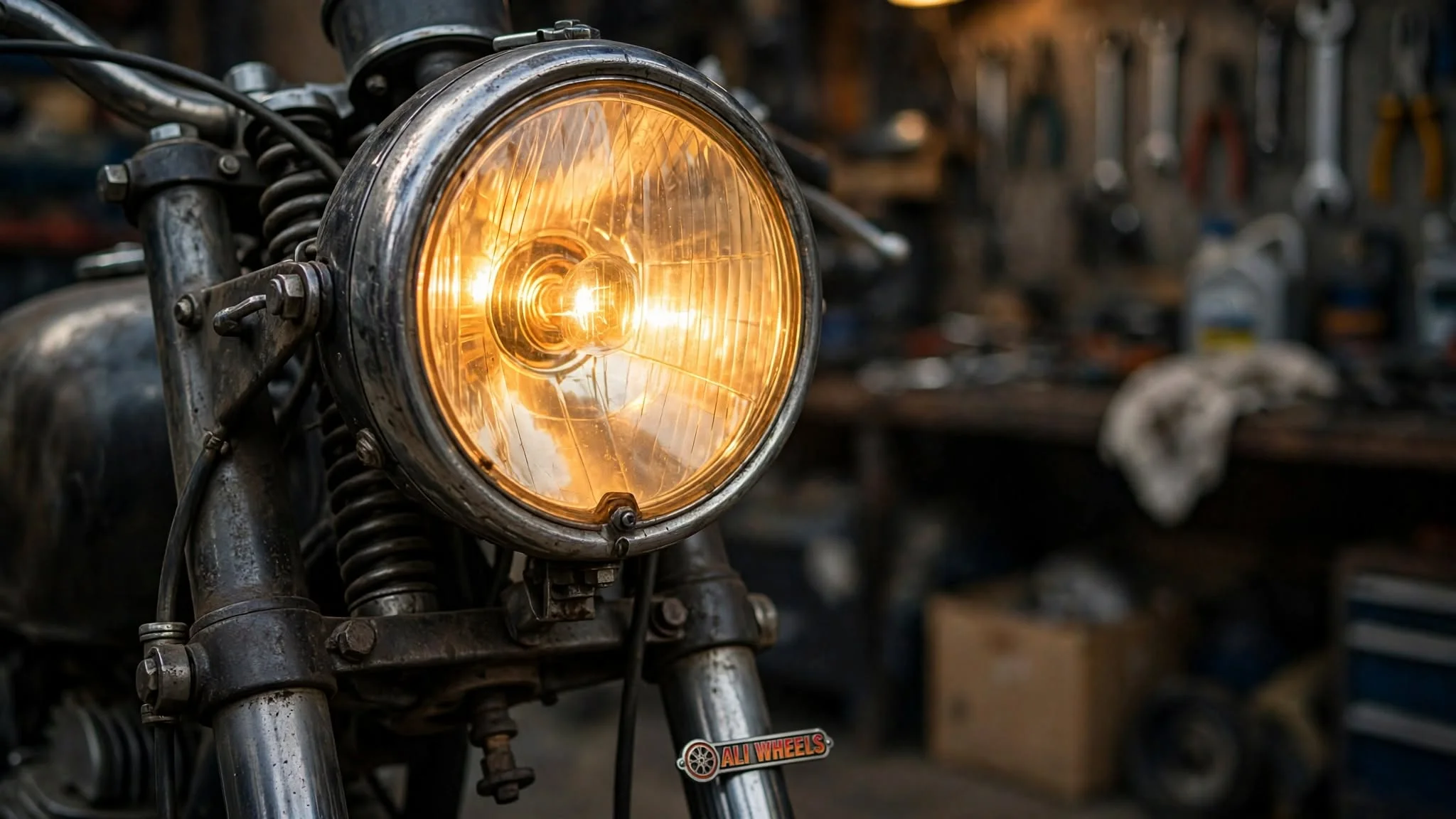
How they work. A halogen bulb heats a thin tungsten filament inside a sealed capsule of halogen gas until it glows. It is the same basic idea as an old incandescent bulb, made hotter and brighter.
What is good about them? Halogen is cheap, simple, and easy to replace. Most bikes are designed around halogen from the factory, so the housing, the wiring, and the beam pattern all match. You can usually swap a failed bulb in minutes with no wiring changes.
What is not so good? Halogen bulbs waste a lot of their energy as heat, give a warmer, yellower light than newer types, and wear out. Our guide to Aprilia SR 50 headlight failures puts the typical life of a halogen or incandescent bulb at roughly 500 to 1,000 hours, which is a useful rule of thumb for how often you may be replacing them.
Examples on Aliwheels. The Honda CB1000R headlight for 2008 to 2016 models is listed with halogen lighting technology, matching how the bike left the factory. The Yamaha YBR 125 headlight is a halogen unit with high and low beam, described as plug-and-play. If you want your bike to look and behave exactly as it did when new, a halogen replacement is the safest route.
LED Headlights
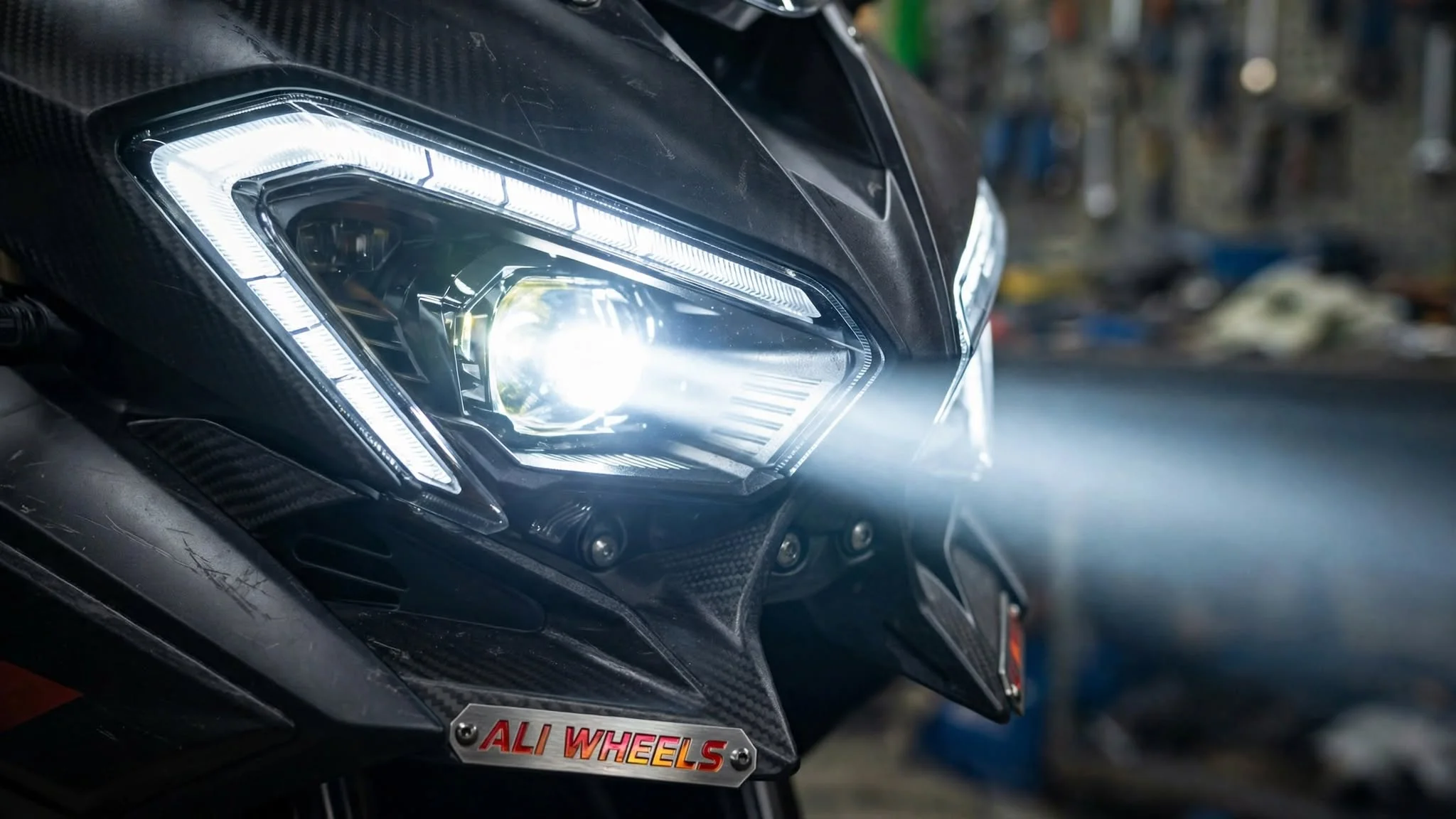
How they work. LEDs produce light by passing current through a semiconductor. They need far less power than halogen for the same visible output and produce a whiter light.
What is good about them. LEDs switch on instantly, use less electrical power, and can last far longer than a filament bulb. That lower draw can also help older bikes with limited charging output.
What is not so good. LED quality varies a lot. Cheap units can flicker, produce an uneven beam, or fail early. LEDs also generate heat at the back of the unit, which needs to be carried away by a heat sink or fan, so a poorly cooled LED loses output or dies young. And many LED units are designed for DC power, which matters more than most riders realise. More on that below.
See Example on Aliwheels. The Honda VTX 1300 LED headlight is a complete 5.75 inch sealed unit rather than a bulb. The listing quotes 6000K to 6500K white light, a DC 10 to 30V operating range, and output figures of 4,800 lumens on high beam and 3,800 on low. Treat any lumen figure as the manufacturer’s claim rather than something you will measure yourself, but the listing shows the key point: a proper LED headlight is a whole assembly designed around its own optics, not just a different bulb in the old housing.
HID (Xenon) Headlights
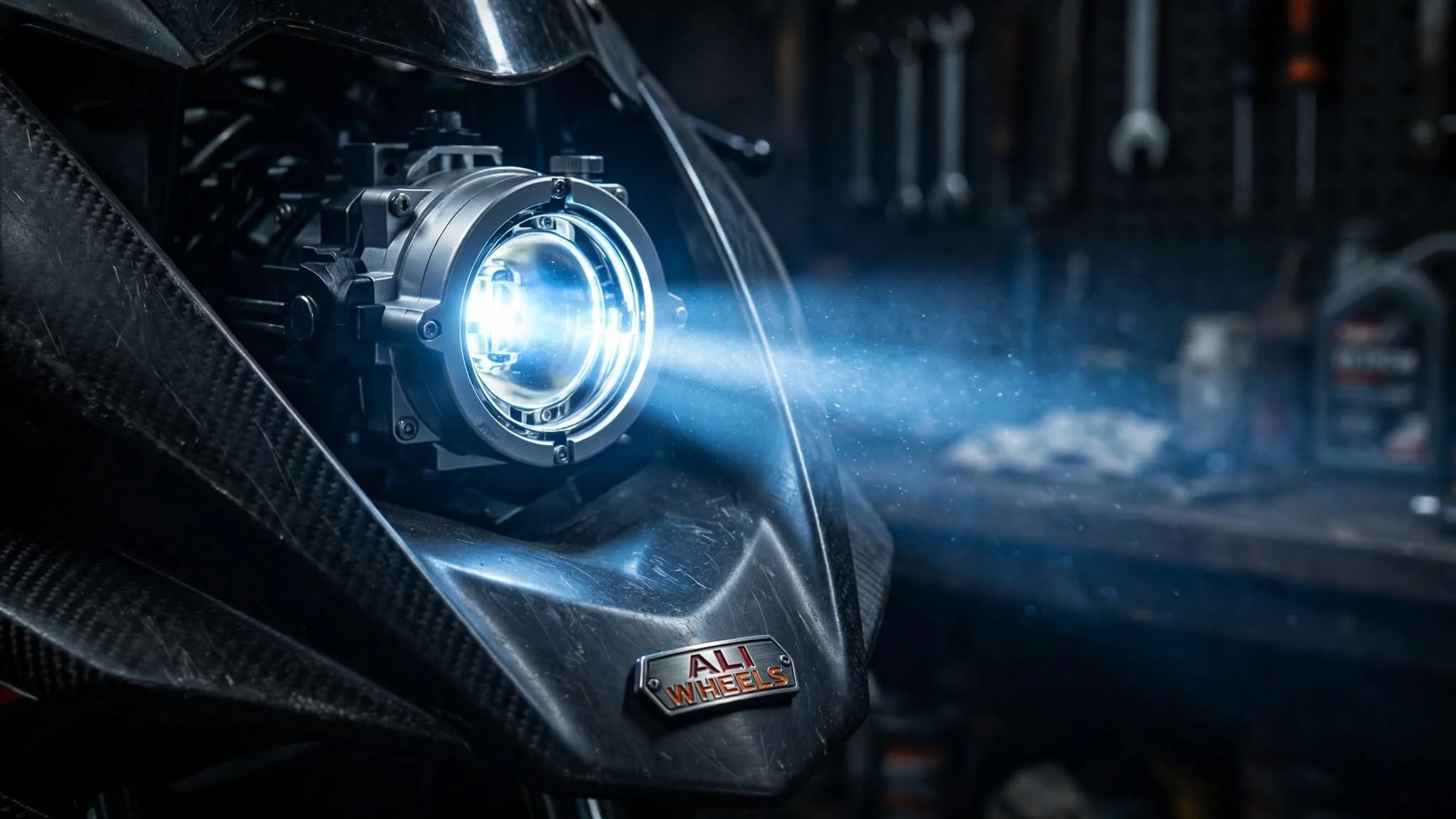
How they work. An HID light has no filament. It makes an electric arc between two electrodes inside a capsule of xenon gas. A ballast controls the high voltage needed to start and run the arc.
What is good about them? HIDs can be very bright and efficient once they are running.
What is not so good. They need a ballast and wiring, they take a moment to reach full brightness, and they are more complex to install and diagnose. A retrofit kit that puts an HID bulb into a housing designed for halogen is the classic recipe for glare, because the beam no longer lands where the housing was designed to put it.
Example on Aliwheels. The KT headlight assembly for the Yamaha YZF-R1, 2012 to 2014 is listed with HID low beam and HID high beam, and as a direct replacement for a stated Yamaha part number. A complete assembly like this, designed to fit the bike, avoids the beam problems that come with a loose retrofit bulb.
Hybrid Headlights: Halogen Plus LED
Some replacement headlights combine a halogen main beam with LED elements for accent or running lights. The KT LED headlight for the Honda Gold Wing F6B, 2013 to 2016 is listed this way, with an H3 12V 55W halogen main lamp and a ring of small white LEDs, quoted at 6000K to 6500K. The BMW R9T LED headlight follows the same mixed approach. The appeal is a modern look with a familiar bulb you can still replace. Check the listing’s bulb type and voltage before you buy, because the bulb you need depends on the assembly.
Reflector vs Projector Housings: Why Bulb Swaps Go Wrong
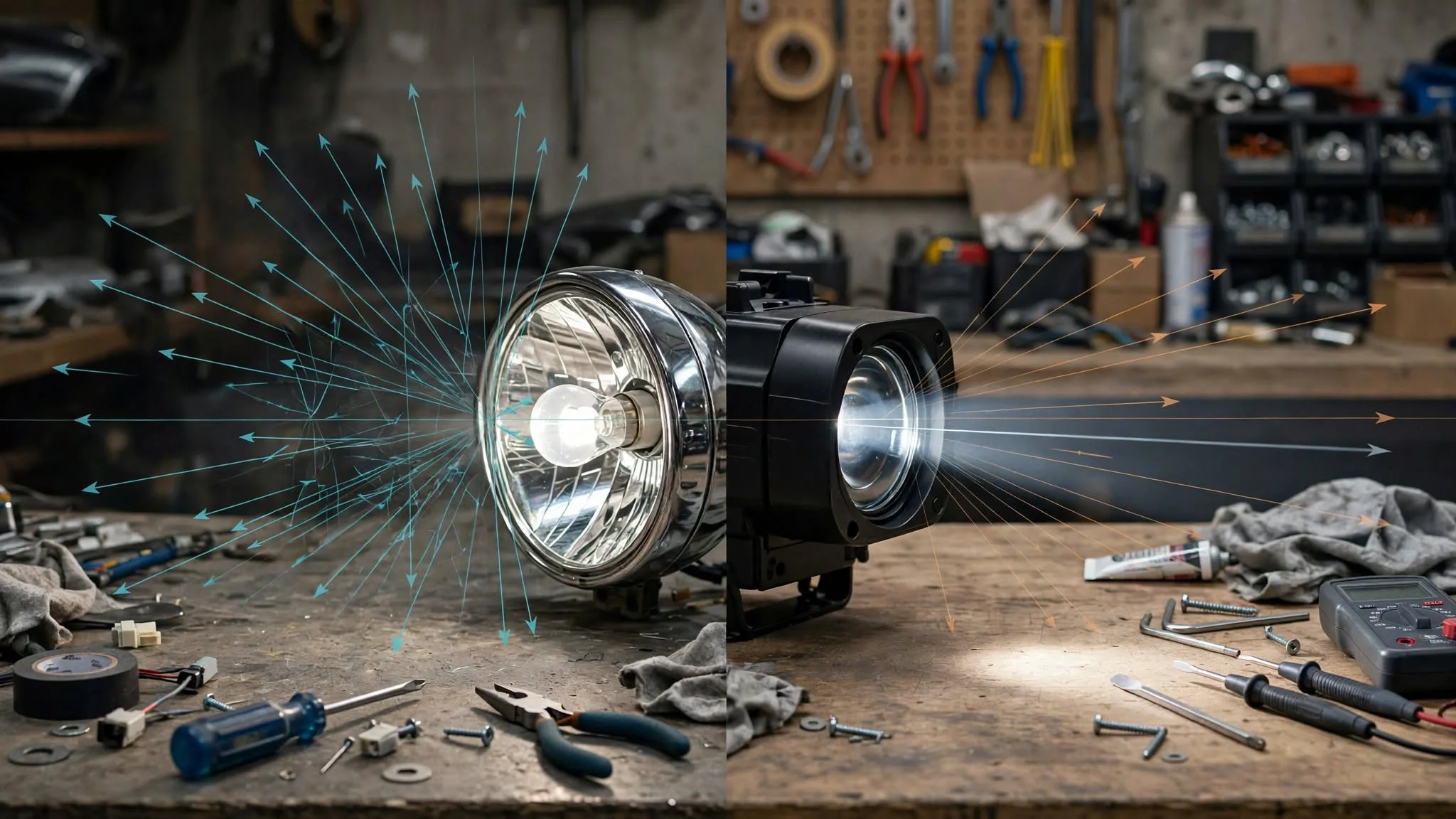
The housing shapes the beam. A reflector housing uses a mirrored bowl positioned around the light source. A projector housing focuses light through a lens and uses a cut-off to keep it out of oncoming drivers’ eyes.
A halogen filament sits in a very specific place relative to the reflector. A “plug-in” LED or HID bulb puts its light source somewhere slightly different. The result can be a patchy beam, dark spots, and stray light thrown up toward oncoming traffic. That is why installing a bright retrofit bulb into an old reflector so often ends with a light that seems bright to you and dazzling to everyone else. If you want a major motorcycle lighting upgrade, a complete assembly designed for LED or HID is the cleaner choice.
Check Your Bike’s Electrical System First
This step stops more headlight upgrades from failing than any other.
AC or DC? Many small bikes, scooters, and older machines power the headlight from an alternating current circuit rather than from the battery. Our SR 50 guide warns that many two-stroke models use an AC-fed headlight circuit and that not all LED units are designed to work on AC power, so you must confirm which your bike uses before choosing a replacement. An LED that expects steady DC power may flicker, dim, or fail on AC.
Bulb connector type. Common types include H4 (high and low beam in one bulb), H7, and H3, which appears in several Aliwheels listings. Small bikes and scooters often use other bases. Match the connector to your assembly before ordering.
Charging system health. Flickering or dimming lights are often a charging problem rather than a bulb problem. If your lights pulse with engine speed, our guide on troubleshooting voltage regulator problems explains how a failing regulator causes it.
Modern electronics. Some newer bikes monitor their lighting circuits. A very low-wattage LED can look to the bike like a failed bulb and trigger a warning. Check compatibility for your model if it has this kind of system.
Color Temperature: Whiter Is Not Always Better
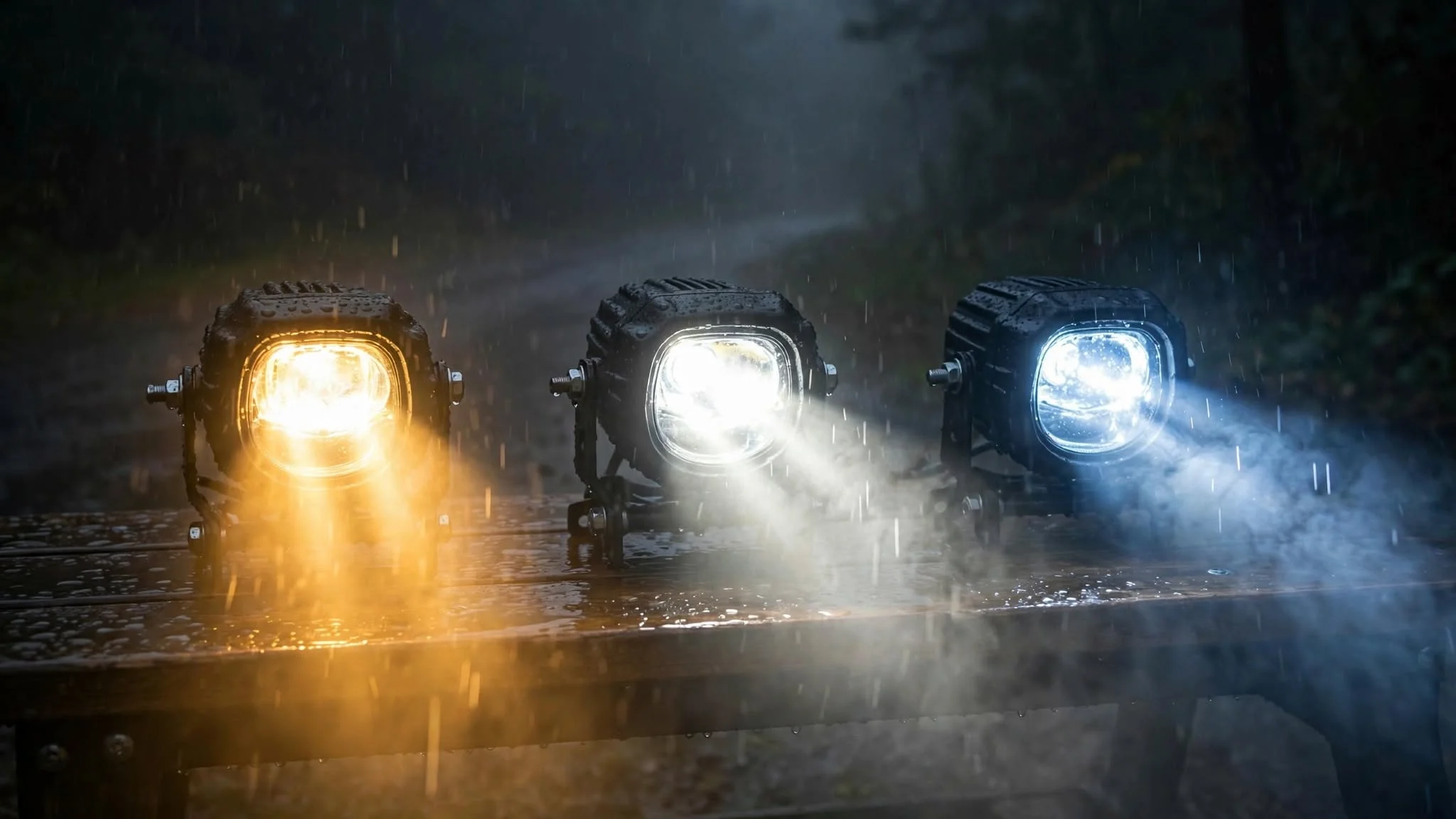
Color temperature is measured in kelvin. Lower numbers look warmer and more yellow, and higher numbers look whiter and bluer. The Aliwheels listings above quote 6000K to 6500K for their LED elements, which is a cool white. Many riders like that crisp look, but a very blue-white light can make rain, fog, and wet road surfaces harder to read. If you ride in poor weather a lot, a more neutral white is often easier on the eyes. Pick for the way you ride, not for the number on the box.
Legal and Safety Considerations
Rules on headlight type, color, and brightness differ from place to place, and they often treat aftermarket retrofits differently from factory-fitted lights. Check what applies where you live before you modify anything. Beyond the law, aim matters for safety. After any headlight change, set the beam height and check it against a wall at night. A well-aimed modest light beats a badly aimed bright one every time.
Which One Should You Choose?
You want the bike to stay original and simple: halogen, in a replacement matched to your model.
You ride mostly at night or in the country and want better output: a complete LED or HID assembly designed for your bike, not a loose retrofit bulb.
Own a small bike or scooter with a simple electrical system: confirm AC or DC first, then choose a unit designed for that supply.
You want a modern look without losing a replaceable bulb: a hybrid halogen plus LED assembly.
You are on a tight budget: replace like with like. A fresh halogen bulb or a matched halogen assembly is cheap and avoids the beam and wiring problems that catch out retrofit buyers.
Before You Replace Anything: Rule Out the Simple Faults

If your headlight stops working, do not assume you need a new type of light. Check the bulb, the fuse, the connector, and the ground first. Our guide on diagnosing motorcycle electrical problems covers the sequence, and the same fuse-first logic appears in our guide to tail light problems. Most “dead headlight” cases turn out to be a bulb, a fuse, or a corroded connector, not a reason to buy new technology.
Choose the Light That Fits the Bike
The best motorcycle headlight is the one that suits your bike’s wiring, sits in a housing designed for it, and puts its beam where you need it. Start with your electrical system, decide how you ride, and choose a matched assembly rather than the brightest bulb in the listing. Do that, and you will see further without blinding anyone else.
Frequently Asked Questions
What are the main types of motorcycle headlights?
Halogen, LED, and HID (xenon), plus hybrid assemblies that combine halogen and LED. Halogen is the most common factory fit.
Can I put an LED bulb in my halogen headlight?
Sometimes, but it often gives a poor beam. Halogen reflectors are designed around a filament’s exact position, and an LED bulb puts its light elsewhere, which can create dark spots and glare. Check that the bulb is designed for your housing, and confirm your bike’s power supply suits it.
Why does my LED headlight flicker?
Common causes are an AC-powered headlight circuit, a failing regulator, or a poor connection. Confirm whether your bike supplies AC or DC to the headlight, and test the charging system.
Are HID headlights better than LED?
Neither is better in every case. HIDs can be very bright but need a ballast and a warm-up, while LEDs switch on instantly and use less power. A complete assembly designed for your bike matters more than the technology it uses.
Is whiter light better for night riding?
Not always. Very cool, blue-white light can make wet roads and fog harder to read. A more neutral white is often easier to see in, and the aim of the beam matters more than the colour.