




AI Summary
OEM motorcycle fairings guarantee perfect fitment and factory-color match, but cost 40 to 80 percent more than quality aftermarket alternatives. Quality aftermarket ABS fairings match OEM fitment and material specifications at a significantly lower cost and are the correct choice for most replacement scenarios. Custom fairings offer unique graphics and personalization at mid-range pricing. Fiberglass fairings are lighter but more fragile than ABS and are better suited to track use, where weight matters more than durability.
You’ve dropped the motorcycle. Or a stone has cracked a fairing panel. Or the previous owner’s repair is failing and the whole front section needs replacing. Whatever brought you here, fairing replacement is one of the most emotionally charged parts purchases a rider makes — because the fairing is the face of the motorcycle, and getting it wrong is immediately visible.
The good news is that the fairing market has developed to a point where quality options exist at every price point, and the decision between OEM, aftermarket, and custom is genuinely straightforward once you know what each option actually delivers.
Here is the complete fairing replacement guide. Browse Aliwheels’ Motorcycle Fairings and Customized Fairings categories for the full range across all major makes.
What Motorcycle Fairings Actually Do
Before comparing options, understanding what fairings are engineered to deliver clarifies which specifications actually matter for your use case.
Aerodynamics are the primary function on sport and supersport motorcycles. The fairing’s profile manages airflow around the motorcycle and rider at speed — reducing drag, managing lift forces, and directing cooling air to the radiator. On a track-day ZX6R at 130 mph, the fairing’s aerodynamic profile is a performance component. On a commuter CBR500R at 50 mph, it’s primarily cosmetic with some weather protection benefit.
Wind and weather protection matters most for touring-oriented fairings. Larger fairing profiles on touring motorcycles redirect wind around the rider, reducing fatigue and improving comfort across long distances.
Cosmetics and visual identity are the primary function in the rider’s perception. The fairing makes the motorcycle visually distinctive and is the surface that shows damage, fading, and personalisation most obviously.
OEM Motorcycle Fairings: What You Actually Get
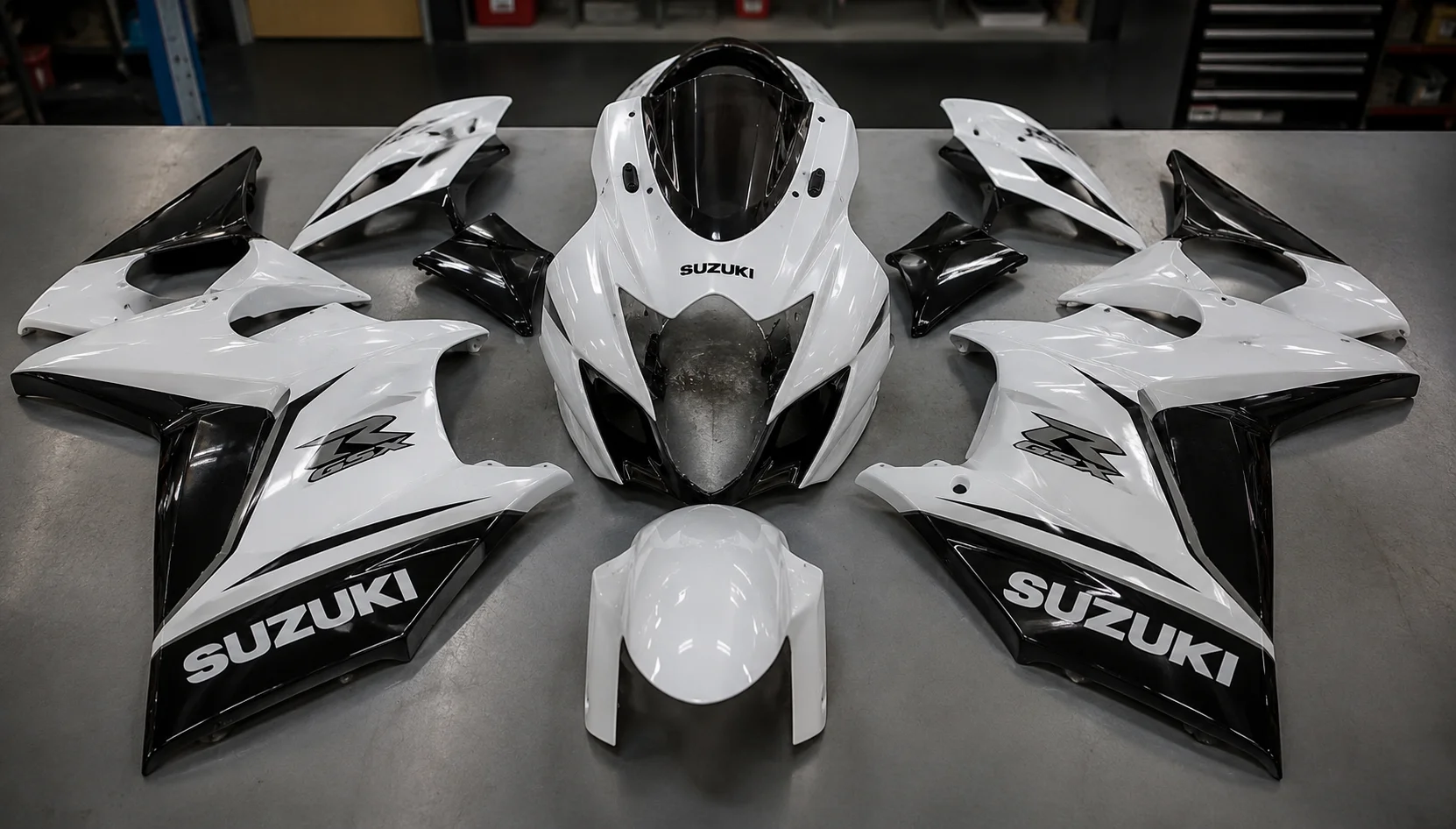
OEM fairings are manufactured to the motorcycle manufacturer’s original specifications — the same moulds, the same ABS plastic compound, the same colour-matched paint process. They are the reference standard against which all alternatives are measured.
What OEM delivers:
Perfect fitment. OEM fairings use the original mounting points, mounting hardware specifications, and dimensional tolerances. They install without modification and align with all adjacent panels correctly.
Factory colour match. OEM paint is mixed and applied to the same specification as the rest of the bike’s bodywork. On a well-maintained motorcycle without panel damage, an OEM replacement panel matches the adjacent surfaces.
Manufacturer warranty. OEM parts carry the manufacturer’s parts warranty — typically one to two years — through the dealer network.
What OEM costs:
The OEM premium is significant. For popular sport motorcycles like the Honda CBR600RR, Kawasaki ZX6R, and Yamaha YZF-R1, a complete OEM fairing set can run $800 to $2,500 depending on model and year. Individual panels run $150 to $600 each at dealer retail. This pricing reflects the dealer network margin, the manufacturer’s parts business profitability requirements, and in some cases genuine supply limitation for older models.
When OEM is the right choice:
The motorcycle is under manufacturer warranty and you need the manufacturer’s parts compliance for warranty purposes. The motorcycle is a rare or collector model where originality affects resale value significantly. You need an exact paint match on a motorcycle with unusual or complex factory colour schemes that are difficult to replicate. Age has faded the adjacent panels and you’re replacing all bodywork simultaneously with OEM so the new paint ages identically.
Aftermarket ABS Fairings: The Smart Choice for Most Riders
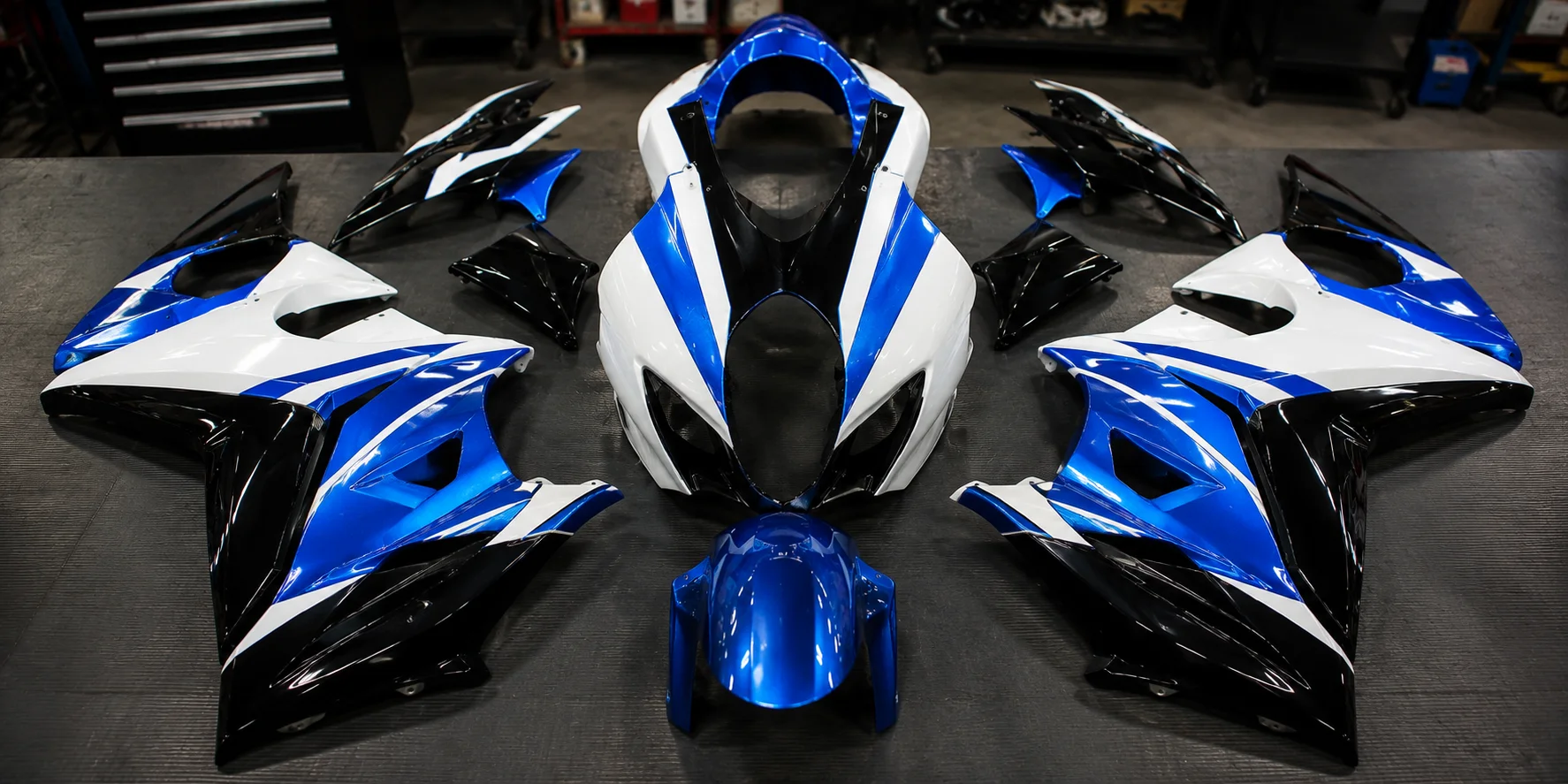
Quality aftermarket fairings for popular motorcycle models are manufactured from the same ABS (Acrylonitrile Butadiene Styrene) material as OEM fairings, using moulds derived from original panels. The result is a fairing that matches OEM fitment and material quality at 30 to 60 percent less cost.
What quality aftermarket delivers:
Equivalent material. ABS plastic is ABS plastic. The wall thickness, flex characteristics, and mounting boss construction in a quality aftermarket fairing matches the OEM specification because both are manufacturing the same material to the same dimensional requirements.
Good fitment. On popular models with well-developed aftermarket tooling, fitment quality is indistinguishable from OEM in installation. Minor trimming or adjustment is occasionally required on less popular models where the tooling has seen less refinement.
Accessible pricing. A complete aftermarket ABS fairing set for a popular supersport costs $200 to $600 — compared to the $800 to $2,500 OEM equivalent. For a rider replacing fairings after a low-side where the insurance excess exceeds the replacement cost, this pricing makes the repair financially practical where OEM pricing would not.
Unpainted or painted options. Aftermarket fairings are available unpainted (raw ABS ready for your own paint) or pre-painted to the OEM colour code. Pre-painted options add cost but save the painting step for riders who don’t want to source a painter.
What aftermarket requires:
Paint matching. Aftermarket pre-painted fairings match the OEM colour code but not the aged paint on the rest of your motorcycle. On a well-maintained, recently painted motorcycle, the match is close. On a motorcycle with several years of UV fading on the existing panels, even perfectly colour-matched new paint looks noticeably different against aged paint. This is not an aftermarket-specific problem — OEM has the same issue.
Minor fitting adjustment on some models. First-fit installation occasionally requires minor trimming at mounting points or tab adjustment for precise alignment. This is a five-minute task on most applications.
Aliwheels stocks ABS aftermarket fairings and body panels across all major motorcycle brands. Browse the complete Motorcycle Fairings catalogue for available models and the Customized Fairings section for personalised options. For all related bodywork parts, browse Motorcycle Parts.
Custom Fairings: Personalisation With Protection
Custom fairings occupy a distinct market position — they are aftermarket ABS fairings with custom graphics, unique colour schemes, or personalised artwork applied rather than OEM colour replication. They suit riders who see a bodywork replacement as an opportunity to personalise rather than simply restore.
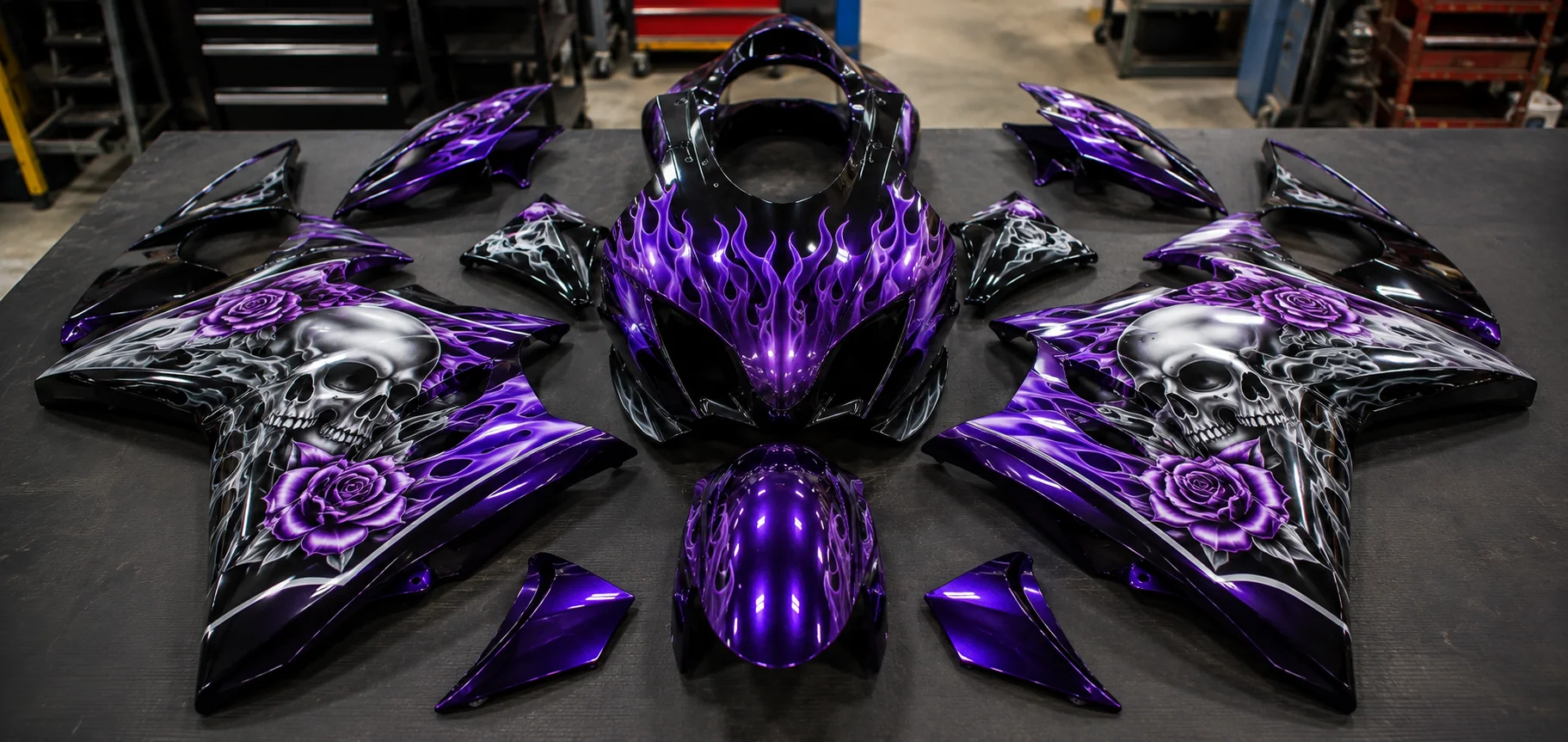
What custom fairings deliver:
Visual distinctiveness. Your motorcycle looks like your motorcycle, not a factory specification. In a paddock full of stock-coloured CBR600RRs, a custom-painted fairing set makes your motorcycle immediately identifiable.
Equivalent protection to standard aftermarket. Custom fairings use the same ABS substrate as standard aftermarket — the customisation is on the surface, not in the material.
Mid-range pricing. Custom fairings typically price between standard unpainted aftermarket and OEM — you’re paying for the artwork and finish rather than the OEM brand premium.
When custom is the right choice:
You’re using a bodywork replacement as an opportunity to give the motorcycle a new identity. The existing paint has faded significantly and you want a distinctive look rather than trying to match aged factory paint. You’re building a track motorcycle where a custom livery is part of the project. You want a race replica design — MotoGP liveries are popular custom fairing choices on street motorcycles.
Fibreglass vs ABS: The Material Question
Fibreglass fairings are lighter than ABS and offer more structural rigidity — properties that matter at race track use where weight reduction and structural performance under high-speed aerodynamic loads are genuine concerns. They are also more expensive to produce and more fragile in low-speed impacts like parking lot tip-overs.
ABS fairings flex slightly on impact without cracking — a characteristic that makes them significantly more practical for street use where minor impacts are part of life. Fibreglass cracks cleanly at impact points. ABS deforms and may crack, but tends to absorb more impact energy before catastrophic failure.
For street use, ABS is the correct material choice in virtually every application. For dedicated track use where every gram of weight reduction has measurable performance value, fibreglass is worth the fragility trade-off.
The Paint Matching Problem — And How to Manage It
Regardless of whether you choose OEM or aftermarket, new fairings will not perfectly match the aged paint on your existing panels unless the entire motorcycle’s bodywork is being replaced simultaneously. UV fading, minor scratches, and the weathering of clear coat change the visual appearance of painted surfaces over time.
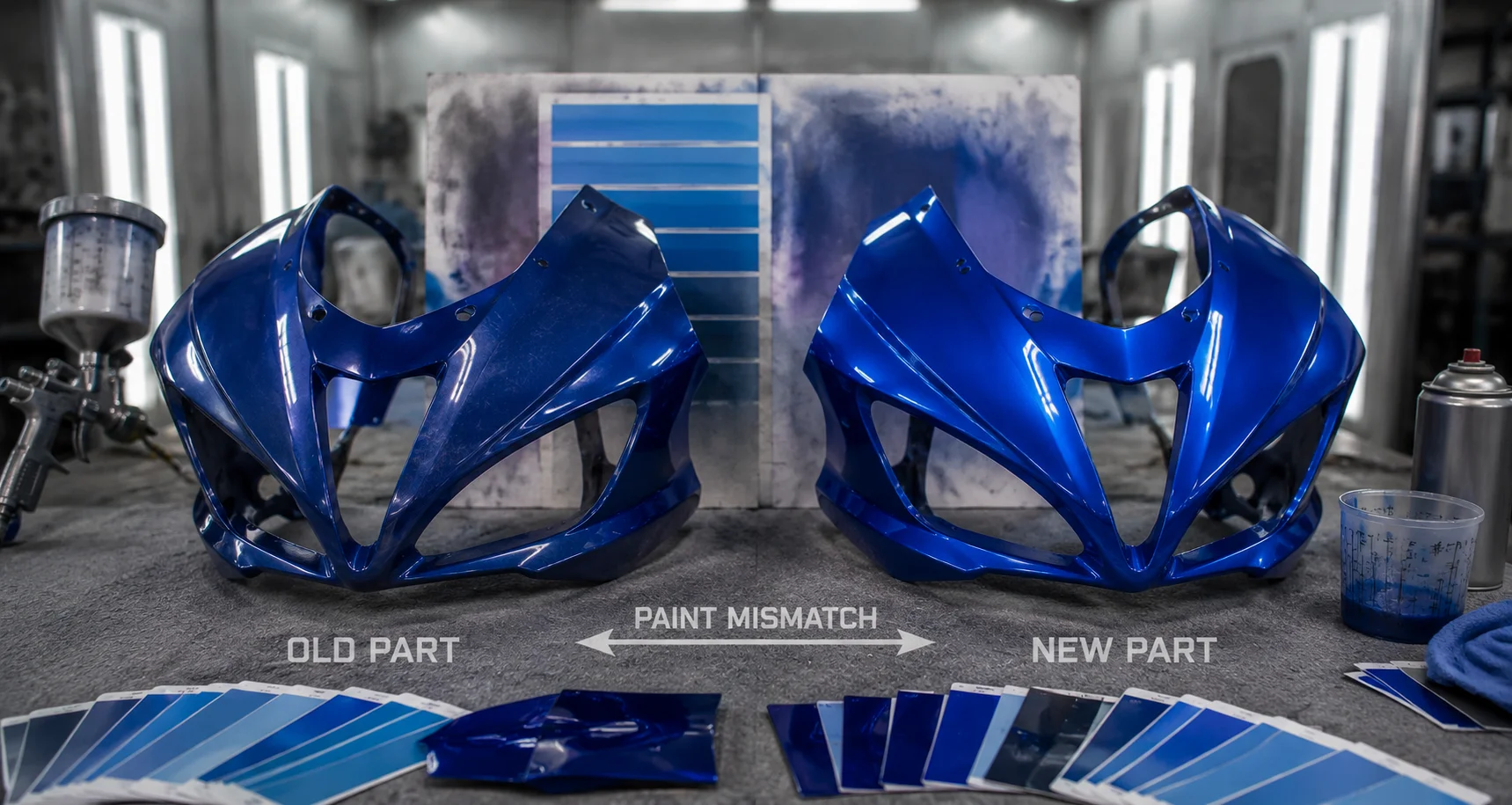
The solutions are either replace all bodywork at the same time so all panels age together, accept a slight visual mismatch that becomes less noticeable as the new panels weather, or have the new panels painted to match the aged colour on your existing panels by a painter who colour-matches by eye rather than strictly by colour code.
For motorcycles where a single panel needs replacement, most experienced riders accept that a slight mismatch is less noticeable than a cracked or missing panel and fades over one to two seasons of UV exposure as the new paint ages to match.
The Full Comparison
| Factor | OEM Fairings | Aftermarket ABS | Custom Fairings | Fibreglass |
| Fitment quality | Perfect | Very good (minor adjust occasionally) | Very good | Good |
| Material | ABS plastic | ABS plastic | ABS plastic | Fibreglass |
| Paint match | Factory spec | Colour code match | Custom design | Custom or bare |
| Price | Highest | 30-60% less than OEM | Mid-range | Higher than ABS |
| Impact resistance | Good | Good | Good | Lower than ABS |
| Weight | Standard | Standard | Standard | Lighter |
| Best for | Warranty motorcycles, collectors | Most replacement scenarios | Personalisation, track builds | Dedicated track use |
Conclusion
OEM fairings are the right choice for warranty motorcycles and collector models. Quality aftermarket ABS is the right choice for the majority of motorcycle fairing replacements — equivalent material, equivalent fitment, significantly lower cost. Custom fairings suit riders who want to personalise the motorcycle during the replacement. Fibreglass suits dedicated track use where weight reduction justifies the fragility trade-off.
The fairing replacement decision is simpler than it appears once you know what each option actually delivers rather than what the marketing around each claims.
Frequently Asked Questions
Q: Are aftermarket motorcycle fairings as good as OEM?
A: Quality aftermarket ABS fairings match OEM material specification and fitment quality for most popular motorcycle models. The material — ABS plastic — is the same in both cases. The difference is the manufacturing process refinement and the OEM brand premium. For the majority of replacement scenarios on out-of-warranty motorcycle, quality aftermarket delivers equivalent results at meaningfully lower cost.
Q: How much do replacement motorcycle fairings cost?
A: OEM fairing sets for popular sport motorcycles range from $800 to $2,500. Individual OEM panels range from $150 to $600. Quality aftermarket ABS fairing sets range from $200 to $600 for complete sets on popular models. Custom painted sets add $100 to $300 above standard aftermarket pricing depending on complexity. Fibreglass racing sets start from $400 and increase based on model and specification.
Q: Can I install motorcycle fairings myself?
A: Yes. Fairing installation is one of the most accessible DIY motorcycle maintenance tasks — it requires basic hand tools, patience with cable and harness routing, and careful attention to the mounting sequence documented in your service manual. The most common DIY installation error is over-tightening plastic mounting fasteners, which cracks the boss around the fastener hole. Use correct torque specification and never use power tools on plastic fairing fasteners.
Q: Do aftermarket fairings require any modification to fit?
A: On popular models with well-developed aftermarket tooling, aftermarket fairings install without modification. On less common models or older generations with less-refined aftermarket tooling, minor trimming at mounting tabs or alignment adjustment is occasionally required. This is typically a 15-minute task and does not affect the final installed result.
Q: Will a cracked motorcycle fairing affect safety?
A: A cracked fairing does not affect the mechanical safety of the motorcycle in most cases — the fairing is a body panel, not a structural component on most street motorcycles. However, a cracked fairing that has sharp edges creates an injury risk to other road users in a collision. Additionally, cracks propagate under vibration and UV exposure, meaning a small crack becomes a larger one and eventually a missing section if not addressed.