


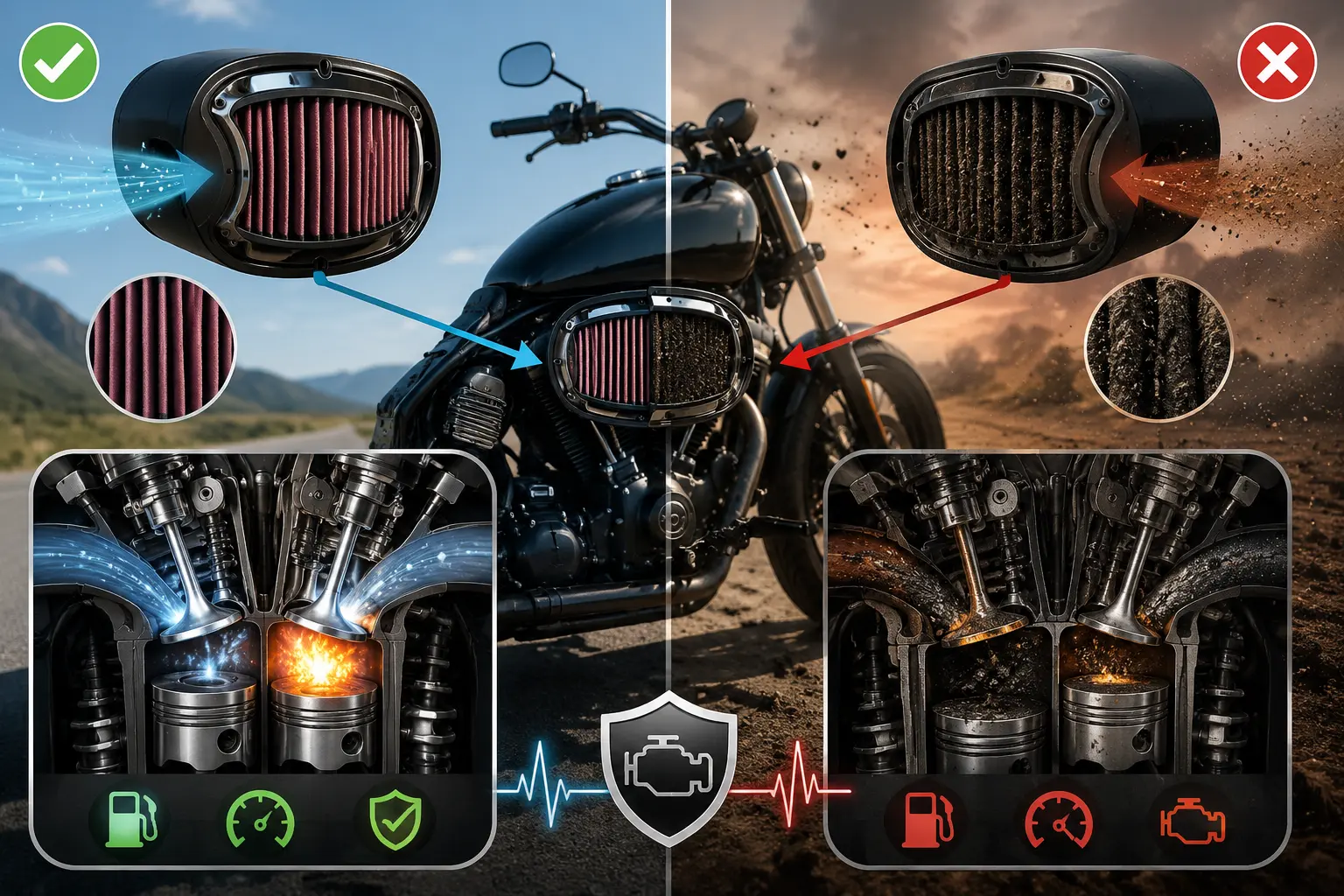

Your motorbike engine needs air. It inhales hundreds of thousands of liters of air per minute at highway speeds.
Now imagine air entering without any filters. Dust and sand particles, pollen, road gravel, insects. It all goes right into your engine!
Without a good motorcycle air cleaner, that is exactly what happens. Damage occurs gradually and is initially unnoticed. However, there’s a real price.
Now let’s discuss why your motorcycle air cleaner is indeed one of the most important components on your bike.
Role of Motorcycle Air Cleaners
The job of an air cleaner is very simple but critical. It removes dirt from the engine before it even gets there.
Simultaneously, it must give adequate ventilation. Excessive filtration causes an engine to breathe. It blocks the “bad stuff.” It allows good air circulation.
The filter media is located between the outside air and the intake system. Each little speck of dust, each grain of sand, is trapped there rather than in your engine. As time passes that will fill up. It will need to be replaced or cleaned up.
Simple concept. Major damage to engines.
What Happens When Dirty Air Enters Your Engine
Think about your engine’s precision surfaces for a moment. Wear on cylinder walls, piston rings, and valve seats. These are machined to a very close tolerance.
We’re talking about 1/1000ths of a millimeter. This is really close.
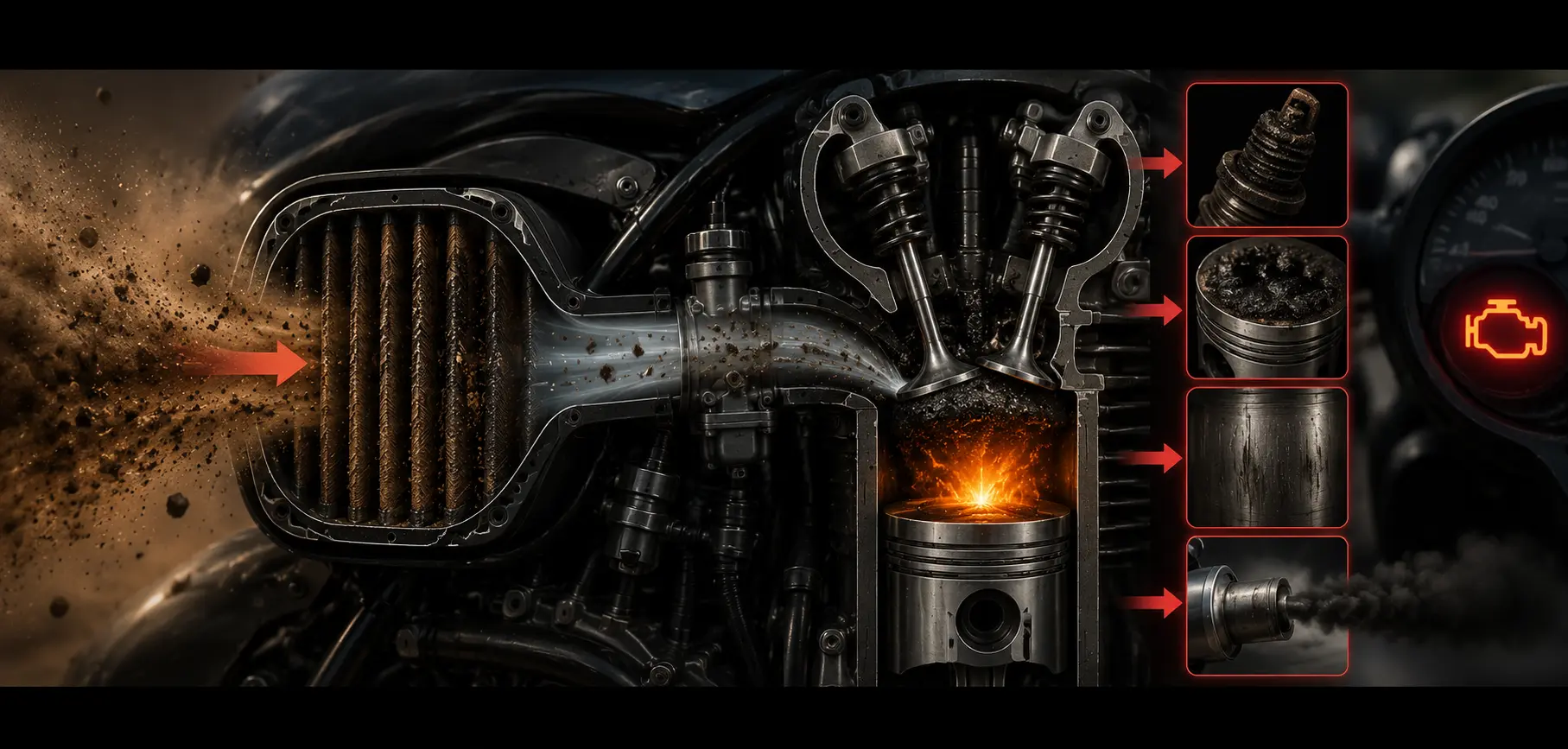
Abrasive particles that pass through the air cleaner act as sandpaper on the surfaces. The cylinder walls are given a fine scratch. Piston rings become loose. Valve seats are worn out unevenly.
Consequently, there is a decrease in compression. The oil begins to leak between the damaged rings into the combustion chamber. Power decreases gradually. Oil consumption goes up.
The engine requires a complete rebuild at some time. That’s a lot of money to be spent on a rebuild.
This is the not-so-good news. This damage occurs gradually and stealthily. It will not be detected until the engine has become quite aged. But at this stage, the repair cost becomes high.
What if the Air Cleaner Becomes More Clogged?
If the filter is dirty, it poses another issue. Your engine is then unable to breathe.
If the air flow is restricted, less air is drawn into the engine. Fuel is still pumped at the calculated rate in the fuel system. However, the amount of air is not sufficient to provide for a clean and complete combustion.
A fuel-injected bike will attempt to make up for this, but it can only do so much. On a carb bike it can’t do anything to help at all. In any case the mixture is too rich.
This results in a bike that lags behind when pedaling. Slightly slow at mid-range. There is a significant increase in fuel usage.
In addition, a highly clogged filter may draw oil into the airbox breather and get into the intake. This causes extra contamination issues within the motor.
The fix is simple. Inspect and replace the air cleaner regularly.
Various Types of Air cleaners Explained
Not all air cleaners are the same. Understanding the differences helps you maintain the right one.
Paper element filters are most common on street motorcycles. They are highly effective at filtering fine particles. The downside is they cannot be cleaned. Once dirty, they need replacing.
They are affordable, though. Replacing them regularly is not a big deal.
Foam filters are common on off-road and adventure bikes. These can be washed, dried, and re-oiled rather than replaced. They work very well in dusty environments when maintained correctly.
The key is using the right foam filter oil after every wash. Too much oil restricts flow. Too little reduces filtration.
Oiled gauze filters are popular in the aftermarket performance world. These flow more air than paper elements. They can be cleaned and re-oiled repeatedly.
For a modified engine with tuned fueling, these make sense. For a stock engine, the performance gain is minimal.
When should you change your air cleaner?
It depends on the type of filter and riding location.
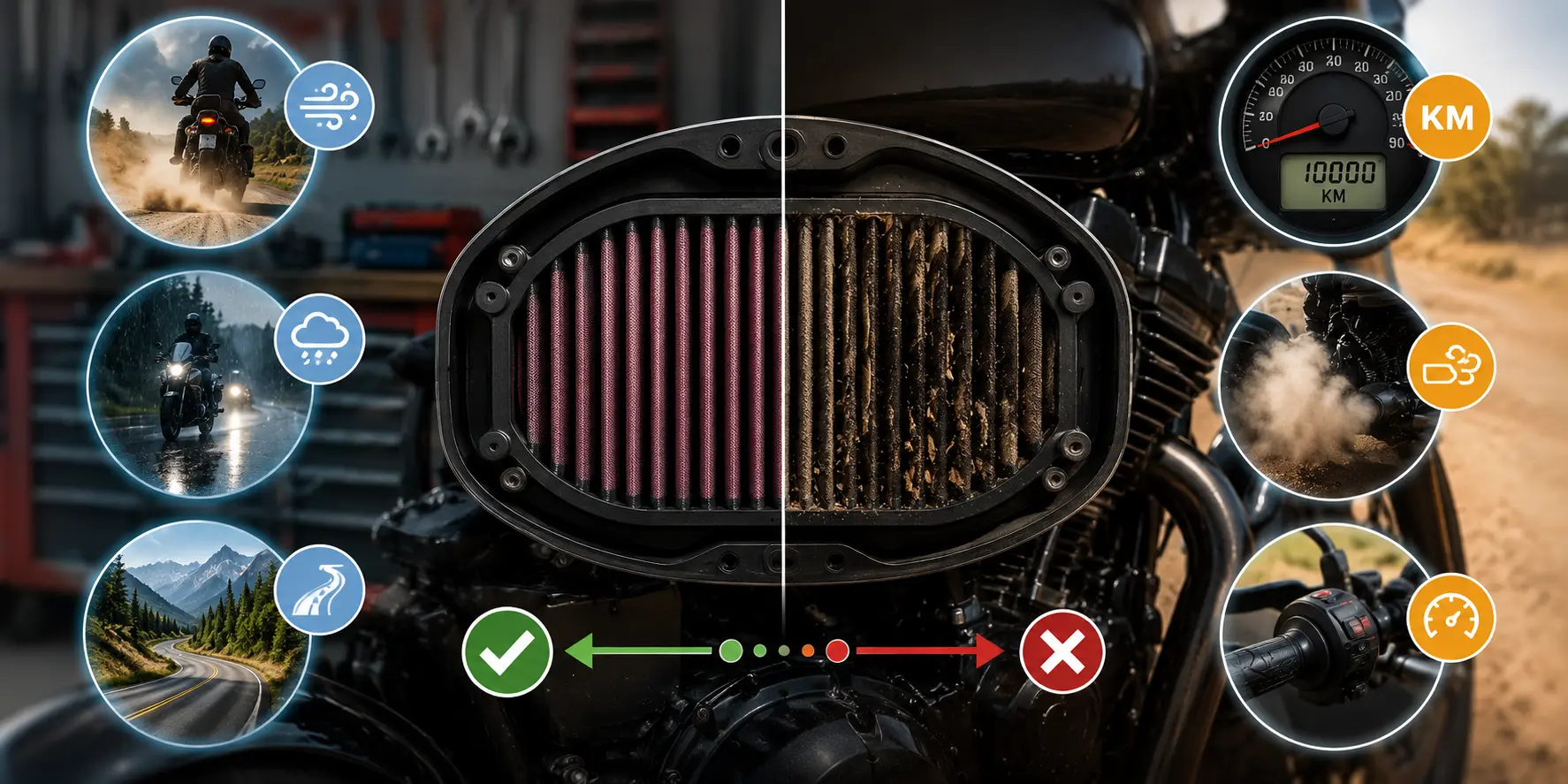
If you have a street bike, opt for paper element filters. Under normal driving conditions they need to be replaced every 10,000 to 15,000 km. In dusty area or near construction, check every 5,000 km.
Foam filters for adventure and off-road bikes. Clean and re-oil after every ride that is dusty or muddy. Normal service is every 3,000 to 5,000 km.
Aftermarket oiled gauze filters. Follow the manufacturer’s guidelines. Typically, this is approximately every 15,000 to 20,000 km on the road under standard driving conditions.
An important tip here: Always check the airbox seal when you’re changing the filter. That rubber seal is between the filter and the housing of the airbox.
If it is cracked or bent, it will let all the air pass through without filtering. If the seal to the filter is poor, it’s close to being a failure.
Check for Air Leaks Around the Filter
This is something most riders never check. But it matters a lot.
The connection between the air cleaner, the airbox, and the intake tract has several rubber boots and clamps. Over time, these age and crack.
A small crack creates an air leak that lets unmetered, unfiltered air into the engine. On a carbureted bike, this causes lean running at idle and low throttle. The bike hunts at idle and pops on deceleration.
On a fuel-injected bike, the ECU detects unusual air-fuel readings. You might see fault codes. Idle quality suffers and throttle response becomes inconsistent.
Inspect these rubber components every time you service the air cleaner. Squeeze the boots and look for cracking. Check that all clamps are secure.
It takes two minutes and can save hours of diagnostic frustration later.
Conclusion
The air cleaner is one of the simplest and cheapest parts on your motorcycle. But its impact on engine health is significant.
Clean air means clean combustion. Clean combustion means less wear, better performance, and a longer engine life. Neglecting the air cleaner means the opposite.
For riders looking for quality air cleaners, replacement air filters, and other motorcycle parts, AliWheels offers a wide selection for various makes and models.
Check it regularly. Replace it on time. Your engine will reward you with years of reliable performance.
FAQ Section
Q: How do I know if my motorcycle air filter is clogged?
A: Hold the filter up to light. If you cannot see light shining through clearly, it needs replacing. Also check your throttle response. A clogged filter causes hesitation and sluggish acceleration.
Q: Can I clean a paper air filter instead of replacing it?
A: No. Paper filters cannot be effectively cleaned. Once they are dirty, they need to be replaced. Attempting to clean them pushes debris deeper into the media.
Q: What happens if I ride with a very dirty air filter?
A: Your engine runs rich, fuel consumption increases, and power drops noticeably. More importantly, long-term riding with a clogged filter accelerates engine wear significantly.
Q: How often should I replace my motorcycle air filter?
A: Every 10,000 to 15,000 km under normal conditions. If you ride in dusty areas, check every 5,000 km. Inspect before every long ride.
Q: Can a clogged air filter damage my motorcycle engine permanently?
A: Yes. Worn piston rings and cylinder walls from abrasive particles cause permanent loss of compression. The only fix is a full engine rebuild.