



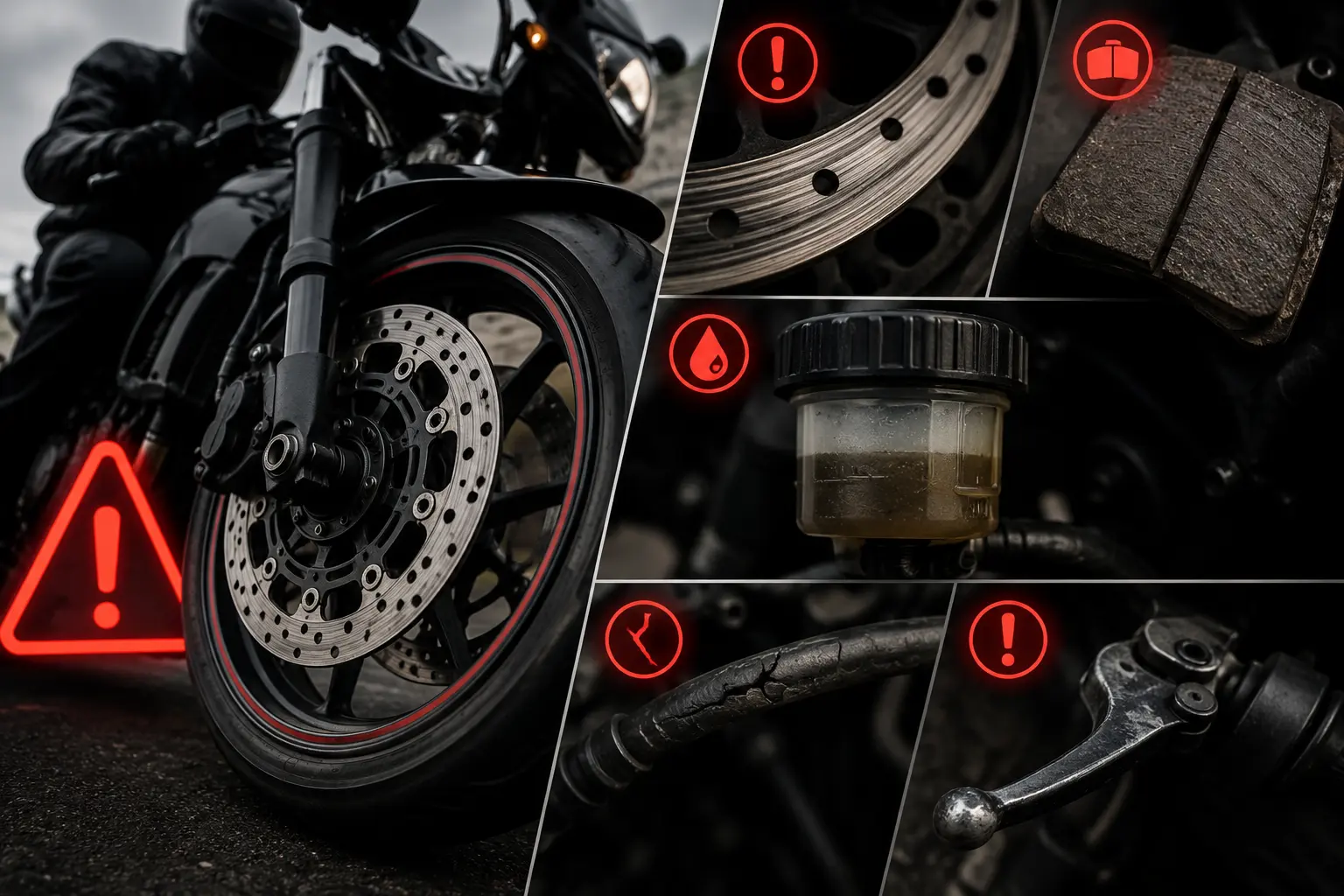

Your brakes are the most important safety feature on your motorcycle. The majority of riders are concerned with engine performance and tyres and appearance. With a car accident, however, it’s when you ignore brake wear.
The good news? Your bike will tell you if something is miss. It only takes a little practice to know what to listen for.
Here are five ways to tell that your motorcycle brake components need to be looked at right now.
Squealing or grinding noises when braking
Squeal is an irritating sound. Grinding noise is a dangerous noise.
Brake pads are fitted with a tiny metal indicator. The indication of wear of the pads makes contact with the rotor when the pad is worn to a minimum. It has a squeal on purpose. It’s your bike screaming for you to do something!
Grinding is not squealing, the pads are completely gone. The metal is coming on top of the metal. The more you stop the rotor the more damage you will cause.
Damage to the rotors can cost you a lot of money. Pad replacement is not an option. Don’t dismiss any brake noises.
The brake lever or pedal feels spongy
The brake lever should be firm. It is pressed and it withstands. You instantly react.
If the lever is soft or spongy or if it can be moved too far before engaging, the problem is a hydraulic issue. Fluid level is low in the brake line. Or, your brake fluid has absorbed water over time.
Brake fluid is hygroscopic. It absorbs moisture from the air. The fluid’s boiling point drops significantly with the passage of time as a result of water contamination.
Contaminated fluid may boil during hard braking. It bubbles and releases gas when it is boiled. Gas compresses. Pads stop responding. This is known as brake fade and can be deadly.
Change the brake fluid every 1-2 years. If there is some sponginess, bleed the lines. Do not wait.
Uneven wear on tires
Most modern brake pads will have a visible groove and/or indicator line for wear. If this groove is lost, the pad has worn out.
Numerous riders don’t pay attention to their pads. That is a mistake.
Always inspect the thickness of oil filters at each oil change. Usually, the thickness should not be less than 2 mm, or else the brake efficiency will be seriously reduced.
Some pads lose the ability to wear evenly. One part of it becomes worn out more quickly than the other part. This indicates that there is a stuck caliper piston or slide pin. The symptom is the pad problem. It is the caliper that is the issue!
Change a pad before it gets to the minimum thickness. You’ll save your rotors and your life.

Brake to one side
You squeeze the brake lever and the bike goes to the left or right. You don’t drive it there.
This is known as a brake pull. There are a number of potential explanations.
One of the more frequent ones is a seized caliper piston. If any one side of the caliper is not releasing as well, that side of brake is breaking harder than the other side. The bike draws in its direction.
Pulling can also be a result of uneven rotor wear. If the rotor is warped, it will not have even contact with the pads. The brake’s force is not applied uniformly on the disc surface.
Another reason is from a contaminated pad or rotor. If there is oil, chain lube or coolant on the braking surface, friction is reduced on that side. The opposite side slows down much more severely.
Brake pull adversely effects straight line stability. It’s truly dangerous at high speeds. Identify the cause of the problem as soon as possible.
Longer stopping distances than usual.
You’re on a familiar road. You stop at your normal stopping point. But the bike isn’t stopping as it should.
This is the most dire of all indicators. When you see longer stopping distances, your brakes are already very worn out.
Worn pads decrease the area of friction. Glazed rotors become “softer. Hot contaminated fluid has lower hydraulic pressure. All of these will add several meters to your stopping distances.
That extra distance will probably result into a bumper at city speed. At highway speeds, it has a much more serious definition.
Trust your instincts. When the bike doesn’t stop like it once did, there is a change. Email for inspection before next ride.
What to Look and When?
The following is a realistic Brake Maintenance Schedule:
Everyday rides – listen for noise; check feel of levers before riding.
Monthly: Check thickness of the pad and rotor surface.
Brake Fluid Level and Color – Check every 6 months. Fluid is dark or cloudy so it needs flushing.
Flushed as necessary, typically every 1 to 2 years, even if fluid is clear.
Every 10,000 to 20,000km: Check for corrosion or sticking on caliper pistons, seal and slide pins.
Just like pad wear, rotor wear is as important.
Most riders change pads, but not the rotors. Rotors are subject to a minimum thickness specification that is stamped on the rotor or the rotor is specified in your service manual.
A thin rotor bends when it is being slowed down. It can’t absorb heat effectively. It warps. It cracks. It fails.
If you have not inspected the rotor after more than one set of pads have worn, use a micrometer to check the thickness of your rotor. Take measurements several times over the braking surface.
If a rotor is lower than the minimum specification, it will need to be replaced. Full stop.

Here’s why Quality Brake Parts Matter
Brakes are not created equal. Specs listed on budget pads from unknown manufacturers may be acceptable. However, it is quite another matter in practice, when it comes to heat and pressure.
Good brake pads employ uniform friction materials. Maintains braking power over a broad temperature range. They wear uniformly and regularly.
Tight tolerance is applied for manufacturing quality rotors. They are particularly resistant to warping on repeated heavy braking. They have a longer life and they work more reliably.
By knowing what you are buying, you are assured of getting the right motorcycle brake parts from a reliable supplier. Specifications are accurate. Parts are compatible. Performance is predictable.
Conclusion
Brakes do not fail without warning. They give you signs. They make noise, change feel, and behave differently long before they stop working entirely.
The difference between a near-miss and a real crash often comes down to whether a rider paid attention to those signs. Regular inspection takes five minutes. Ignoring wear and tear signs can cost everything.
Check your brakes. Replace worn parts. Ride with confidence.
Ready to replace your brake parts? Shop genuine motorcycle brake parts at Aliwheels and keep your ride safe.