




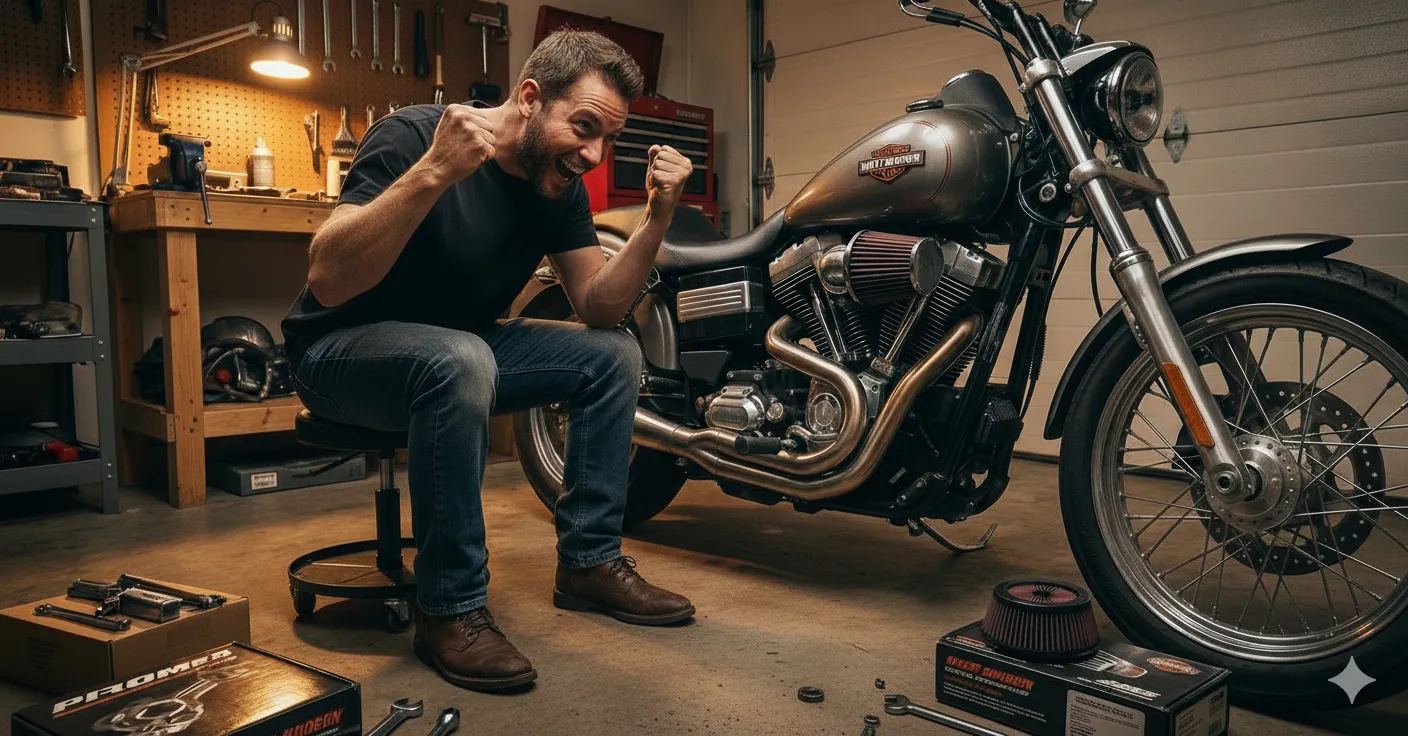

Many Harley owners invest serious money into cams, exhausts, big-bore kits, or intake upgrades, expecting a dramatic transformation. On paper, the horsepower numbers look better. The Harley parts are proven. Yet once the bike is back on the road, something feels off. The throttle response is dull. Acceleration feels lazy. The bike simply does not feel as quick as it should. This frustration is one of the most common performance issues older Harley riders face, and it is rarely caused by the engine parts themselves. The real problem usually lies in how age, electronics, drivetrain wear, and tuning interact over time.
Let us break down why your upgraded Harley may feel slower and what experienced riders and mechanics do to fix it properly.
The Power Is There, But It Is Not Reaching the Road
One of the biggest misconceptions is that Harley engine upgrades alone guarantee performance gains you can feel. In reality, power delivery matters just as much as peak output. Many riders experiencing Harley engine power loss after upgrades are actually dealing with efficiency problems elsewhere on the bike.
As Harleys age, multiple systems slowly degrade together. Throttle cables stretch. Sensors lose accuracy. Rubber components harden. Bearings develop resistance. Each issue on its own seems minor, but together they rob the bike of responsiveness.
Throttle Response Problems on Older Harley Models
A common complaint after upgrades is delayed or inconsistent throttle response. Throttle response problems on older Harley models are often caused by wear rather than tuning alone.
Here are the usual culprits:
- Throttle body buildup that restricts airflow
- Worn throttle cables that introduce slack
- Aging throttle position sensors are sending inaccurate signals
- Cracked intake seals are causing unmetered air
When the throttle input does not match what the ECU expects, the bike hesitates. That hesitation is often due to a lack of power when it is actually delaying power. Many riders describe this as a bike that feels sluggish after mods, even though it pulls harder at higher RPM.
Harley EFI Tuning Problems Are More Common
Electronic fuel injection works exceptionally well when everything is new and calibrated correctly. On older bikes, however, Harley EFI tuning problems are one of the top reasons upgrades do not deliver expected results.
Here is why.
Many older Harleys are tuned using base maps or canned flashes that do not account for aging components. Oxygen sensors degrade. Fuel injectors lose spray efficiency. Engine temperature readings drift. The ECU then compensates incorrectly, often pulling timing or leaning out the mixture under load.
The rider feels this as flat acceleration, inconsistent power delivery, or a motor that feels strong one day and weak the next. A proper dyno tune with live data correction often reveals that the engine was never operating in its optimal range, even with expensive upgrades installed.
Drivetrain Wear Quietly Steals Performance
Another overlooked factor in older Harley’s performance issues is drivetrain drag. Power does not disappear. It gets lost.
- Worn clutch baskets cause slip under load
- Dry primary chains increase resistance
- Aging wheel bearings create rolling drag
- Final drive belts stretch and absorb torque
When these parts are worn, the engine works harder just to move the bike at the same speed. The rider interprets this as power loss, even though the engine itself may be healthy. This is especially common on touring models with higher mileage, where drivetrain wear develops gradually and goes unnoticed until upgrades highlight the weakness.
Weight Gain Cancels Out Power Gains
Many older Harleys quietly gain weight over time. Larger saddlebags, crash bars, audio systems, luggage racks, and touring accessories add up fast.
If the bike gained 60 to 80 pounds over the years, a modest engine upgrade may only offset the added mass. This creates the illusion that nothing improved. Riders chasing performance often forget that to weight ratio matters more than raw horsepower. Without addressing weight, even solid engine work can feel underwhelming.
Ignition Timing Gets Conservative With Age
As sensors age and knock detection becomes less reliable, many ECUs default to conservative ignition timing. This protects the engine but reduces snap and urgency.
The rider feels a muted throttle response and slower roll on acceleration. This is frequently misdiagnosed as Harley engine power loss after upgrades, when the real issue is the ECU protecting an aging system.
Correcting this requires data-driven tuning, not just adding more parts.
Heat Management Plays a Bigger Role
Older Harleys often run hotter due to carbon buildup, restricted airflow, or lean conditions. Excess heat forces the ECU to pull timing and fuel to protect the engine.
That heat-induced power reduction happens silently. The bike still runs, but it does not feel eager.
Upgrades that increase airflow without addressing cooling or fuel delivery can actually worsen this problem, especially in stop-and-go riding.
Why the Bike Feels Sluggish After Mods
When riders say their bike feels sluggish after mods, it is usually because the upgrades exposed weaknesses rather than fixed them.
- More airflow demands better fueling
- More torque highlights clutch and belt wear
- Sharper cams expose lazy throttle response
- Higher RPMs stress aging sensors
Without addressing the supporting systems, upgrades become limited by the weakest link on the bike.
How Experienced Riders Reduce Slowness After Harley Performance Upgrades?
Veteran Harley owners approach performance holistically. Instead of chasing more parts, they focus on restoring efficiency.
- They start with a full intake and exhaust leak inspection
- Service or replace aging sensors
- Refresh throttle cables and intake seals
- Inspect clutch, primary, and final drive components
- Invest in a proper dyno tune, not a canned flash
This approach allows the engine to deliver its power cleanly and consistently. When done correctly, riders often report that the bike feels faster even without adding more horsepower. That is the difference between raw output and usable performance.
Performance Is a System, Not a Part
The biggest takeaway for anyone dealing with older Harley’s performance issues is this. A Harley is a system. Upgrading one component without addressing age-related wear elsewhere leads to disappointment.
Power that reaches the pavement smoothly always feels stronger than power trapped behind hesitation, drag, or poor tuning. If your upgraded Harley does not feel faster, do not assume the parts failed you. More often, the bike is asking for attention in places that are easier to ignore but impossible to outrun. When efficiency is restored, even modest upgrades feel like a brand new machine again.