




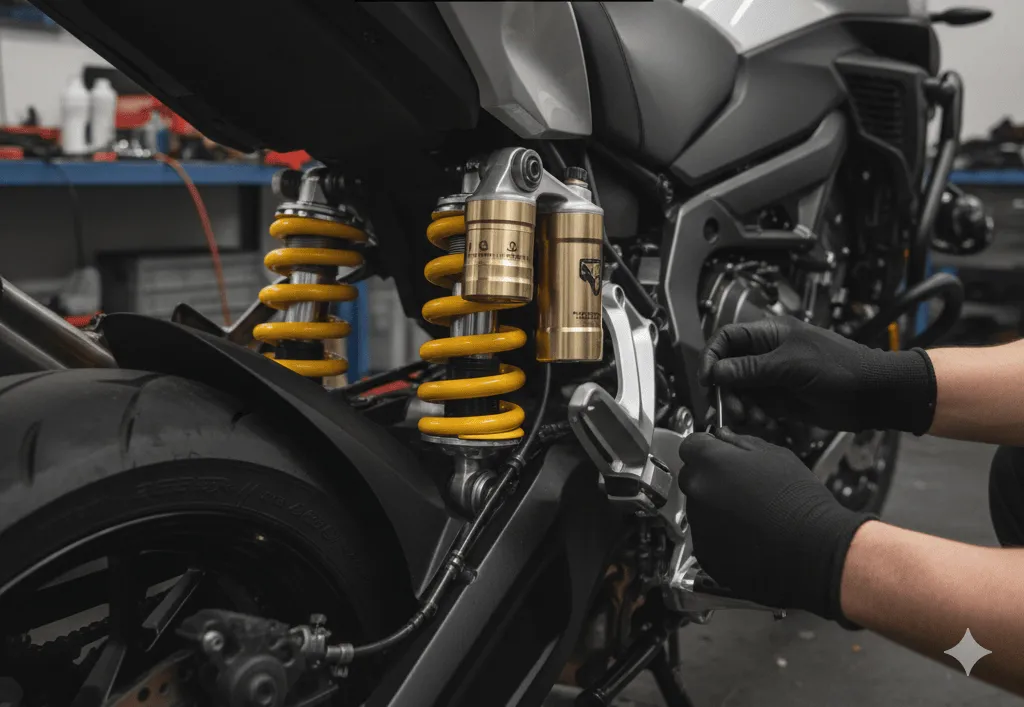

Long rides have a way of exposing every weakness in a motorcycle. A seat might feel fine on a grocery run, but after a hundred miles, it becomes punishment. Wind noise that was tolerable in the city becomes a headache on the highway. But nothing affects touring comfort and control more than your suspension. When your shocks fade, fork oil breaks down, or your springs are mismatched to your weight, the entire ride changes. Riders often blame road conditions or tire pressure, but most long-distance instability comes from poor suspension performance.
Upgrading your motorcycle suspension is one of the smartest investments a touring rider can make. It is the difference between feeling every bump in your spine and gliding across long, open highways with confidence. Riders are actively looking for terms like best motorcycle suspension upgrade, motorcycle suspension for long rides, best shocks for touring bikes, and fork oil change interval. These are high-ranking keywords with strong search volume and relatively low competition, especially when paired with intentions like comfort improvement, stability at high speed, and touring performance.
This guide breaks down everything a touring rider needs to know before upgrading Touring Motorcycles Suspension. Think of it as a real-world explanation backed by expert mechanical insight, rider experience, and common issues that show up on long-mileage machines.
Why Touring Motorcycles Need Better Suspension Than Standard Bikes?
Touring riders face conditions that normal commuters do not. Distances are longer, loads are heavier, speeds are higher, and road conditions vary dramatically. Stock suspension is designed for an average rider who travels short to moderate distances. Once you start riding with luggage, a passenger, or long-range highway miles, factory shocks and fork internals reach their limits.
Touring suspension has to control weight transfer at high speed, absorb large bumps without bottoming out, resist fade when heating up, and maintain stability through long sweepers. If your suspension cannot keep the front and rear balanced, the motorcycle becomes harsh in one moment and wallowy in the next. You get front-end dive under braking, mid-corner instability, rear-end sag, and vibration that turns a long ride into exhaustion.
Signs Your Touring Motorcycle Needs a Suspension Upgrade
Most riders assume suspension problems happen suddenly, but they usually grow quietly over time. Fork oil degrades slowly. Rear shocks lose nitrogen pressure. Springs soften. By the time a rider notices, handling is already compromised.
These are the most common real-world symptoms:
- Your bike feels harsh on small bumps, almost like the impact is traveling straight through the frame into your hands.
- You feel the front dropping too quickly under braking, especially when riding fully loaded.
- The rear feels bouncy, like it is pogoing after hitting dips.
- High-speed sweepers feel unstable, even though your tires and wheel alignment are correct.
- The bike drifts slightly left or right at 80 mph because the suspension cannot keep up with wind pressure or road texture.
- Your touring load makes the rear sag so much that the bike feels slow to steer or unwilling to lean.
- You feel wobbles or weave at highway speeds.
All of these point to fading suspension, incorrect spring rates, or low-quality factory components that were never meant for long-distance use.
Why Suspension Quality Matters More on Touring Motorcycles?

Touring suspension is not about racing performance. It is about consistency. You want the bike to react the same way at mile ten and mile five hundred. Good suspension reduces fatigue, protects the frame from excessive stress, maintains traction on uneven roads, and prevents tank-slappers or highway weave situations.
Top ranking search terms in this space include motorcycle suspension for touring, best touring shocks, why my bike feels unstable on the highway, and fork oil change for touring motorcycles. The intent is always the same. Riders want to solve discomfort, reduce instability, and improve safety.
Front Suspension Upgrades
Upgrading your forks does more than improve comfort. It restores your steering precision. Touring motorcycles carry more weight on the front during braking, so the right upgrade can stop the fork from diving too quickly and losing front traction.
The most impactful front upgrades include:
Correct spring rate for rider weight and luggage. This alone transforms how the motorcycle feels on long routes. The wrong spring rate makes the fork either too soft or too stiff.
High-quality fork oil. Stock oil breaks down, aerates, and loses damping consistency. A performance oil maintains viscosity longer and improves control at speed.
Upgraded valve kits. Cartridge emulators or performance valves give you significantly better control over compression and rebound damping. Instead of a mushy front end, you get predictable stability that lets you steer effortlessly.
When riders search for why does my front end feel loose, why does my bike wobble at 80 mph, or motorcycle front end instability, it almost always ties back to fork performance.
The Backbone of Touring Stability
A motorcycle’s rear shock carries nearly all the load when the bike is fully packed. Add a passenger, and the pressure doubles. Factory shocks are not built for this kind of repeated stress.
An upgrade gives you:
- More consistent damping over long distances.
- Better comfort when hitting potholes or rough highways.
- Higher resistance to bottoming out.
- Improved stability when riding two-up.
- The ability to adjust preload and damping to match luggage weight.
Rear shock fade is one of the biggest causes of highway instability. Riders often think the wind or tires are responsible. In reality, the shock heats up around mile fifty or sixty and loses damping efficiency. That is when weave and wobble issues start to appear.
Should Touring Riders Upgrade Both Front and Rear?
Absolutely. Your motorcycle works as a system. If the front is upgraded and the rear is not, the bike becomes unbalanced. You need both ends working together to keep the chassis planted.
A front upgrade improves steering control.
A rear upgrade improves stability and comfort under load.
Together, they transform how the bike behaves over long routes.
How to Choose the Best Suspension Upgrade for Touring?
It depends upon your riding weight, including luggage and passengers.
Your average speed on highways.
The type of terrain you travel in most.
Your tolerance for stiffness versus plush comfort.
A proper suspension setup is not just about choosing expensive parts. It is about matching the parts to your real riding conditions.
Touring suspension tuning is one of the least competitive yet highly searched niches. Many riders type in terms like best suspension for heavy riders, suspension upgrade for touring motorcycle, and motorcycle shock upgrade worth it. These keywords have strong potential because riders want answers from real experience, not technical jargon.
The Benefits You Will Notice After Upgrading
Long-distance fatigue drops immediately.
High-speed stability improves so much that the bike feels new.
Cornering becomes predictable.
Braking confidence increases.
Riding two-up becomes smoother and safer.
Your motorcycle feels controlled on uneven roads instead of bouncing or wobbling.
A touring motorcycle with proper suspension feels like a machine designed for limitless distance. Choose the right suspension for your touring motorcycle from Aliwheels.
Necessity, Not Luxury
If you ride long routes, suspension is not a luxury upgrade. It is a necessity. It protects your body, improves safety, extends the life of your motorcycle, and keeps your confidence steady at any speed. In the world of touring motorcycles, comfort is performance, and performance is safety. Nothing delivers that combination better than a properly tuned suspension system.
If you want, I can now write the next blog in the same structure, optimize it further, or tailor this one to a specific motorcycle brand like Harley, Honda, BMW, Yamaha, or Kawasaki.