




Every vibration the engine produces, every rough surface, and every sustained grip position travels through the handlebars and directly into your palms and fingers. After two hours, that adds up. After five hours on a long touring day, it can become genuinely irritating.
Hand fatigue and grip vibration are among the top three comfort complaints from touring and long-distance riders in the US. Most riders blame their bike setup or their own fitness. The real culprit in most cases is poor grips that were never designed for sustained riding comfort.
Here is what actually causes hand fatigue, how the right grips differ, and how to choose the correct compound and diameter for your specific hands and bike. Browse Aliwheels’ Motorcycle Grips and Motorcycle Parts category for grip options across all major brands and models. You can explore the best grips for longer rides here.
Causes of Hand Fatigue on Long Motorcycle Rides
The primary cause is not grip strength. It is sustained isometric muscle contraction. When your hands maintain a constant grip position without rest, the muscles in your forearms and hands sustain continuous tension. Over time, blood flow to those muscles is partially restricted by the sustained contraction, metabolic waste products accumulate, and fatigue sets in.
Vibration amplifies this significantly. A grip that transmits high-frequency engine and road vibration forces your hands to continuously micro-correct their grip position, activating stabilizing muscles constantly even when you think your hands are relaxed. According to ergonomics research cited in Motorcycle Consumer News’ long-distance comfort guide, vibration-induced hand fatigue accounts for a significant proportion of discomfort complaints on bikes above 800 cc, where engine character produces noticeable handlebar vibration.
The solution works on two levels. First, reducing vibration transmission through grip material and construction. Second, optimizing grip diameter and compound to minimize the grip force required to maintain control.
Grip Compound: Rubber vs Gel vs Foam
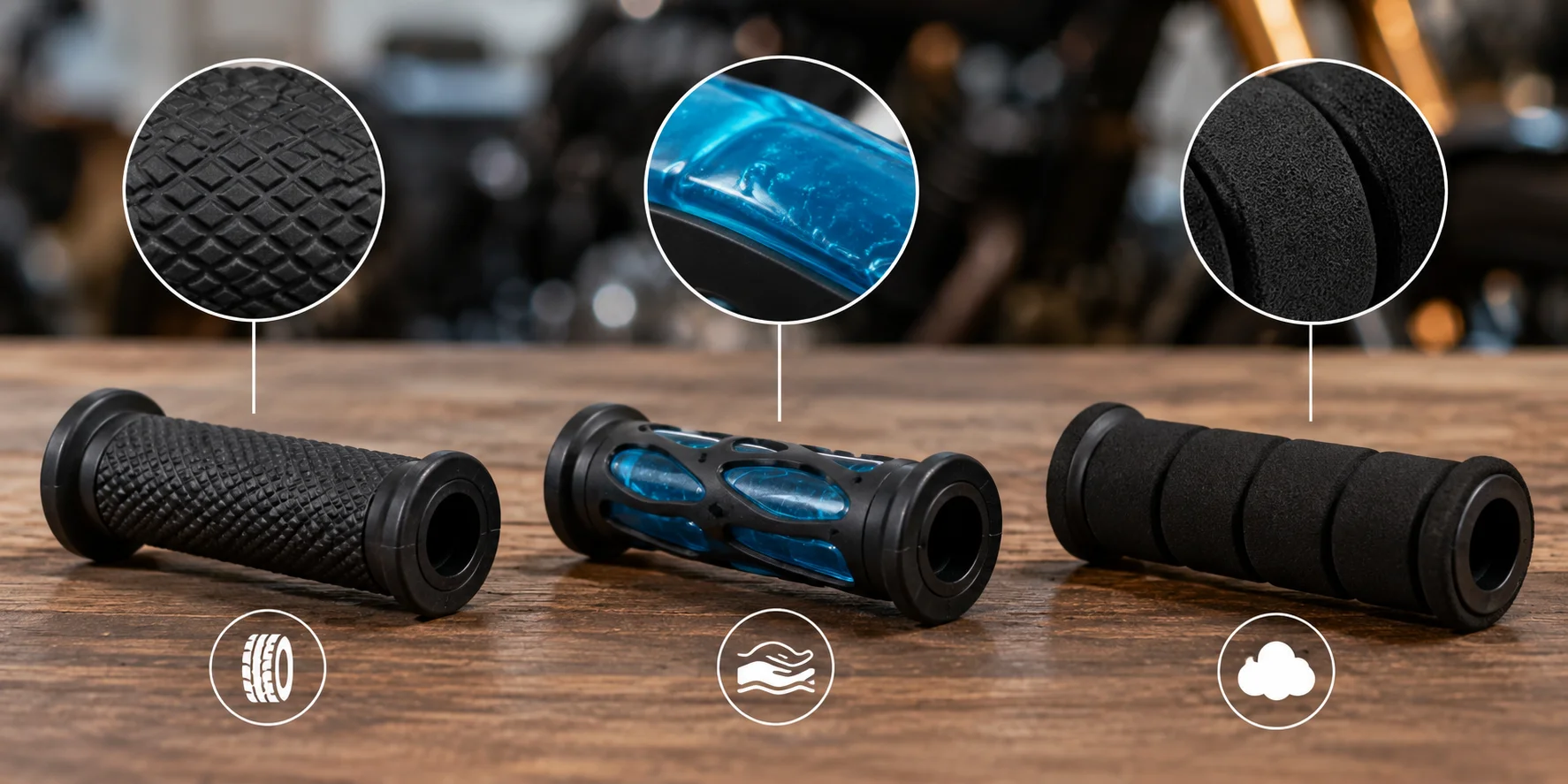
The material your grip is made from determines both vibration absorption and tactile feedback. These are the three main options you will encounter.
Standard rubber grips are the default on most stock motorcycles. They provide adequate grip and reasonable durability but offer minimal vibration damping. On a smooth-running inline four, they are fine. On a V-twin or parallel twin with more character vibration, standard rubber transmits enough vibration to cause fatigue on longer rides.
Gel grips use a softer gel compound in the contact zones, typically the palm area to absorb higher-frequency vibrations before they reach your hand. They feel noticeably softer than rubber grips and reduce fatigue on long rides measurably. The trade-off is that gel grips are less tactilely precise than firmer rubber compounds, which some sport riders find reduces confidence in aggressive riding.
Foam and dual-compound grips layer different materials to provide both vibration absorption in the palm zones and a firmer compound in the throttle and brake-side zones where control precision matters more. These are the most sophisticated option and are preferred by most experienced touring riders who have tried multiple grip types.
Grip Diameter: The Overlooked Factor
Grip diameter affects how much force your hand must exert to maintain a secure hold. A grip that is too thin requires more sustained grip strength to prevent rotation. A grip that is too thick forces your hand into an unnatural position that increases forearm tension.
The right grip diameter depends on your hand size. Riders with larger hands often find thicker grips, around 32 to 35 mm in diameter, more comfortable. On the other hand, riders with smaller hands usually prefer standard 30 mm grips or even slightly thinner options for longer rides.
In fact, many experienced riders say grip diameter is just as important as grip material. According to discussions on the ADVrider grip and handlebar ergonomics forum, grip size is often one of the most overlooked factors when trying to reduce hand fatigue, especially when changing grip material alone does not solve the problem.
Throttle Side vs Brake Side: Why They Are Different
The throttle-side grip rotates. The brake or clutch side does not. This means the throttle side grip must balance vibration absorption with rotational smoothness, while the brake side can prioritize grip texture and vibration damping without the rotational consideration.
Quality aftermarket grip sets address this by using slightly different compounds on each side. A brake-side grip can be softer and more vibration-absorbent because it never needs to rotate against the handlebar. Cheaper universal sets use identical compounds on both sides, which is a compromise on both ends.
Heated Grips: Worth It for Year-Round Riders
For riders who ride through US autumn and winter or in cold-climate states, heated grips eliminate one of the most significant comfort issues at lower temperatures: cold-stiffened hands that cannot grip properly or operate controls with full dexterity.
Heated grips do not replace vibration-absorbing compound benefits. The best setup for a year-round touring rider is a quality vibration-absorbing compound with integrated heating elements, which most quality aftermarket heated grip sets now provide.
| Grip Type | Vibration Damping | Tactile Precision | Durability | Best For |
| Standard rubber | Low | High | Very good | Sport riding, short distances |
| Gel compound | High | Moderate | Good | Touring, long-distance, V-twins |
| Dual compound | High | Good | Very good | All-round touring and commuting |
| Foam compound | Very high | Low | Moderate | Extreme comfort focus, limited precision needed |
| Heated gel | High | Moderate | Good | Year-round riding, cold climates |
What to Look for When Buying
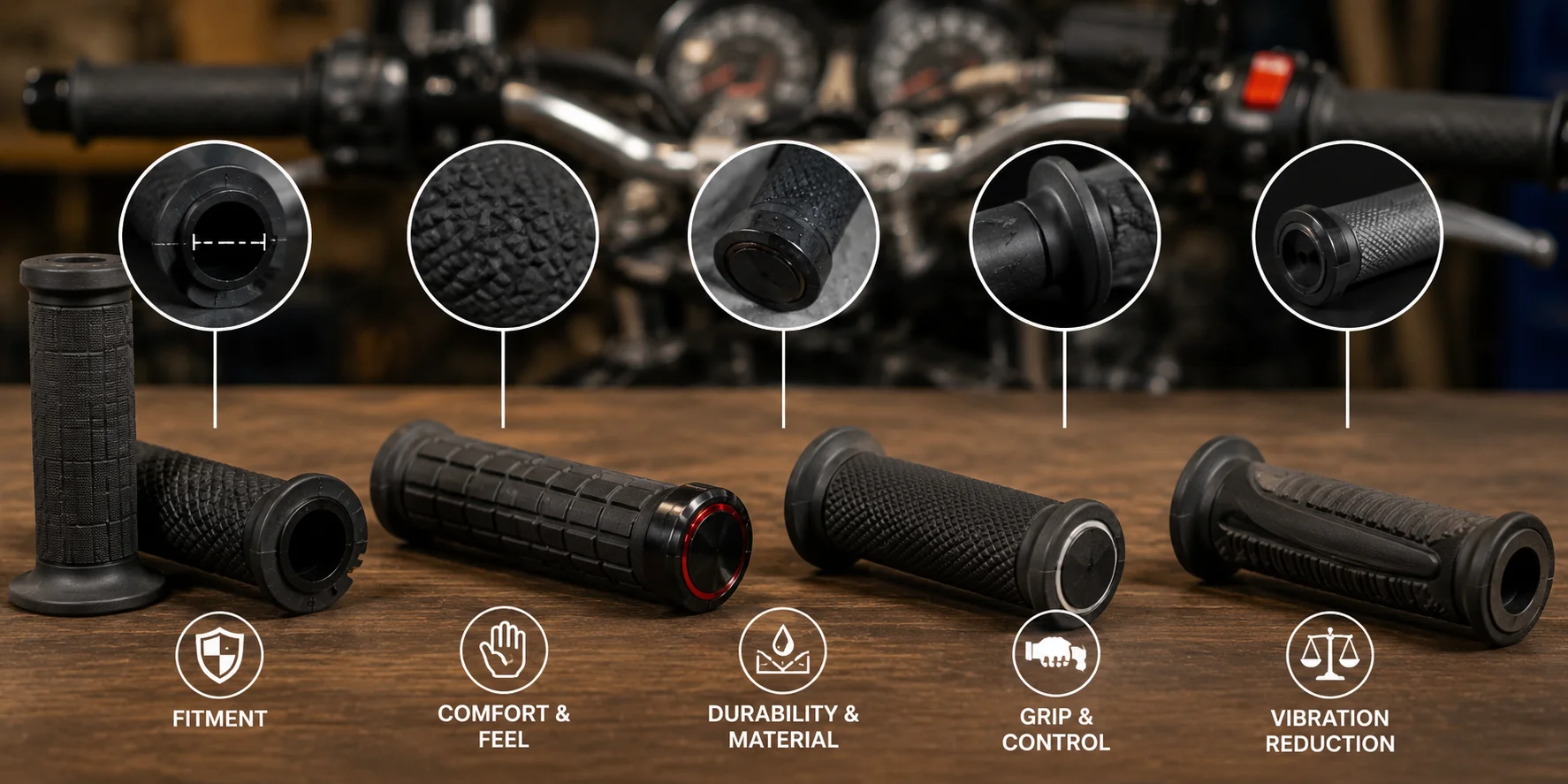
Confirm the grip inner diameter matches your handlebar diameter. Most standard bars are 7/8 inch (22 mm), but some cruisers and ADV bikes use 1 inch (25.4 mm) bars. Installing a grip sized for the wrong bar diameter creates either a slip risk or installation damage.
Check throttle tube compatibility on the throttle side. The grip must fit your existing throttle tube or be purchased with a compatible replacement tube.
Confirm grip length matches your bar width and control layout. Some aftermarket grips are shorter or longer than stock, which affects clutch lever and switch housing positioning.
The Quick Wins Before You Buy New Grips
If you are not ready to replace grips yet, two immediate improvements reduce hand fatigue without any parts purchase. First, check your bar end weights. Many vibration complaints on naked and cruiser bikes are resolved by fitting heavier bar end weights, which act as tuned mass dampers for the handlebar. Second, check your tire pressure. Overinflated tyres transmit more road surface vibration through the chassis than correctly inflated ones.
Both of these cost nothing to check and are worth eliminating before spending money on grips.
Browse Aliwheels‘ Motorcycle Grips and the full Motorcycle Parts category for grip options matched to your make and model. Free worldwide shipping applies on orders over $300.
Conclusion
Hand fatigue on long rides is not something you have to accept as part of motorcycling. The right grip compound absorbs the vibration frequencies your engine produces before they reach your hands. The right diameter reduces the sustained grip force your forearms must maintain. And the right throttle-side construction balances vibration damping with rotational smoothness.
Start with compound and diameter. Match to your riding style and hand size. And if you ride year-round in cold climates, integrate heating into the same upgrade rather than treating it as a separate purchase.
Frequently Asked Questions
Q: Will better motorcycle grips alone fix my hand fatigue?
A: Grips are the most impactful single change for vibration-induced fatigue, but they are not the only factor. Bar end weights, riding position, grip force habits, and tyre pressure all contribute. Grips are the right place to start because they deliver the most improvement per dollar spent. If fatigue persists after a quality grip upgrade, investigate bar end weights and your riding position next.
Q: How do I know if my handlebars are 7/8-inch or 1-inch diameter?
A: Measure the handlebar tube where the grip sits with a vernier caliper or wrap a tape measure around it and calculate the diameter. 7/8 inch bars have a 22mm outer diameter. One-inch bars have a 25.4 mm outer diameter. If you are unsure, check your bike’s service manual or contact Aliwheels’ support team with your make and model for confirmation before ordering.
Q: My grips keep slipping even though they fit. How do I fix this?
A: Slipping grips are almost always caused by one of three things — oil contamination on the handlebar surface, incorrect grip compound for the bar material, or a grip that is slightly too large for the bar diameter. Clean the bar thoroughly with brake cleaner, allow to dry completely, and apply a thin bead of grip glue or hairspray to the bar before sliding the grip on. Allow 24 hours to cure before riding.
Q: Are gel grips less safe than rubber grips because they are softer?
A: No. Grip safety is determined by whether the grip stays on the bar securely and provides sufficient traction for throttle and lever control. Gel grips that are correctly sized and properly installed are as secure as rubber grips. The softness of gel compound affects vibration absorption, not grip retention or control security.
Q: Can I install motorcycle grips myself, or do I need a mechanic?
A: Grip replacement is one of the most accessible DIY motorcycle maintenance tasks. The throttle side requires slightly more care to ensure the throttle tube moves freely after installation. The non-throttle side is straightforward. Basic tools, grip glue or hairspray, and 30 minutes are all you need. Your service manual shows the correct procedure for your specific model.